
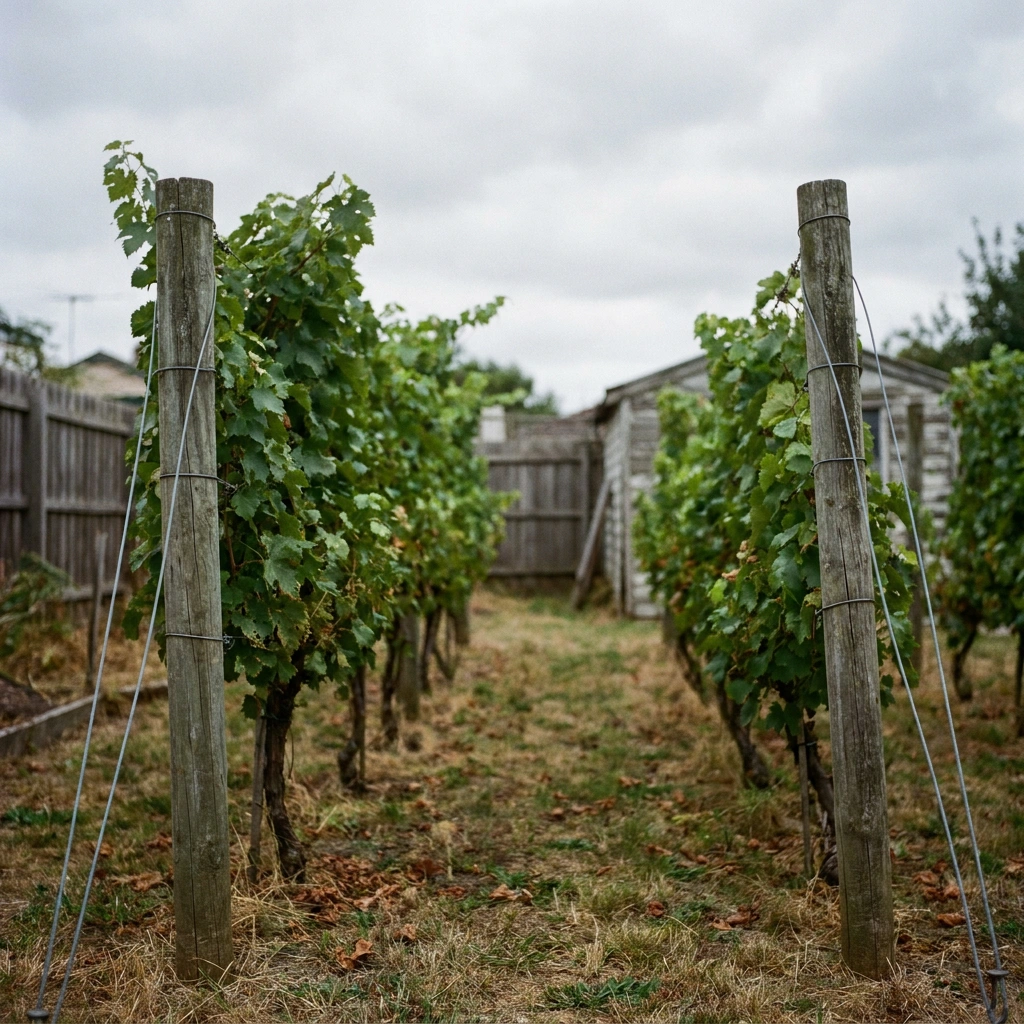
The best grape trellis for a backyard cold-climate vineyard is a Vertical Shoot Positioning (VSP) system on 8-foot (2.4 m) treated wooden posts spaced 24 feet (7.3 m) apart, with a fruiting wire at 30 inches (76 cm) and shoot-training wires up to 5 feet (1.5 m). Build it before you plant – your vines will thank you the day they wake up in spring.
Here is a practical guide to trellis systems for cold-hardy hybrid grapes – the choices, the materials, and how to put it together so it lasts 20+ years.
Why trellis design matters for cold-climate grapes
Cold-hardy hybrid varieties like Marquette, Frontenac, La Crescent, and Petite Pearl are vigorous growers. In Zones 3-6 you are also dealing with late spring frosts that can kill tender new shoots, and fall frosts that arrive before you want them to. The trellis system you choose directly affects:
- Canopy airflow – critical for disease control in humid climates. VSP opens the fruiting zone to spray coverage and sun.
- Cold-air drainage – cordon height matters. Higher cordons (3-4 ft / 90-120 cm) sit above the coldest air that pools near the ground on still nights.
- Winter protection access – in Zone 4 and colder, some growers bury canes under soil or mulch. A lower fruiting wire makes that dramatically easier.
- Long-term ease of pruning and picking – this trellis will be there for decades. Get the ergonomics right up front.
The three main grape trellis systems for backyard growers
1. Vertical Shoot Positioning (VSP) – the workhorse system
VSP is the most widely recommended system for cold-climate hybrid varieties. University of Minnesota Extension and Cornell’s viticulture team both default to it for small vineyards in northern states. Here is how it is laid out:
- Fruiting wire (bottom wire): 30 inches (76 cm) off the ground. This is where you tie down your canes or cordon arms – the structural spine of the vine.
- Catch wire pair 1: 8-10 inches (20-25 cm) above the fruiting wire – a movable foliage wire to tuck shoots in as they grow upward.
- Catch wire pair 2: 12 inches (30 cm) above catch wire 1 – trains shoots vertical so they do not flop over and tangle.
- Top catch wire: 24-30 inches (60-76 cm) above the fruiting wire, total trellis height around 5 feet (1.5 m) above ground.
Total wire courses: 4-5. Post height above ground: 5-6 feet (1.5-1.8 m). This fits easily in a backyard 30 feet (9 m) wide.
2. High Cordon – for vigorous vines in cold climates
Marquette and Frontenac in good soil can put on 15+ feet (4.5+ m) of shoot growth in a single season – far more than VSP handles cleanly. A high single or double cordon solves this by raising the fruiting wire to 4-5 feet (1.2-1.5 m) and letting shoots drape downward rather than forcing them up. Benefits for cold climates:
- The fruiting zone sits well above the cold-air layer that settles near the ground on frost nights.
- Downward-hanging shoots shade themselves less than upward VSP shoots, improving sun exposure on fruit clusters.
- Less labor tucking shoots – gravity does the work.
The tradeoff: vigorous hybrid varieties trained high can develop dense canopies that reduce spray penetration. Aggressive summer hedging is required. Not the best fit for one or two vines; excellent for a longer row of a vigorous variety.
3. Arbors and decorative trellises
An arbor – a pergola-style overhead structure – works fine for table grapes grown for shade and aesthetics. For wine grapes or serious fruit production, skip it. Overhead canopies make disease management difficult, and in cold climates the wood is hard to manage for winter protection. That said, if you want one Concord vine shading a patio in Zone 5, an arbor is perfectly practical. Use 4×4 (90×90 mm) cedar posts and stout galvanized hardware – it will carry significant weight by year five.
Trellis materials: what to buy and what to skip
Posts
For a permanent vineyard trellis in cold climates, the standard choice is pressure-treated wood posts rated for ground contact (UC4B or above). Black locust and cedar also hold up well without treatment. Typical sizes:
- Line posts: 8 ft (2.4 m) long, set at least 2.5 ft (75 cm) deep – leaves about 5.5 ft (1.68 m) above ground. Space them no more than 24 ft (7.3 m) apart. Freeze-thaw zones require at least 2.5 ft depth to prevent frost heave; 2 ft is not sufficient.
- End posts: 10-12 ft (3-3.6 m), set 2.5-3 ft (75-90 cm) deep – end posts carry the full tension of every wire and need to be stouter and deeper.
- Diameter: 4 inches (10 cm) for line posts; 5-6 inches (13-15 cm) for end posts.
Steel T-posts work in a pinch for the middle of long rows but avoid them for end posts – they flex too much under wire tension and are miserable to drive in rocky soil.
Wire
12.5-gauge high-tensile galvanized wire is the standard. It is strong enough to span 24 ft (7.3 m) without excessive sag, resists rust, and holds tension well through freeze-thaw cycles. Do not go lighter than 12.5 gauge for the fruiting wire – a vine loaded with Frontenac clusters in late September puts real strain on it.
For catch wires (the upper foliage wires you tuck shoots into), 14-gauge smooth wire is fine and easier to handle. Some growers use the foliage wires as movable clips rather than permanent wires.
Our pick: High-Tensile Vineyard Wire
For the fruiting wire, we recommend standard 12.5-gauge high-tensile galvanized vineyard wire – available in 1/4-mile (400 m) rolls that cover a serious backyard planting. Find 12.5-gauge high-tensile vineyard wire on Amazon – compare rolls from Red Brand, Keystone, and similar brands sold at farm supply prices.
End-post anchors
The end post is the most stressed part of any trellis. A well-anchored end post prevents the entire row from leaning inward over time. Two reliable options:
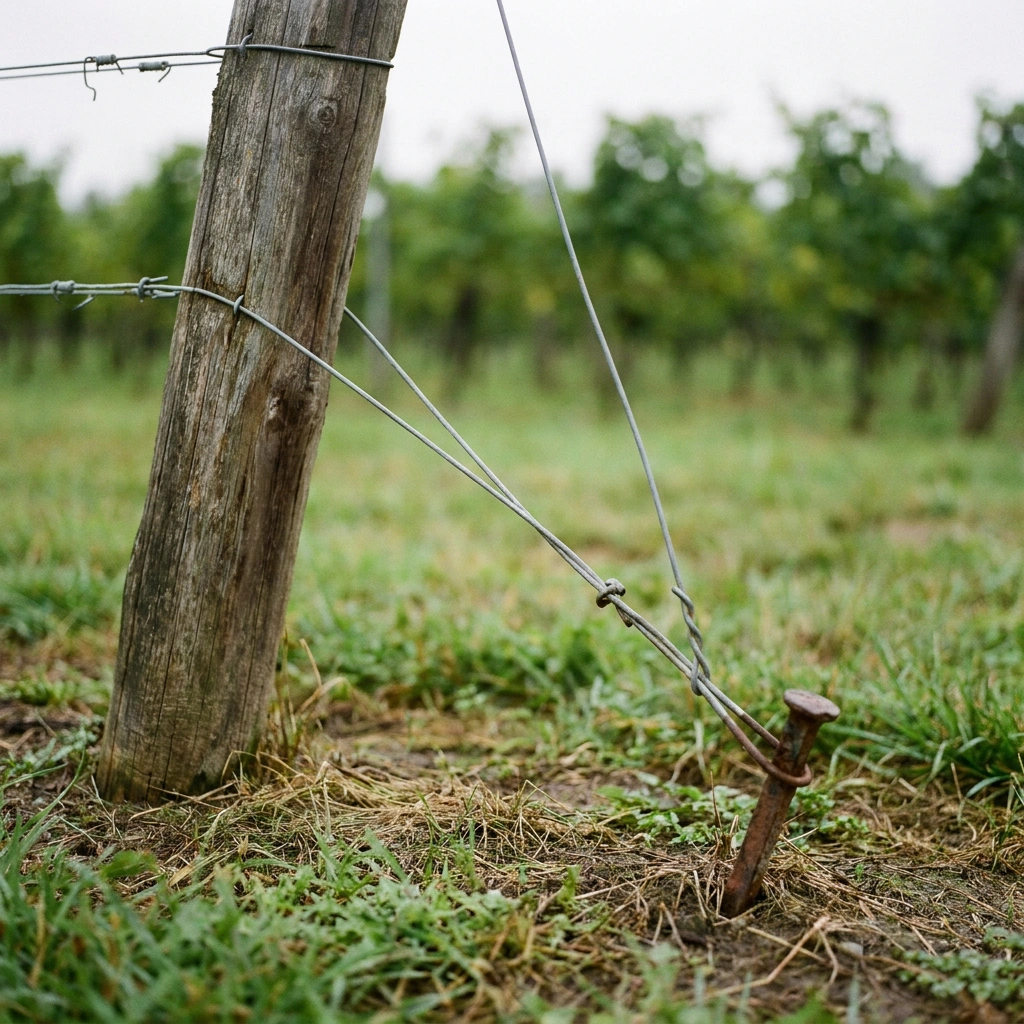
- Helix anchor (screw-in earth anchor): Drive a 30-inch (76 cm) helix anchor into the ground 6 feet (1.8 m) from the base of the end post at roughly a 45-degree angle away from the row. Loop heavy-gauge brace wire from the post top to the anchor, then tighten with a twitch stick or wire tightener. This is the simplest option – no diagonal brace post needed, easy to install alone.
- H-brace or deadman: A horizontal crosspiece between the end post and an adjacent post forms a compression brace. More visible, requires a second post, but extremely solid on soft or sandy soils where helix anchors pull out.
Wire tensioning and attachment
Wrap the wire twice around the end post and secure with barbed fence staples or crimping sleeves. For the line posts, attach with staples hammered in at an angle (not straight in – this lets the wire slide slightly as it expands and contracts with temperature). Install in-line wire tighteners (strainers) on the fruiting wire so you can retension in spring – wire sags noticeably by the second or third year. Tighten wires at the start of every growing season before growth begins.
How to build a basic VSP trellis: step by step
- Mark your row line. Use stakes and string. Orient rows north-south if possible for maximum sunlight – especially important in Zones 4-5 where every hour of sun matters for ripening.
- Set end posts first. Drive or dig the end posts to 2.5-3 ft (75-90 cm) deep, plumb and aligned. Backfill and tamp firmly. Let concrete set if you used it (24-48 hours).
- Install end-post anchors. Screw in the helix anchor at 45 degrees, 6 ft (1.8 m) from the post base. Run brace wire and tighten.
- Set line posts. Space them evenly – no more than 24 ft (7.3 m) apart. In rocky soil, a rented hydraulic post driver saves hours on long rows.
- Staple the bottom (fruiting) wire at 30 inches (76 cm). Run from end post to end post, staple at each line post. Install an in-line tightener at one end and crank it snug.
- Add upper catch wires. At 8-10 inches (20-25 cm) and 20-22 inches (50-56 cm) above the fruiting wire – attach more lightly, as these are adjusted more often.
- Now plant your vines. Posts and bottom wire in place is all you need at planting time. Do not wait for the full trellis to be complete.
For more on spacing vines relative to your posts, see grape vine spacing guidelines. Once your vines are established, training and pruning go hand in hand with the trellis system – read up on grape pruning for cold-climate vines before that first dormant season. And if you are just getting started, the full process is covered in starting your backyard vineyard.
Cold-climate trellis tips worth knowing early
- Build the trellis before the vines arrive. Bare-root vines ship in early spring when the ground is just barely workable. If you wait, you will be scrambling in the mud while the vines are already growing.
- Higher cordon = better frost insurance. If you are in Zone 4 or 5 and your site has any frost-pocket risk, raising the fruiting wire from 30 to 36 inches (76-91 cm) or even 42 inches (107 cm) keeps buds above the coldest air.
- Plan for snow load. In Wisconsin and Minnesota, wet spring snow can dump 18-24 inches (45-60 cm) in April. Stout posts and well-set anchors matter.
- Wire sags every year. Build in-line tighteners into your budget. They cost almost nothing and save you from re-stapling wires every few seasons.
- Drive posts before the ground freezes. If you are planning a spring planting, set posts the previous fall while the soil is still workable. This is the single best thing you can do to avoid a rushed, imperfect installation.
Frequently asked questions
What is the best trellis for cold-climate grape varieties?
For most backyard cold-climate growers in Zones 3-6, a 4-wire VSP (Vertical Shoot Positioning) trellis is the best starting point. It manages shoot growth, opens the canopy to air and spray, and works well with moderate-vigor varieties like La Crescent or Itasca. For vigorous varieties like Marquette or Frontenac in fertile soil, a high cordon or Geneva Double Curtain is worth considering once you understand the extra summer management it requires.
How tall should a grape trellis be?
For a standard VSP trellis with 8 ft (2.4 m) line posts set 2.5 ft (75 cm) deep, the top wire sits about 5.5 ft (1.68 m) above ground. End posts are 10-12 ft (3-3.6 m) long, set 2.5-3 ft (75-90 cm) deep. For a high cordon system, posts can be 10 ft (3 m), leaving more height above ground. Taller is not always better – it makes hand-work harder and requires longer posts and anchors.
What gauge wire should I use for a grape trellis?
Use 12.5-gauge high-tensile galvanized wire for the fruiting wire (the bottom structural wire that bears the weight of canes and fruit). For the upper foliage catch wires, 14-gauge smooth wire is sufficient and easier to handle. Avoid soft baling wire – it stretches and sags rapidly under the vine’s weight.
How far apart should trellis posts be?
Keep line posts no more than 24 feet (7.3 m) apart to prevent wire sag under the weight of fruit clusters. Many backyard growers use 18-20 ft (5.5-6 m) spacing, which gives more support but means more posts. End posts should be 10-12 ft (3-3.6 m) long and set 2.5-3 ft (75-90 cm) deep with a proper anchor.
Can I build a grape trellis myself, or should I hire a contractor?
A 2-4 vine backyard trellis is a realistic weekend DIY project for one person with basic tools. A post-hole digger or rented auger, a fence driver or heavy mallet, and a wire strainer are the main equipment you need. For rows longer than 100 feet (30 m), consider renting a hydraulic post driver or hiring a fence contractor – they often have the equipment and can complete it faster than you can by hand. The key is getting the end posts and anchors right; line posts are forgiving.
See the wire, tensioning tools, anchors, posts and hand tools that match the systems on this page – grouped by job, with where to find each one.
Trellis Tools & Materials →🍇 Don’t plant the wrong grape
Vines take years to fruit. Get the free cheat-sheet of varieties that actually survive and ripen in your zone.
By subscribing you agree to our Privacy Policy.
