
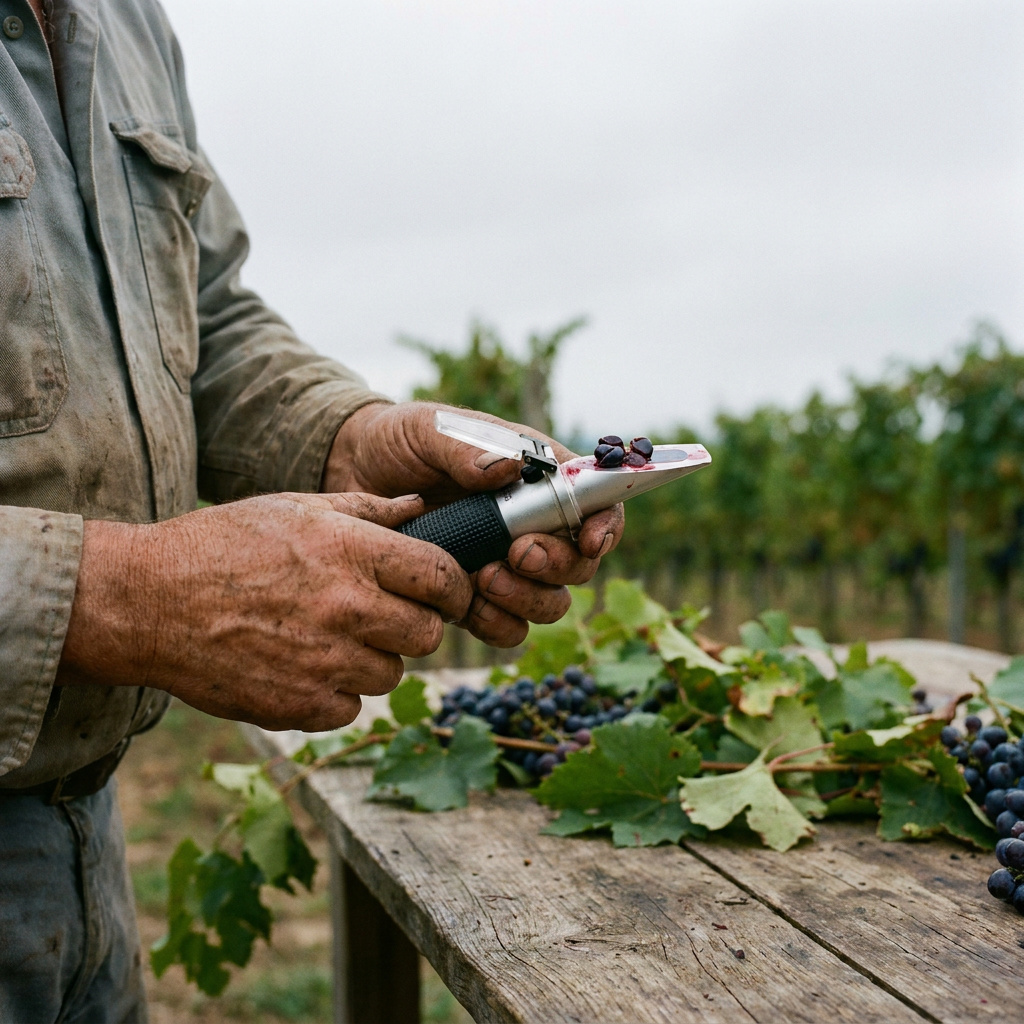
To turn a Brix reading into potential alcohol, multiply it by about 0.55–0.60 — so grapes at 22 °Brix make roughly a 12–13% wine. But the more useful question is whether your fruit is ripe enough for the wine you actually want to make, and what to do if it isn’t. This calculator does both: it converts your reading across every must-weight scale, checks it against your target style, and tells you how much sugar to add if you’re short.
🍇 Brix → Potential Alcohol & Harvest Readiness
Enter your refractometer or hydrometer reading and see your potential alcohol, whether the fruit is ripe for your wine style, and how much sugar to add if it’s short.
Add acid numbers (optional — for an acid check)
How the numbers work
A grape’s ripeness for winemaking is mostly about sugar (which becomes alcohol) balanced against acid (which keeps the wine fresh). Sugar is measured as “must weight” on one of four interchangeable scales — Brix, specific gravity, Baumé or Oechsle. Potential alcohol is just that sugar read through a fermentation factor of roughly 0.55–0.60. The tool reports a likely figure (factor 0.57) plus the realistic range, because your yeast strain and how dry the wine finishes both move it.
Must-weight conversions at a glance
Every row below is the same juice expressed four ways, with the potential alcohol it carries. Handy if your hydrometer reads in specific gravity but your recipe is written in Brix.
| °Brix | Specific gravity | Baumé | Oechsle | Potential ABV |
|---|---|---|---|---|
| 16 | 1.065 | 8.9 | 65 | ~9.1% |
| 18 | 1.074 | 10.0 | 74 | ~10.3% |
| 20 | 1.083 | 11.1 | 83 | ~11.4% |
| 22 | 1.092 | 12.2 | 92 | ~12.5% |
| 24 | 1.101 | 13.3 | 101 | ~13.7% |
| 26 | 1.110 | 14.4 | 110 | ~14.8% |
| 28 | 1.120 | 15.5 | 120 | ~16.0% |
| 30 | 1.129 | 16.6 | 129 | ~17.1% |
Target Brix by wine style
Pick your style first, then ripen toward its window. These are working ranges from university viticulture and winemaking programs; cold-climate hybrids are frequently picked at the lower end because their acid stays high.
| Wine style | Harvest °Brix | Typical ABV | TA (g/L) | pH |
|---|---|---|---|---|
| Sparkling base wine | 17–20 | 9.5–11.5% | 7–11 | 2.9–3.2 |
| Dry white table wine | 19–23 | 11–13.5% | 6–9 | 3.0–3.3 |
| Off-dry / aromatic white | 20–24 | 8–11.5% | 6–9 | 3.0–3.4 |
| Rosé | 20–23 | 11–13% | 6–8.5 | 3.1–3.4 |
| Dry red table wine | 22–26 | 12–14.5% | 5.5–8 | 3.3–3.6 |
| Dessert / late-harvest | 28–42 | 12–16% | 6–11 | 3.2–3.7 |
🍇 Our pick: for a quick field check, use a 0–32 Brix refractometer — one drop of juice, instant reading, perfect for walking the rows at harvest. For the fermenting must, switch to a triple-scale hydrometer (it reads Brix, specific gravity and potential alcohol on one stick). A refractometer reads high once alcohol is present, so the hydrometer takes over the moment fermentation starts.
A note on acid in cold climates
Northern hybrids like Frontenac, Marquette and La Crescent ripen with high titratable acidity, commonly 9–16 g/L at harvest depending on variety (see our harvest-timing guide for the separate winemaking target). That isn’t a flaw; it’s why these grapes make such lively sparkling and aromatic whites. The catch is which acid it is. A big share is malic acid (Iowa State’s Frontenac numbers show about twice as much malic as tartaric), and cold stabilization only drops tartaric acid as potassium bitartrate crystals, so it takes off very little of the excess.
So the practical fix works on the malic side. Malolactic fermentation comes first: bacteria convert sharp malic acid into softer lactic acid, and every 1 g/L of malic converted lowers TA by about 0.56 g/L. If the wine is still too tart after that, blend it with a lower-acid wine, leave a little residual sugar to balance the acid, or bench-trial a deacidifier (the FAQ below covers which one suits high-malic juice). Watch pH as you go, because MLF and carbonate deacidifiers both push it up. For the full playbook, from choosing an MLF strain for low pH to a step-by-step Frontenac plan, see our guide to taming high acidity in cold-climate grapes. Enter your TA and pH in the tool for a quick verdict, and lean on these cellar tools rather than leaving fruit to hang until it’s overripe and the freshness is gone.
Next steps
- How to know when grapes are ready to harvest
- Will my grapes ripen? (GDD calculator)
- Wine making instructions for beginners
- How many pounds of grapes per bottle
Frequently asked questions
How do you convert Brix to potential alcohol?
Multiply your Brix reading by about 0.55 to 0.60 to estimate the finished alcohol by volume. So 22 °Brix gives roughly 12–13% ABV. The factor varies with yeast strain and how completely the sugar ferments — 0.57 is a good middle estimate for a dry wine that ferments to completion.
What Brix should grapes be at harvest?
It depends on the wine. Sparkling base is picked early at 17–20 °Brix; dry whites at 19–23; rosé around 20–23; dry reds at 22–26; and dessert or late-harvest wines at 28 °Brix and up. Cold-climate hybrids are often picked on the lower end with brighter acidity, which suits sparkling and crisp whites well.
What are Brix, specific gravity, Baumé and Oechsle?
They are four scales for the same thing — how much sugar is dissolved in the juice (the “must weight”). Brix is grams of sugar per 100 g of juice (most common in North America). Specific gravity is the density vs. water (hydrometers). Baumé is used in parts of Europe/Australia and conveniently sits close to the potential alcohol number. Oechsle is the German scale. The tool and table above convert between them.
How much sugar do I add to raise the alcohol (chaptalization)?
Roughly 17 grams of sugar per litre of must raises the finished alcohol by about 1%. The calculator works out the exact amount for your batch size and target. Add sugar before or early in fermentation, dissolved in a little juice. Note that chaptalization is regulated or banned in some wine regions — check your local rules if it matters to you.
My cold-climate grapes are high in acid. What can I do?
High titratable acidity (often 9–16 g/L in northern hybrids at harvest, depending on variety) is normal, but much of it is malic acid, and that changes which fixes work. Cold stabilization only removes tartaric acid (as potassium bitartrate crystals), so it barely dents the excess. What does work: malolactic fermentation turns malic into softer lactic acid and lowers TA by about 0.56 g/L for every 1 g/L of malic converted (choose a bacteria strain rated for low pH). Blending with a lower-acid wine and leaving some residual sugar both help, since sugar balances acid; that is why the International Riesling Foundation’s sweetness scale is based on the sugar-to-acid ratio, not sugar alone. For chemical deacidification, bench-trial first. Potassium bicarbonate takes about 0.9 g/L to drop TA by 1 g/L, but it works on the tartaric side, so keep it for modest corrections. For high-malic juice, a double-salt treatment (a calcium carbonate product such as Acidex, dosed into part of the juice) is the chemical route that also removes malic. Letting fruit hang a little longer helps too, weather permitting, because malic acid keeps dropping as grapes ripen. Watch pH at every step: MLF and carbonates both raise it, and a must that already pairs high TA with a fairly high pH (Iowa State reports Frontenac at 11.9–13 g/L TA with pH 3.35–3.46) can overshoot into the range where spoilage bacteria thrive and sulfite protects less. Watering it down is a poor fix: it thins flavor along with the acid, EU wine rules don’t allow adding water to grape wine except for a specific technical necessity, and US rules allow wineries only limited amelioration. Enter your TA and pH above for a quick read on where you stand.
