Small grapes almost always trace back to one of six things: the vine is carrying more clusters than its leaves can ripen, the flowers didn’t set well at bloom, the vine went dry at the wrong time, the vine is still too young for a full crop, it’s underfed or root-restricted, or – and growers hate hearing this one – the variety is simply small-berried and nothing is wrong. Work through the list below and you’ll usually land on the real cause.
The Six Real Reasons Grape Berries Stay Small
- Over-cropping – too many clusters for the leaf area feeding them
- Poor fruit set (shatter / coulure) – cool, wet, or windy bloom weather left clusters loose with fewer, unevenly sized berries
- Water stress – the vine went dry between fruit set and veraison, when berries do most of their cell division
- A vine that’s still too young – vines in years one through three aren’t supposed to carry a full crop yet
- Under-fed or root-restricted vines – short on potassium or nitrogen, or crammed into too small a container, can’t fill berries properly
- Variety – some cold-hardy hybrids (Marquette is the classic example) are bred for hardiness and disease resistance, not berry size; their small berries are normal
Read on for how to tell these apart, plus the cluster-thinning steps that fix the most common cause directly.
Cause 1: Over-Cropping – Too Many Clusters for the Vine’s Leaf Area
This is the most common reason home-vineyard grapes stay small, especially on young hybrids that suddenly fruit heavily in their third or fourth year. Every berry is filled with sugar and water made by the vine’s leaves. Leave more clusters on the vine than the canopy can support, and every berry gets a smaller share, then stalls out before it should.
The benchmark most university viticulture programs lean on comes from a 2005 study in the American Journal of Enology and Viticulture (Kliewer and Dokoozlian): a vine needs roughly 0.8 to 1.2 square meters of healthy, sun-exposed leaf area per kilogram of fruit – about 4 to 6 square feet per pound. Extension guides translate that into a simpler field number: roughly 12-16 well-exposed leaves per cluster. Fewer leaves than that, and both berry size and sugar fall short.
Your pruning method affects how many shoots you’re working with each year; see my cane vs spur pruning comparison if you’re not sure which system your vine is on.
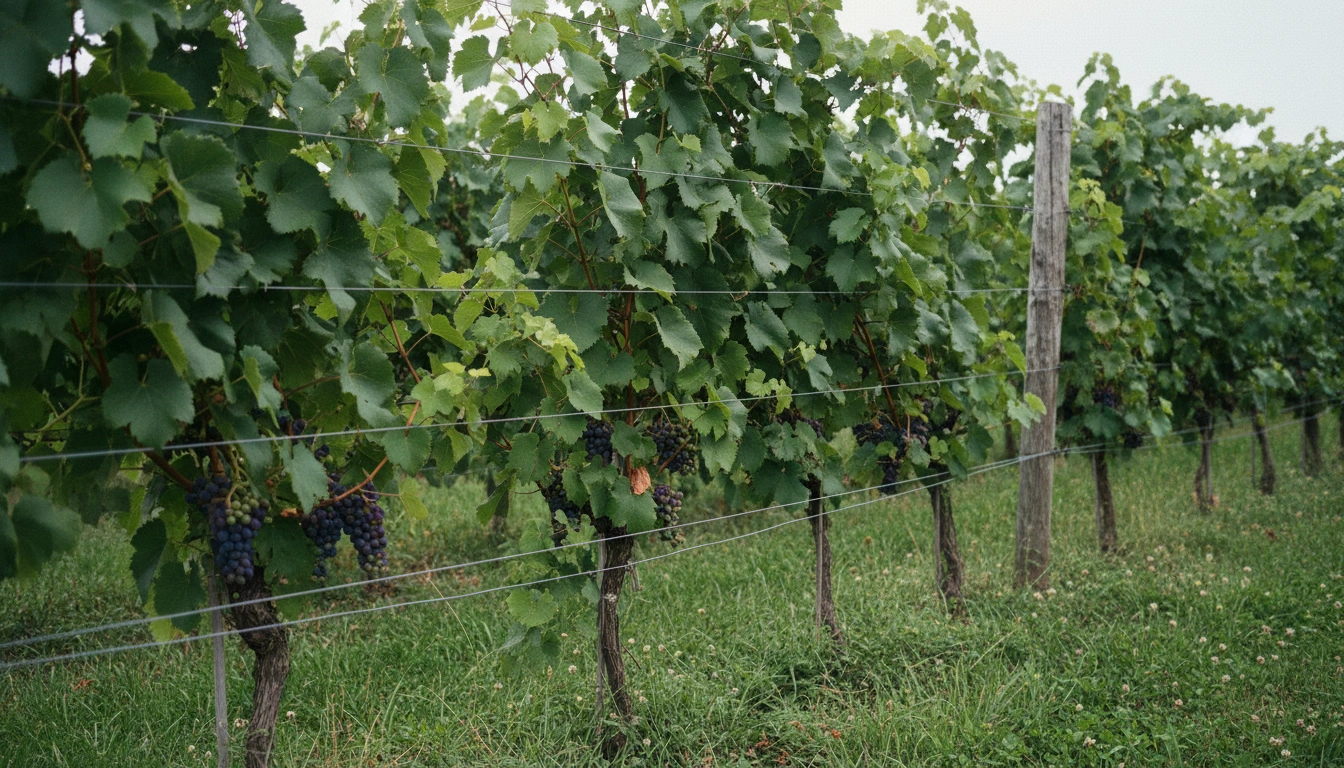
Signs you’re over-cropped: a healthy, dark-green canopy but clusters that are small, tight, and slow to color or sweeten; noticeably more clusters than shoots; or a young vine (see Cause 4) left with a full crop before it was ready.
Cause 2: Poor Fruit Set and Shatter (Coulure and Millerandage)
If the real problem isn’t small berries so much as small, loose, straggly clusters with far fewer berries than usual – some full-size, some tiny and seedless – the cause is usually poor fruit set at bloom, not over-cropping. Viticulturists call heavy berry drop after flowering shatter or coulure, and a mix of full-size and tiny seedless berries in the same cluster millerandage (“hen and chickens”).
University of Maryland Extension identifies the main triggers: cold, cloudy, rainy weather during bloom, since rain and overcast conditions physically interfere with pollination, keep the flower caps from shedding properly, and cut into the photosynthesis the vine needs to feed the flower cluster. Excessive heat above roughly 90°F (32°C) or cold below roughly 59°F (15°C) during bloom can damage pollen development directly. A shortage of boron or zinc – both essential for pollen tube growth – can cause the same symptoms, and so can a vine that’s out of balance going into bloom.
There isn’t much you can do about a cold, rainy bloom week after the fact. If poor set happens repeatedly in otherwise normal weather, a soil and tissue test for boron and zinc is worth doing – it’s the one contributing cause you can actually correct.
Cause 3: Water Stress at the Wrong Time
Grape berries do almost all of their cell division – which sets their maximum possible size – in the weeks between fruit set and veraison (when berries begin to soften and change color). Grapevine water-relations research summarized by University of Maryland Extension shows that letting the vine get too dry in that early window produces berries that stay small for good; once cell division stops, no amount of watering afterward makes the berry bigger. Water stress after veraison affects sugar and flavor concentration more than size, and a little stress there is actually normal, even desirable for flavor.
If your vine went through a dry spell right after bloom this year, that’s a reasonable explanation for smaller-than-usual berries on a vine that has ripened well before. In cold-climate home vineyards this is less common than over-cropping, since most sites get adequate early-summer rain, but container-grown and young vines with limited roots (see Cause 5) are the most exposed to it.
Cause 4: The Vine Is Simply Too Young
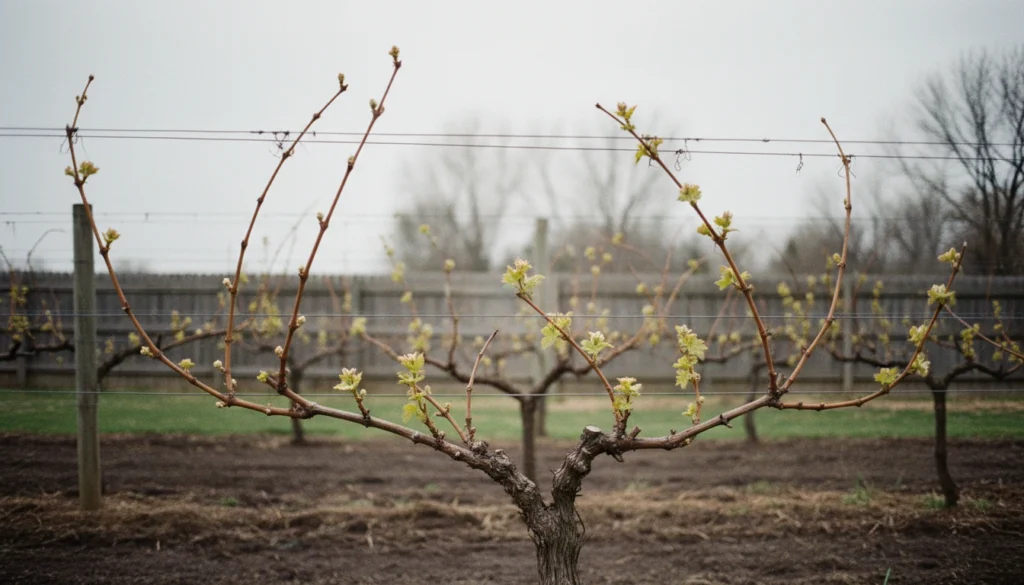
If your vine is in its first, second, or even third leaf, small or sparse clusters aren’t a problem to fix – they’re expected. Extension guidance is consistent across programs: remove all flower clusters in years one and two so the young vine puts its energy into roots and trunk instead of fruit. Most vines don’t produce a worthwhile crop until year three, and cold-climate hybrids typically don’t reach full production until year five or six. Fruit that does set on a two-year-old vine will usually be undersized regardless of variety, simply because the root system and canopy haven’t developed enough yet to fill it.
If you’re not sure whether your vine’s small crop is age or a real problem, count growing seasons since planting. Under year three, be patient – it’s on schedule, not sick.
Cause 5: Under-Fed or Root-Restricted Vines
Grapevines aren’t heavy feeders (see my full fertilizing guide for why more fertilizer usually isn’t the answer), but a vine genuinely short on potassium or nitrogen will produce small, unevenly ripening clusters. Potassium plays a direct role in loading sugar into the berry, so a deficient vine short-changes fruit fill even when everything else looks right. The tell usually shows on the leaves first: marginal scorch or yellowing on older leaves for potassium, overall pale, weak growth for nitrogen.
Root-restricted vines – grown in containers, or planted where roots hit compacted soil, rock, or a foundation – hit a similar wall from the other direction: vigorous top growth can’t be matched by a cramped root system, so the vine shortchanges fruit to protect itself. This shows up most in container vines in pots smaller than about 20 gallons (75 L), and in young vines planted into shallow or poor soil.
A soil test plus leaf color is the only reliable way to tell a genuine nutrition problem from over-cropping – see the comparison below.
Cause 6: Some Varieties Are Naturally Small-Berried – and That’s Normal
This is the case growers least want to hear, but it’s real, and it isn’t a mistake on your part. Cold-hardy hybrids were bred first and foremost for winter survival and disease resistance, not berry size, and several popular ones – Marquette, Frontenac, La Crescent, Petite Pearl – simply carry smaller, tighter clusters than table grapes or classic wine vinifera.
The difference between hybrids is documented, not anecdotal. In official cultivar registration testing by the Canadian Food Inspection Agency, Marquette clusters averaged about 73 g (2.6 oz) with roughly 89 berries per cluster, compared with about 151 g (5.3 oz) and 143 berries per cluster for Frontenac – close to double. Both are normal, healthy cold-hardy varieties; Marquette is simply the smaller-clustered of the two by design, with parentage tracing partly to Vitis riparia, a wild North American species with naturally small fruit.
If your vine is a known small-berried variety, is healthy, ripens on schedule, and tastes right, there’s nothing to fix. Small berries on a Marquette vine aren’t a symptom – they’re the variety.
Over-Cropping vs a Nutrition Problem: How to Tell the Difference
These two get confused constantly, because both produce small berries on an otherwise normal-looking vine – and the fixes run in opposite directions: remove crop for one, feed or test for the other.
- Canopy vigor: Over-cropped vines usually still have a dense, healthy, dark-green canopy – the vine is fine, it’s just carrying too much fruit. Nutrient-deficient vines usually show weak, sparse, or discolored canopy alongside the small fruit.
- Leaf position: Deficiency symptoms typically start on specific leaves – older, basal leaves for potassium or magnesium, newest growth for iron – not just “the whole vine looks small.” Over-cropped vines have normal leaf color throughout.
- The math: Count shoots, then clusters. More than one cluster per shoot on a young or moderate-vigor vine, or clusters that clearly outnumber what 12-16 leaves per cluster could support, points to over-cropping.
- The test: When canopy signs are ambiguous, a soil test (and petiole/tissue test at bloom, if you want precision) is the only way to confirm a real deficiency rather than guess – the same $15-25 (roughly EUR14-23) test worth running before any fertilizing decision.
Cluster Thinning: When, How Many, and What to Cut
If over-cropping is your answer, cluster thinning is the direct fix, and it works within the same season.
When: Thin as early as you can tell which clusters to keep – ideally right around fruit set, no later than the start of veraison. Cornell’s Lake Erie Regional Grape Program notes that early thinning lets the vine redirect energy into the berries that remain while they’re still in active cell division, so remaining clusters actually grow larger, not just fewer. Thinning after veraison mostly wastes the effort – berry size is already close to locked in.
How many: Work back from the leaf-area target above. Count your shoots and roughly how many leaves each carries, then aim for about one cluster per 12-16 well-exposed leaves. In practice that usually means one cluster per shoot on young or moderate-vigor vines, and at most two on strong, established vines with long shoots. Remove the second and third clusters on any shoot that set more than one – they’re almost always the smallest and latest to ripen anyway.
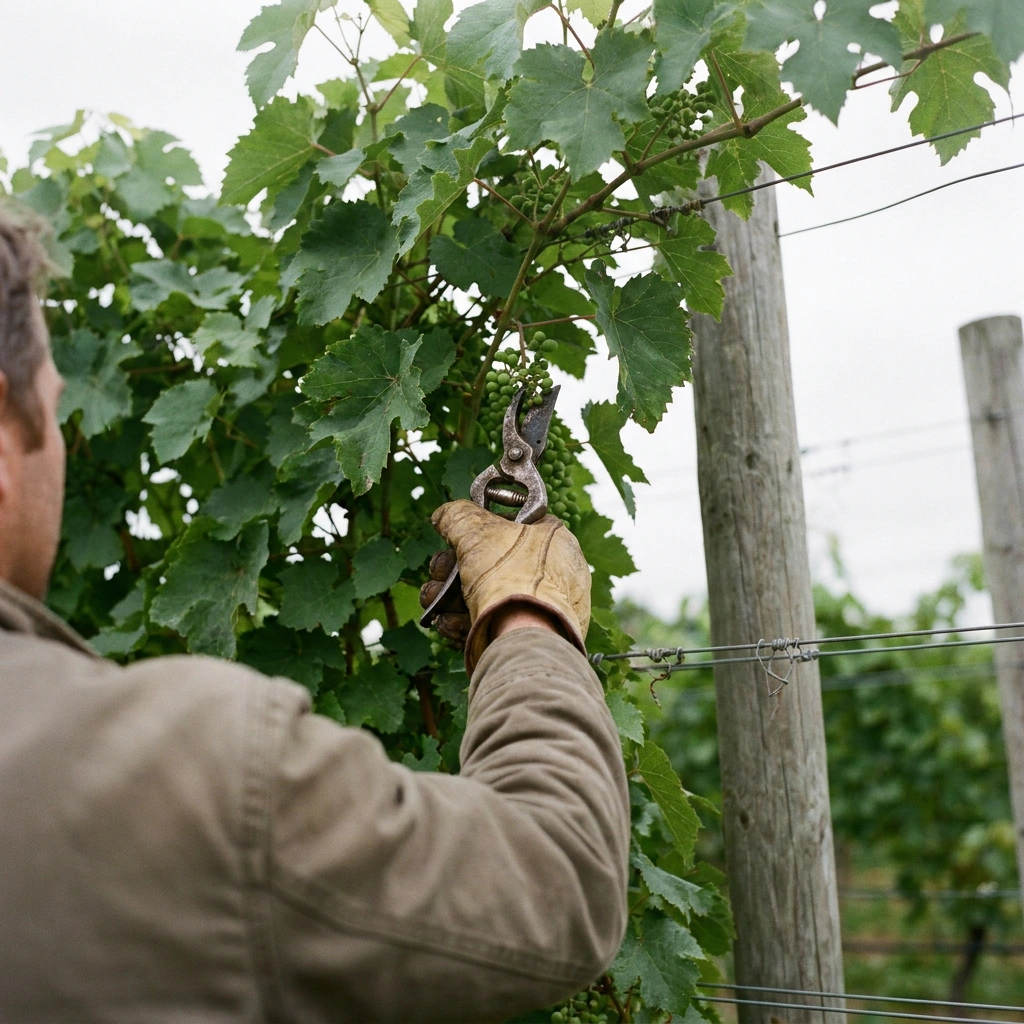
What to cut: Remove the smallest, most shaded, latest-developing clusters first, along with any second-crop clusters from lateral shoots. Leave the single largest, best-positioned cluster per shoot in full sun. Snip at the cluster stem with clean bypass shears – the same tool you’d reach for at winter pruning – rather than pulling clusters off by hand, which can tear the shoot.
Working the opposite problem – a vine that isn’t producing enough clusters at all? See my guide to getting more grapes from an underproducing vine.
Small berries are one symptom among many, and they often travel with others. If your vine is showing more than this, start at the symptom-to-cause diagnostic guide and work back from what you can actually see on the leaves and fruit.
Frequently Asked Questions
Will cluster thinning make my grapes bigger?
Yes, if the vine was over-cropped. Removing excess clusters, especially early near fruit set, gives the remaining berries a larger share of the vine’s sugar and water supply, so they grow larger and ripen faster. Thinning a vine that wasn’t actually over-cropped, or thinning a naturally small-berried variety, won’t change berry size much.
How many clusters should I leave on a young vine?
None in years one and two – remove all flower clusters so the vine builds roots and trunk instead. From year three on, start with roughly one cluster per shoot and increase gradually as the canopy fills in, reaching a full crop load by year five or six.
Is it normal for cold-hardy hybrid grapes to have small berries?
Yes, for several popular varieties. Marquette in particular is documented to have notably smaller clusters and berries than a variety like Frontenac, since these hybrids were bred primarily for winter hardiness and disease resistance rather than fruit size. If the vine is healthy and ripens normally, small berries on these varieties are not a defect.
Can a lack of water make grape berries stay small?
Yes, if the vine gets too dry between fruit set and veraison, when berries are dividing cells and setting their maximum size. Water stress after veraison affects sugar concentration more than final berry size, and mild stress at that later stage is often beneficial for flavor.
How do I know if small grapes are from over-cropping or a nutrition problem?
Check the canopy first: over-cropped vines usually look vigorous and dark green, while nutrient-deficient vines show yellowing or scorch on specific leaves (older leaves for potassium, new growth for iron). Then count clusters per shoot – more than one on a young vine points to over-cropping. A soil or petiole test settles it when the visual signs are unclear.
🍇 Don’t plant the wrong grape
Vines take years to fruit. Get the free cheat-sheet of varieties that actually survive and ripen in your zone.
By subscribing you agree to our Privacy Policy.