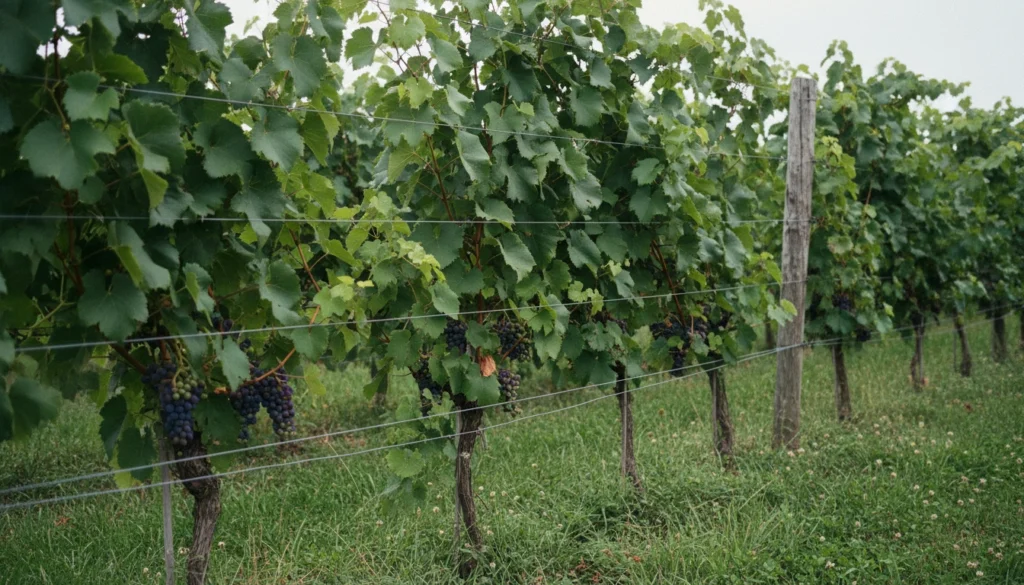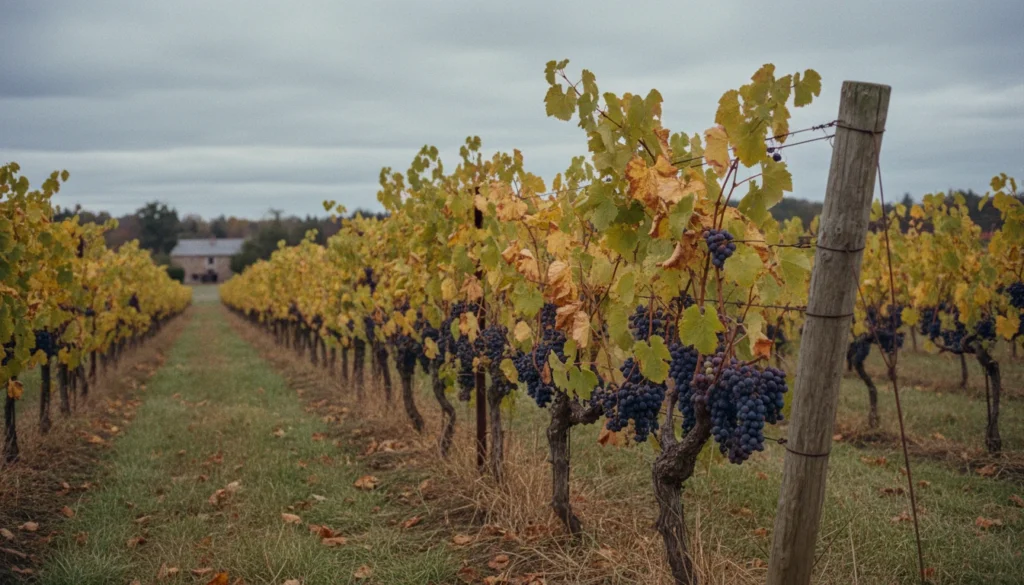
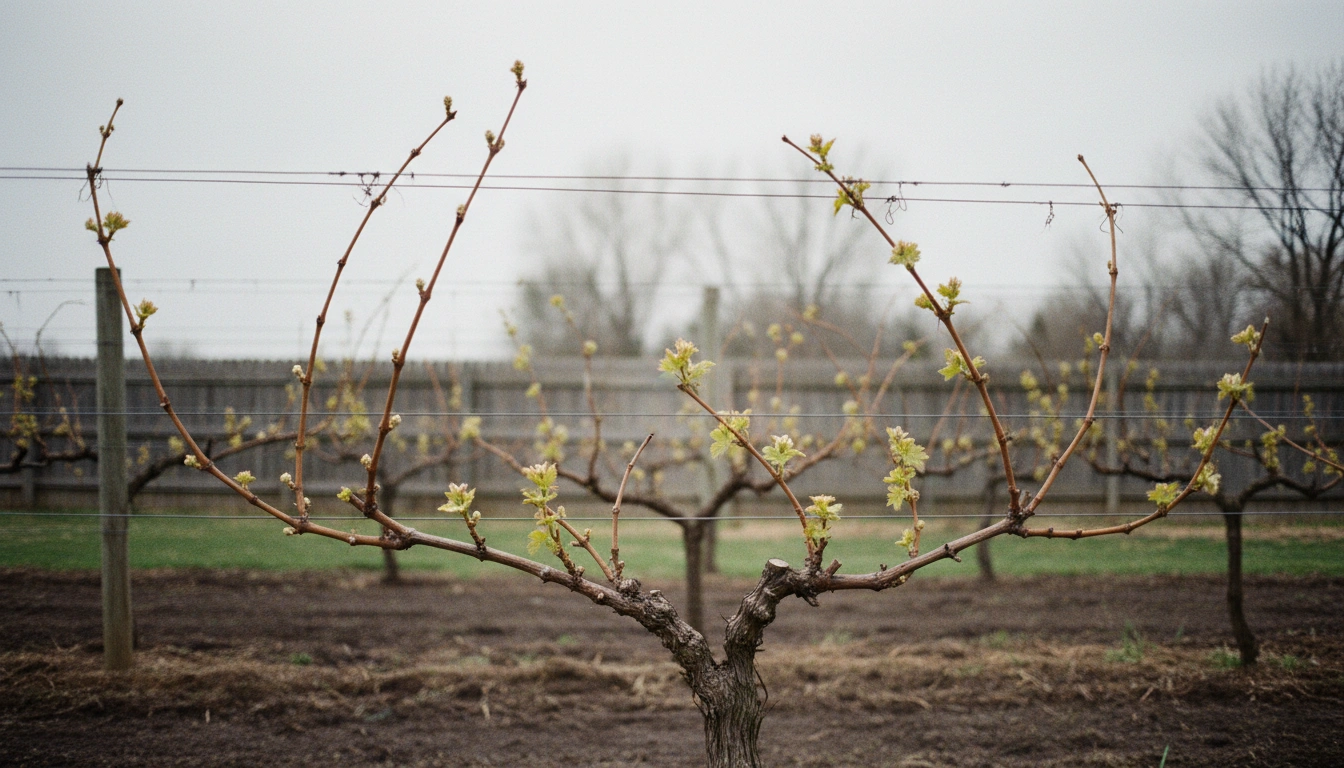
Most grape vine problems sort into eight visible patterns: leaf color change, spots or lesions, shriveled fruit, small clusters, no fruit at all, wilting canes, a vine that looks dead, or animal damage. Match what you’re seeing to the table below, confirm it with the quick check listed, then follow the link to the full guide for that specific problem. If you garden in a cold-climate region (USDA Zone 3-6), check winter injury and short-season ripening failure first – they cause a huge share of the “problems” home growers see here, and most warm-climate grape sites never mention them at all.
Rule Out Winter Injury and Short Season First (Cold-Climate Growers)
If you’re growing in Zone 3-6 – Wisconsin, Minnesota, Vermont, Ontario, most of Lithuania and northern Europe – two causes belong at the top of every differential, and warm-climate references (written for California or the Mediterranean) simply don’t cover them:
- Winter injury and bud kill. A hard winter, a sudden cold snap after a warm spell, or a variety planted past its limit can kill primary buds outright, split trunks near the base, and injure the cambium under the bark. The result next spring looks a lot like “disease” or a “dead vine” – delayed or absent bud break, canes that never leaf out, or a vine that leafs out on one side and not the other. Cold-hardy hybrids (Marquette, Frontenac, La Crescent, Petite Pearl, Itasca) tolerate far more cold than European vinifera, but none are bulletproof in a genuinely severe winter.
- Short-season ripening failure. Grapes that stay small, sour, and green-tinged right up to frost aren’t necessarily diseased or deficient – the season may simply have run out of warm days first. This shows up as a whole-vineyard pattern rather than the patchy, vine-by-vine pattern typical of disease or a nutrient problem.
Both of these get ruled in or out with the same basic test: scratch the bark or cut a bud and look for living green tissue versus brown, dry, dead tissue. Our full walkthrough for that test is in Is My Grape Vine Dead? – start there if winter injury is even a possibility before you assume disease.
How to Use This Table
Before you scan the table, notice three things – they narrow the diagnosis fast:
- Which part of the vine is affected – leaves, fruit, canes, or the whole plant.
- Where and when – old vs. new growth points to a nutrient deficiency; trouble right at bud break points to winter injury; trouble after a rainy stretch points to fungal disease.
- One vine or the whole planting – one vine (or one side of a vine) usually means localized injury or a graft problem; every vine usually means soil, weather, or season length.
| Symptom | Most Likely Causes | How to Confirm | Full Guide |
|---|---|---|---|
| Leaves turning yellow, red, or purple | Nutrient deficiency (N, Fe, Mg, K), downy mildew, natural fall color, herbicide drift | Note which leaves (old vs. new) and whether the color is uniform or interveinal (between the veins, veins stay green) | See “Leaf Color Changes” below |
| Spots or lesions on leaves or fruit | Black rot, powdery mildew, downy mildew | Check spot color, margin, and whether there’s a powdery or downy coating | Black Rot / Powdery Mildew |
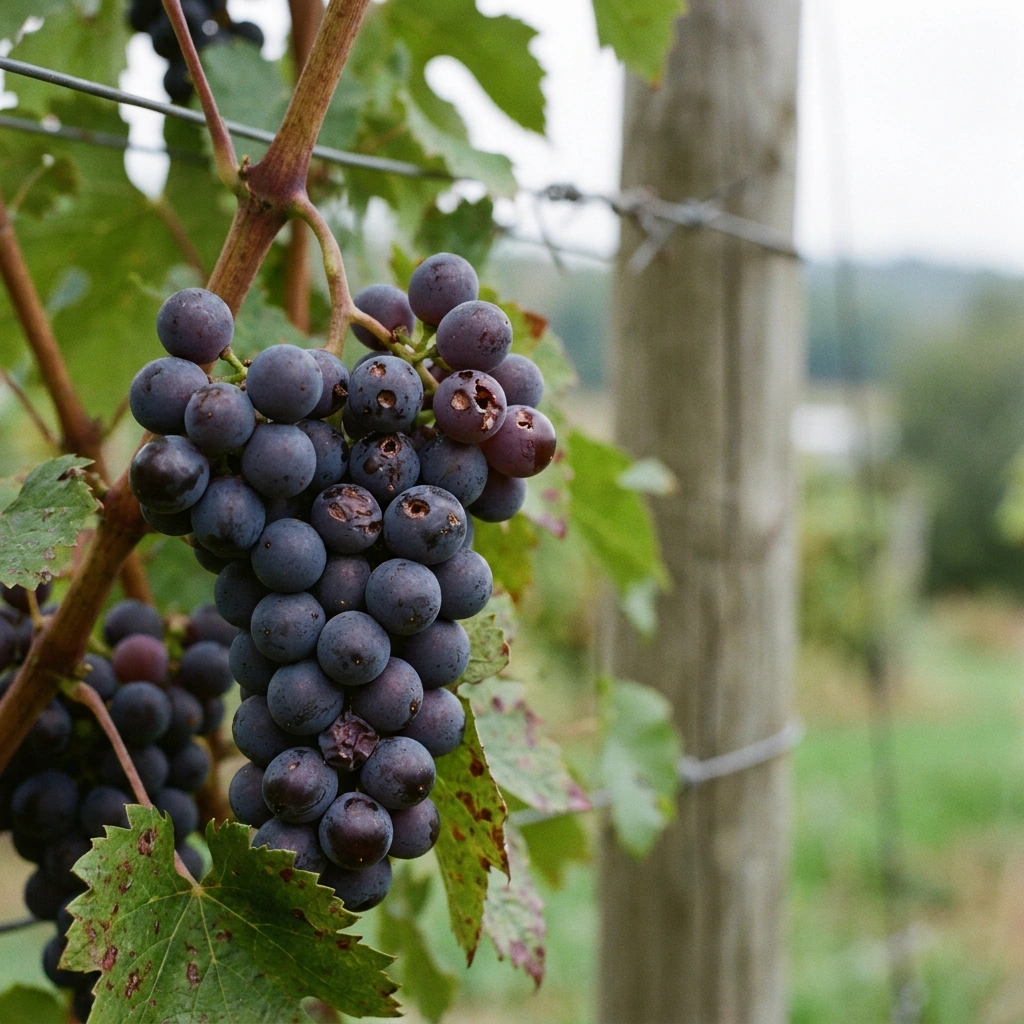
| Fruit shriveling on the vine | Black rot mummies, bunch stem necrosis, sunburn, winter/frost damage | Look for tiny black dots inside the shriveled tissue (black rot) vs. a dead, blackened rachis feeding only part of the cluster (bunch stem necrosis) | Black Rot |
| Small clusters or berries | Over-cropping, poor fruit set, water stress, young vine, or just a small-berried variety | Compare crop load to last year’s cane growth; check if it’s every vine (season/water) or just one (vine-specific) | See “Small Clusters” below |
| No fruit at all | Vine too young, over-vigorous shade, fruiting wood pruned off, frost killed primary buds | Check vine age, look for any flower clusters earlier in the season, and review last winter’s pruning | Why Isn’t My Grape Vine Fruiting? |
| Wilting or collapsing canes/shoots | Water stress, herbicide drift, crown gall, girdling below the wilted point | Look for cupped/twisted leaves (drift) or rough tumor-like galls near the graft union or soil line (crown gall) | Pest & Disease Control Guide |
| A vine that looks dead | Winter injury/bud kill, late bud break, crown gall, or an actually dead vine | Scratch-test the bark for green tissue; give it extra weeks before writing it off | Is My Grape Vine Dead? |
| Animal or insect damage | Japanese beetles, spotted wing drosophila, deer, raccoons, birds, wasps | Look at the damage pattern – skeletonized leaves, punctured soft fruit, browse height, torn vs. neat wounds | Beetles & SWD Guide |
Leaf Color Changes
Leaf color is one of the most reliable diagnostic clues on the whole vine, because different causes show up on different leaves.
Yellowing (Chlorosis)
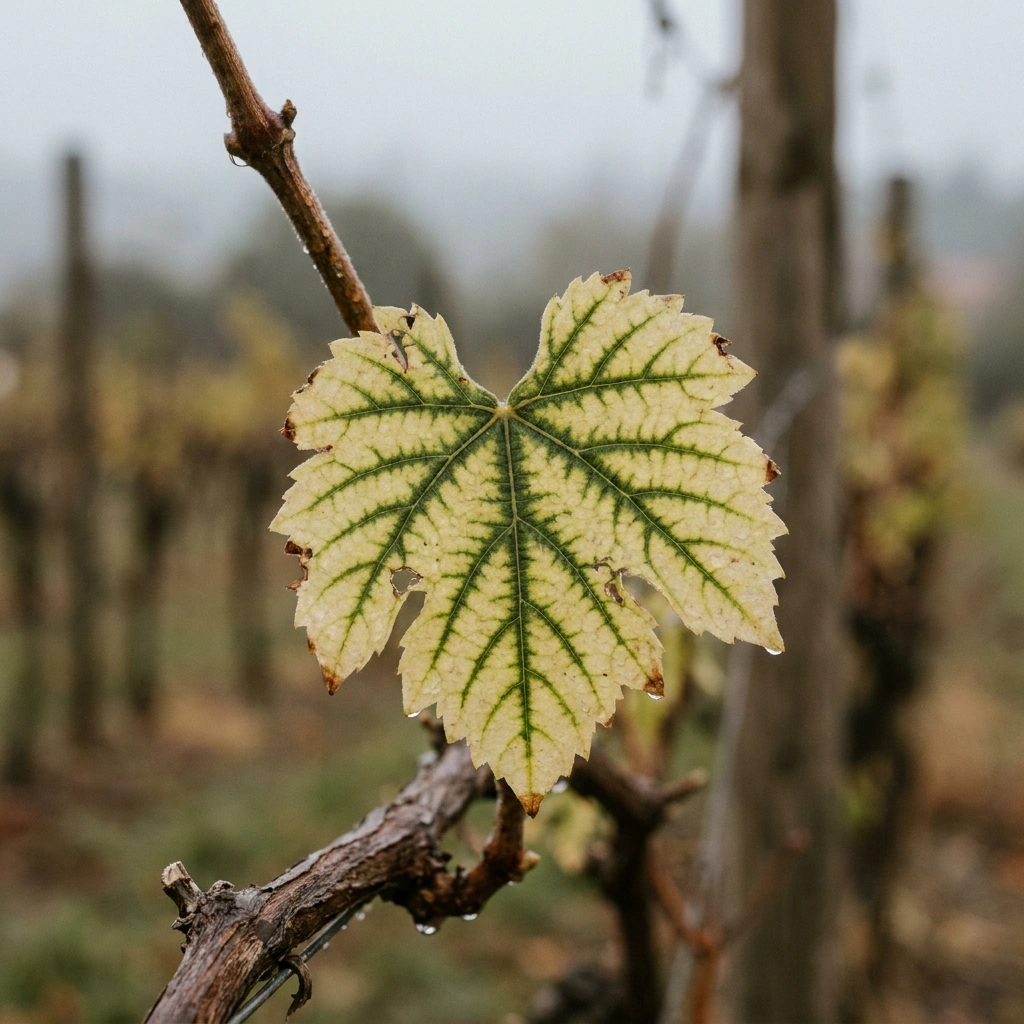
If the yellowing is interveinal – tissue between the veins turns pale while the veins stay dark green – on the newest growth, that’s the classic pattern of iron deficiency, most common on high-pH or heavily limed soils where iron becomes chemically unavailable to the roots even when there’s plenty in the ground. If the yellowing is uniform and starts on the oldest, lowest leaves, that points to nitrogen, which is mobile in the plant and gets pulled from old growth to feed new growth when supply is short. A dull, pale yellow-green over the whole canopy late in the season can also just be normal senescence – not every yellow leaf in October is a problem. Yellow “oil spot” blotches on the upper leaf surface with fuzzy white-to-gray growth on the underside in humid weather is downy mildew, not a nutrient issue.
Our pick before you guess: Before you add any fertilizer or amendment based on leaf color alone, test the soil. A cheap pH and nutrient test kit rules out half the guesswork in twenty minutes and keeps you from correcting the wrong deficiency.
Reddening or Purpling
Red or purple leaf color has several honest explanations. Potassium deficiency can cause reddish-purple discoloration with marginal leaf scorch, usually starting on older leaves. Some red-fruited varieties simply color their foliage red or purple in early autumn – that’s normal, not a deficiency. Girdling (a tight tie, a trellis wire, or vole damage at the base) can also trigger reddening above the injury as sugars back up in the leaf.
Leafroll virus and red blotch virus can both cause reddening between the veins, usually developing in late summer into fall in red-fruited varieties. The honest answer: you cannot tell a virus from a nutrient problem by looking at a photo – the symptoms overlap too much. Lab testing (ELISA or PCR on a leaf or petiole sample through your state’s plant diagnostic lab) is the only real confirmation. If you suspect a virus, don’t self-diagnose or treat it as a nutrient problem – get it tested before deciding what to do with the vine.
Spots or Lesions on Leaves or Fruit
Three fungal diseases account for most leaf and fruit spotting in a home vineyard, and they look different enough to tell apart without a lab:
- Black rot – circular spots, roughly 1/8 to 1/4 inch (3-6 mm), tan with a dark margin, with tiny black dots (pycnidia) inside the tan area after a week or two.
- Powdery mildew – a dusty white-to-gray powdery coating on leaves and berries, often starting on shaded interior growth.
- Downy mildew – yellow, oily blotches on the upper leaf surface, paired with white-to-gray downy growth on the underside directly below, worst after warm, humid weather.
Sanitation and airflow (removing infected tissue, opening up the canopy) help against all three; beyond that, treatment specifics differ enough by disease that it’s worth reading the dedicated page for whichever one matches. For a broader view of insect and disease pressure across the season, see the full Pest and Disease Control Guide.
Shriveled or Shrunken Fruit
Shriveling fruit panics people, and it’s usually not what they fear:
- Black rot mummies – berries turn brown, then shrivel into hard, wrinkled, blue-black “mummies,” usually with the same black pycnidia dots described above. See Black Rot on Grapes.
- Bunch stem necrosis – a physiological disorder, not an infection. A section of the cluster stem (the rachis) dies and turns dark, cutting off water and sugar to everything past that point, so part of the cluster shrivels while the rest ripens normally. There’s no fungal spotting on the berries themselves – the damage traces back to the dead stem tissue.
- Sunburn – berries exposed to direct, intense sun after aggressive leaf pulling can scald, bronze, and shrivel on the sun-facing side only.
- Winter or frost damage – if it’s early in the season and whole clusters or shoots are affected uniformly, look at winter injury first (see the cold-climate section above) rather than disease.
The fastest way to sort these out: fungal spotting on the berry itself means disease; a dead, discolored stem feeding an otherwise-healthy berry means bunch stem necrosis; damage only on the sun side means sunburn.
Small Clusters or Berries
Small fruit has more benign explanations than growers usually assume. Over-cropping – more clusters than the vine’s leaf area can properly ripen – produces smaller berries and clusters across the board, and it’s common on vigorous young vines that weren’t thinned. Poor fruit set (shatter), where flowers fail to develop into berries after a cold or wet bloom, leaves loose, straggly clusters with fewer, uneven-sized berries. Water stress during berry development limits cell expansion and shrinks the whole crop. A vine in its first two to three years naturally carries a smaller, lighter crop than a mature one – that’s patience, not a problem. And some hybrid varieties are genuinely small-berried and small-clustered by nature; judging them against a large-clustered table grape isn’t a fair baseline.
No Fruit At All
A vine with no fruit is almost always one of four things: still too young to fruit heavily (most vines don’t carry a real crop until year three); putting all its energy into vegetative growth because it’s over-fertilized or overshaded, which suppresses flower formation; fruiting wood accidentally removed during pruning (grapes fruit on one-year-old canes, so cutting back to old wood removes next season’s crop); or a late spring frost that killed the primary buds carrying flower clusters, leaving only less-fruitful secondary buds. Full differential, including how pruning system and vine age interact, in Why Isn’t My Grape Vine Fruiting?
Wilting or Collapsing Canes
Wilting shoots or canes point to something interrupting water and nutrient flow above a specific point. Simple water stress in hot, dry weather is the most common and least worrying cause. Herbicide drift – especially from phenoxy herbicides like 2,4-D used on a nearby lawn or field – is worth ruling out if leaves are cupped, twisted, or strap-shaped rather than just droopy; grapevines are unusually sensitive to this kind of drift. Crown gall, caused by the bacterium Agrobacterium vitis, produces rough, tumor-like galls, most often at the graft union or a site of past winter or mechanical injury, and it frequently shows up as a delayed consequence of a hard winter. Girdling from a tight tie, wire, or rodent damage below the wilted section also cuts off flow to everything above it – check the trunk and cordons for a constriction point before assuming disease.
A Vine That Looks Dead
This is where cold-climate growers most often jump to the wrong conclusion. A vine that hasn’t leafed out by the time its neighbors have isn’t necessarily dead – it may simply be slower to break dormancy, or it may have lost its primary buds to winter injury while less-vigorous secondary buds are still on the way. Before you pull anything out, scratch a small patch of bark on a few canes and on the trunk near the soil line: green, moist tissue means that part is alive; brown, dry tissue means it isn’t. Crown gall at the graft union is another cause of an apparently dead or badly struggling vine, particularly after a rough winter. The full walkthrough, including how long to wait and where to check, is in Is My Grape Vine Dead?
Animal or Insect Damage
Damage patterns tell you who the culprit is faster than almost anything else on this list:
- Japanese beetles skeletonize leaves, eating the soft tissue between the veins and leaving a lacy skeleton, usually starting in mid-summer.
- Spotted wing drosophila (SWD) is a fruit fly that, unlike common fruit flies, lays eggs directly into intact, still-ripening fruit rather than needing fruit that’s already damaged – which is why it hits grapes earlier than growers expect.
- Deer browse leaves and shoots with a ragged, torn edge rather than a clean cut, and reach well above head height – effective exclusion fencing generally needs to be around 8 ft (2.4 m) tall.
- Birds peck individual berries just as they start to ripen and color up, leaving small puncture wounds.
- Wasps and yellowjackets are usually secondary damage – drawn to fruit that’s already split, overripe, or opened by a bird, rather than puncturing sound, intact skin themselves.
For a closer look at the two most damaging insects, see Japanese Beetles and Spotted Wing Drosophila on Grapes, and for the full pest and disease picture, the Pest and Disease Control Guide.
Frequently Asked Questions
How do I tell winter injury from disease in spring?
Timing and pattern are the biggest clues. Winter injury shows up right at bud break, often affecting whole canes, one side of the vine, or the graft union, rather than the scattered spotting typical of fungal disease. The scratch test – checking for green tissue under the bark – is the most reliable way to confirm it; see Is My Grape Vine Dead?
My leaves are yellow between the veins but the veins stay green – what’s wrong?
That’s classic interveinal chlorosis, and on new growth it’s most often iron deficiency, particularly common on high-pH or heavily limed soils where iron becomes less available to the roots. A soil pH and nutrient test is the fastest way to confirm before treating.
Could my red or purple leaves be a virus like leafroll or red blotch?
It’s possible, but you can’t tell from a photo or from symptoms alone – leafroll and red blotch both mimic potassium deficiency and normal autumn color closely enough that lab testing is the only real confirmation. Don’t fertilize or remove a vine based on a suspected virus diagnosis until it’s actually been tested.
Is fruit shriveling on the vine always black rot?
No. Black rot mummies usually show tiny black pycnidia dots in the shriveled tissue. If the berries themselves look clean but a section of the cluster stem is dead and dark, that’s more likely bunch stem necrosis, a physiological disorder rather than an infection. See Black Rot on Grapes for how to tell them apart.
My grapes never fully ripened this year – is that a disease?
Not necessarily. In a short-season cold climate, an unusually cool or wet year can leave the whole vineyard undersized, sour, and behind schedule simply because there weren’t enough warm days to finish ripening – a season-length problem, not a disease, and it typically affects every vine rather than one at a time.
🍇 Don’t plant the wrong grape
Vines take years to fruit. Get the free cheat-sheet of varieties that actually survive and ripen in your zone.
By subscribing you agree to our Privacy Policy.