
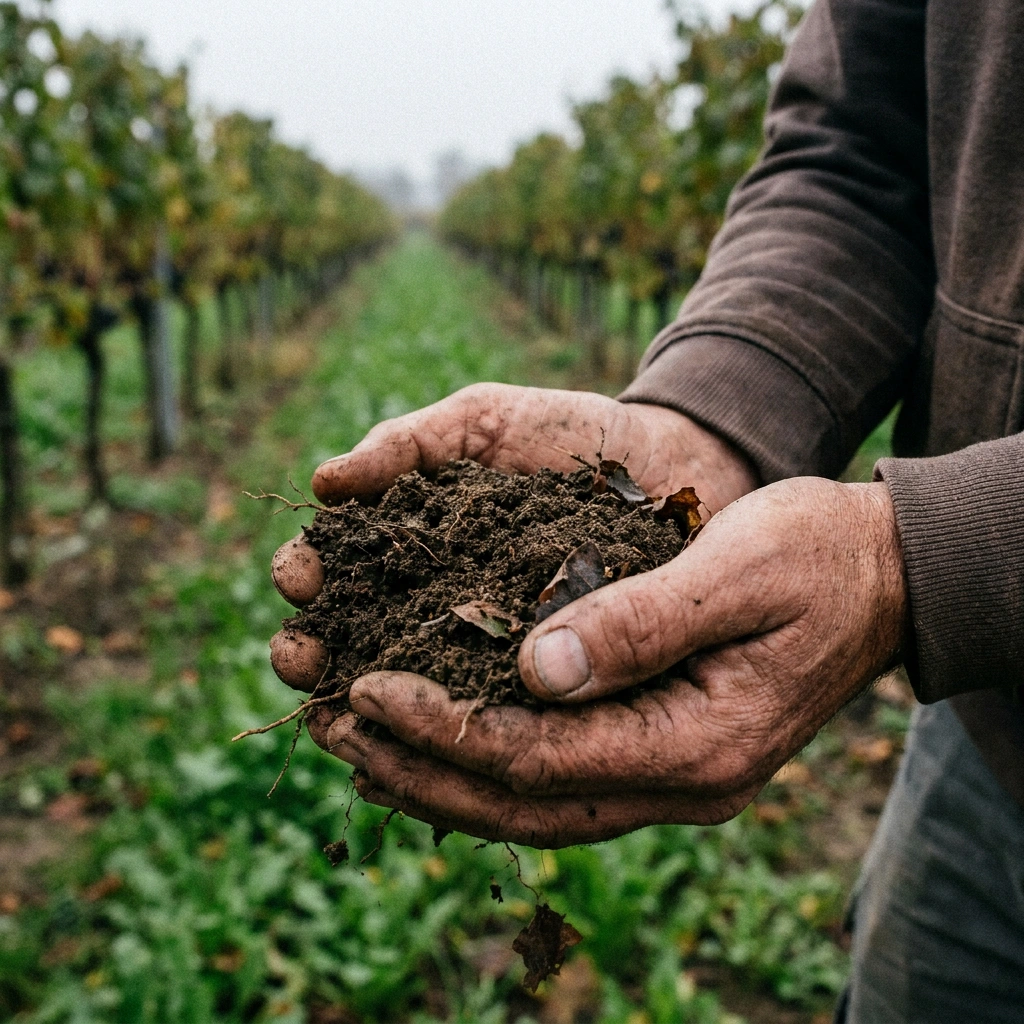
Grape roots need oxygen just as much as they need water. If your soil stays waterlogged or gets compacted hard under heavy clay, the roots suffocate – you’ll see stunted growth, yellow leaves, and vines that never really take off. The fix is straightforward: improve drainage so excess water moves away, open up the soil structure so air can get in, and stop adding compaction on top of what’s already there. This guide covers the practical steps for cold-climate home vineyards, from Wisconsin and Minnesota to zones where heavy clay and spring snowmelt are the norm.
Why Aerated, Well-Drained Soil Matters for Grapes
Grapevine roots are surprisingly deep when conditions allow – often reaching 3-6 feet (0.9-1.8 m) in good soil. But they need a steady supply of oxygen at the root zone to drive nutrient uptake and respiration. University of Minnesota Extension notes that grapevines are particularly sensitive to waterlogged soils; even a few days of flooded root zone in the growing season can cause root death and invite Phytophthora root rot.
In cold climates, the problem is often worse. Heavy glacial clay, common across the Upper Midwest, compacts easily and holds water. When snowmelt comes fast in March or April, low-lying vineyard spots can stay saturated for weeks. Add in any tractor or foot traffic on wet soil and you lock in compaction that lasts for years.
The good news: most compaction and drainage problems are fixable, and the fixes mostly cost labor rather than money.
Signs Your Vineyard Soil Has a Problem
Before doing anything, walk your rows after a heavy rain and look for these red flags:
- Standing water or slow-draining puddles in the row middles more than 24-48 hours after rain
- Gray or blue-gray mottling when you dig down 12 inches (30 cm) – a classic sign of anaerobic (oxygen-deprived) soil
- Hard, dense layer at 6-12 inches (15-30 cm) that resists a metal rod or screwdriver pushed in by hand – this is a hardpan
- Shallow root systems when you dig near an underperforming vine – roots circling in the top 4-6 inches instead of going deep
- Stunted shoot growth or chlorosis (yellowing) that doesn’t respond to fertilization
If you’re seeing one or more of these, the soil is the likely culprit – not a nutrient problem or disease.
Fix #1: Add Organic Matter to Open Up the Structure
The single most important long-term fix for compacted or poorly draining soil is organic matter. It improves both ends of the drainage problem at once – in clay soils it opens up aggregates and lets water move through; in sandy soils it improves water-holding and root anchorage. Cornell Cooperative Extension recommends incorporating 2-4 inches (5-10 cm) of compost into the top 6-8 inches (15-20 cm) of soil at planting time, and annually top-dressing with 1-2 inches (2.5-5 cm) of aged compost in the row middles. If you have the chance to incorporate before planting, working compost deeper – into the top 12-18 inches (30-45 cm) – benefits the root zone more than a shallow surface pass, since grape feeder roots concentrate in that upper horizon.
For established vines, you can’t till deep without damaging roots. Instead, apply compost as a surface mulch in fall and let earthworms and freeze-thaw cycles work it down over winter. Over a few seasons, heavy clay starts to take on the dark, crumbly quality that good soil should have.
Good sources: aged wood chips, leaf compost, straw, or a mix. Avoid fresh manure near the vine root zone; it can burn roots and introduce pathogens. Wood chips piled directly on the vine trunk can also harbor crown rot – keep a clear foot around the base.
Fix #2: Broadforking or Subsoiling to Break Compaction
When you have a hardpan – that dense layer at 8-14 inches (20-35 cm) – organic matter alone won’t solve it quickly. The hardpan physically blocks roots and traps water above it. The mechanical fix is either a broadfork (for smaller home-scale vineyards) or a single-shank subsoil ripper pulled behind a tractor.
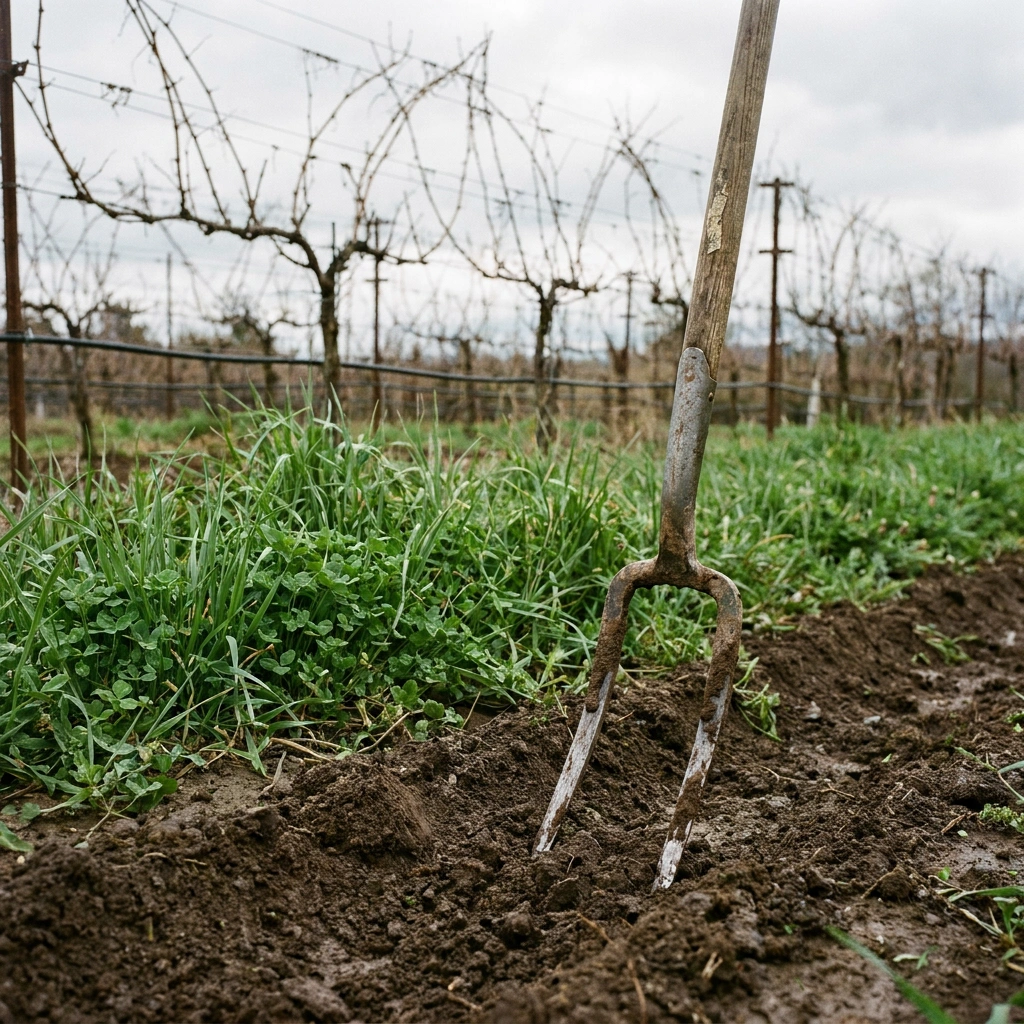
A broadfork has two long tines (typically 10-14 inches / 25-35 cm) and is pushed into the ground vertically, then rocked back and forth to fracture the soil without inverting it. The key is to work it in the row middles rather than directly under the vine trunk. Work the middles when the soil is moist but not wet – you want it to fracture cleanly, not smear.
For a home vineyard of 10-20 vines, broadforking the middles once a season in early spring (before bud break) is practical and effective. For larger plots, a subsoil ripper pulled at 16-20 inches (40-50 cm) in fall handles the job mechanically. The University of Minnesota Viticulture Extension recommends subsoiling in fall rather than spring so the fractured soil can settle over winter without collapsing back.
Our pick: the broadfork
A good broadfork is one of the most useful tools for the home vineyard. A solid choice is a heavy-duty broadfork with welded tines rather than bolted – the bolted ones work loose over time in dense clay soil. Check what’s available on Amazon; they range from lightweight 8-inch versions to serious 14-inch tine models that can handle compacted clay.
Fix #3: Cover Crops in the Row Middles
Planting a cover crop in the row middles is one of the best things you can do for long-term soil aeration – it’s also the most underused practice in home vineyards. The roots of cover crop plants, especially deep-taproot varieties, break up compaction over time and create channels that remain even after the roots decompose. When the cover crop is mowed or rolled in spring, the decomposing organic matter feeds soil biology and improves structure.
For cold-climate Zone 4-5 vineyards, good choices include:
- Annual ryegrass or oats: fast to establish, winterkill in Zone 4/5, no spring management needed – they die back and decompose in place
- Daikon radish: taproots punch through compacted layers up to 18 inches (45 cm) deep; winterkills and decomposes, leaving channels (“bio-tillage”)
- Crimson clover: nitrogen-fixer, low-growing, easy to mow; tolerates Zone 5-6
- Buckwheat: summer option, scavenges phosphorus, winterkills reliably, fast decomposer
Keep cover crops mowed to 4-6 inches (10-15 cm) during the growing season so they don’t compete aggressively for water. Under the vine itself – within about 18 inches (45 cm) of the trunk – keep a bare zone or shallow mulch rather than living cover, especially for younger vines.
Cover crops also help a lot with the compaction problem by keeping foot and equipment traffic off bare, wet soil. When the middles have a living mat, you can walk the rows after rain without smearing and compacting the top layer.
Fix #4: Stop Working Wet Soil
This sounds obvious but it’s the rule most home growers break every spring. When soil is at or above field capacity – when it smears like putty rather than crumbling – any traffic or tillage destroys soil structure. You can undo a season of cover-cropping and compost additions with one pass on a wet day.
The simple test: grab a handful of soil and squeeze it into a ball. Then poke it with your finger. If it crumbles, it’s workable. If it stays as a smeared ball or plastic-feeling lump, it’s too wet – come back in a day or two.
In cold climates, this means being patient in April and early May. It’s tempting to fire up the tiller the first warm weekend after snowmelt, when the soil is still basically saturated. The compaction you create that day can take two or three years to undo.
Fix #5: Raise the Planting Row or Build a Berm
If your site has naturally high water tables or slow-draining subsoil – common in low-lying areas and river-valley sites – drainage amendments alone may not be enough. The reliable fix is to get the vine roots physically above the saturation zone by mounding soil into a planting berm or raised row.
A berm 10-12 inches (25-30 cm) high and 24-30 inches (60-75 cm) wide gives the roots enough elevation to stay above a high water table for all but the worst flood events. Cornell’s viticulture extension recommends berms in all but the most freely draining sites in the Northeast – they speed up soil warming in spring as well, which matters for bud break timing in Zones 4-5.
Building a berm is a one-time job. Rip the subsoil first, then pile the topsoil into the mound and add compost. The berm will settle; build it taller than you need and let it consolidate before planting. See our guide on how to prepare your soil and plant a grapevine for more on site prep.
Fix #6: Gypsum for Sodic or Sticky Clay
If your clay is particularly sticky and cement-like – more common in prairie and Midwestern soils – it may be sodic: high in sodium, which causes clay particles to disperse and collapse into a dense, impermeable layer. Gypsum (calcium sulfate) is the traditional fix. The calcium displaces the sodium and causes the clay particles to flocculate – clump together – improving drainage and aeration without changing pH.
Important caveats: gypsum only works if your soil is genuinely sodic (high sodium content), which is uncommon in the cold-climate zones this site covers. Have a soil test that includes SAR (sodium adsorption ratio) or exchangeable sodium percentage before spending money on gypsum – on non-sodic soil it does essentially nothing. If a test confirms sodic conditions, application rates for reclamation are typically 2-5 tons per acre (4,500-11,200 kg/ha), higher than often cited for light maintenance use. For home-scale spot treatment, about 4-6 lbs per 100 sq ft (2-3 kg per 10 sq m) can be tried if sodium is confirmed. Work it into the top 4-6 inches before planting. Results take a season or two to show fully.
Gypsum is not useful if your clay is well-structured and the problem is just compaction from traffic – save your money and use the organic matter + cover crop approach instead. Get a soil test first; extension services in Minnesota, Wisconsin, and most land-grant states will test for both sodium levels and structure. USDA-NRCS offices can often advise for free.
Putting It Together: A Practical Priority List
You don’t need to do all of this at once. Here’s how we’d prioritize it for a cold-climate home vineyard:
- Stop compacting wet soil. Free. Immediate. Do it first.
- Start a cover crop in the row middles. Seed cost is minimal; the long-term soil benefit is large.
- Add compost annually – surface-apply in fall, 1-2 inches.
- Broadfork the middles each spring before bud break if compaction is a problem.
- Build berms at planting if your site drains poorly – easier to do before the vines go in.
- Consider gypsum only after a soil test confirms sodic conditions (high SAR/exchangeable sodium) – it does nothing on non-sodic clay, which is the norm in most cold-climate zones.
For more on preparing the soil before planting, see How to Prepare Your Soil and Plant a Grapevine and Organic Vineyard Site Selection. If drainage is the bigger concern at your site, Vineyard Site Drainage covers tile drains and surface grading in more depth.
Frequently Asked Questions
How do I know if my vineyard soil is compacted?
The easiest test is a metal rod or screwdriver – push it into the soil with steady hand pressure. If it stops abruptly at 6-10 inches (15-25 cm) rather than sliding smoothly to 12-18 inches, you have a compaction layer. Standing water that drains slowly after rain is another clear sign. Digging near an underperforming vine and finding roots bunched in the top 4 inches rather than spreading deep confirms it.
Can I use a rototiller to aerate my vineyard?
A rototiller works in the row middles if you need to incorporate organic matter before planting, but it’s not a substitute for deep aeration and can make compaction worse over time. Repeated shallow tilling creates a “plow pan” – a dense layer just below the tines. For established vineyards, broadforking or subsoiling reaches the compaction layer that tilling misses. In the row middles with no vine roots, light tilling is fine for cover crop seedbed prep.
How deep should grapevine roots be able to grow?
In ideal conditions, grapevine roots can reach 3-6 feet (0.9-1.8 m) deep and spread equally wide. Most of the active feeder roots are in the top 12-24 inches (30-60 cm). The goal of soil aeration is to ensure there’s no compaction layer or saturated zone cutting off that root development in the critical upper 18 inches.
Are there cover crops that are too aggressive for Zone 4-5 vineyards?
Hairy vetch, while a good nitrogen-fixer, can be hard to control and may reseed aggressively. Chicory has deep tap roots and good drought tolerance but can be difficult to eliminate once established. For beginners in cold-climate zones, we’d stick with annual options that winterkill reliably – oats, daikon radish, buckwheat – so you’re not fighting the cover crop in spring. Perennial grasses like fescue in the middles are fine once you’re comfortable managing them with mowing.
Does gypsum change soil pH?
No – gypsum (calcium sulfate) does not significantly affect soil pH. That’s one of its useful properties. If your pH needs adjusting, use lime (to raise pH) or sulfur (to lower it). Gypsum specifically addresses the soil structure of sodic or dispersive clays, helping particles aggregate and improving drainage. It’s not a universal soil fix – it’s targeted at a specific clay chemistry problem.
🍇 Don’t plant the wrong grape
Vines take years to fruit. Get the free cheat-sheet of varieties that actually survive and ripen in your zone.
By subscribing you agree to our Privacy Policy.
