The most reliable way to protect ripening grapes from birds is draping fine-mesh bird netting over the canopy at or just before veraison – when berries begin to soften and color up. Scare tactics (reflective tape, fake owls, noise devices) may work for a day or two, but birds learn fast. Once a flock discovers your ripening clusters, only a physical barrier keeps the harvest. Here is what actually works, and how to do it without harming birds.
Why Birds Target Grapes at Veraison
Birds are not random; they are tracking sugar. As Brix climbs in late summer – typically starting 40-60 days before harvest for most cold-climate varieties like Marquette, Frontenac, or La Crescent – the sweetness becomes irresistible to starlings, robins, cedar waxwings, and house finches. Bird pressure typically starts as berries change color and sweeten at veraison. By harvest time it can be severe enough to strip 30-50% of a small home vineyard overnight, especially from starling flocks.
Bird visits tend to begin the same week clusters start turning soft and translucent. That timing – not the calendar date – is your cue to act. If you want to know where your vines are in the ripening window, the post on whether your grapes will ripen covers the signs to watch.
The Options: Compared Honestly
1. Drape Netting Over the Canopy (Best for Most Home Vineyards)
Full-row drape netting is the gold standard for home vineyards with more than 4-5 vines. You drape a wide net over the entire trellis canopy – not just the fruit zone – so it hangs down on both sides and is secured at ground level. The key detail: the net must be supported above the clusters so birds cannot reach through. If it sags and rests directly on the fruit, starlings will sit on the outside and peck right through.
Mesh size matters. Use 5/8-inch (15-17 mm) mesh. Mesh larger than 3/4 inch (19 mm) allows small birds to pass through or reach in. Mesh finer than 1/2 inch (12 mm) adds weight, reduces breathability, and offers no meaningful protection gain for this use. The 5/8-inch sweet spot excludes the problem birds while staying easy to work with.
UV-stabilized polyethylene is the right material – it handles seasons of outdoor use without becoming brittle. Cheap non-UV nets crack and tangle badly after one or two seasons.
Our pick: UV-stabilized garden bird netting in the 5/8-inch mesh size. Sold in rolls of 7.5 ft × 65 ft (2.3 m × 20 m) or larger – size up to be sure you have enough drape on both sides. Check current options on Amazon (grape netting).
2. Full Enclosure / Cage (Best Protection, Highest Effort)
A permanent or semi-permanent cage – net walls on all four sides, top, and bottom – gives 100% exclusion. It is the right choice if deer pressure is also high (more on that below) or if you have a very compact 1-3 vine setup. The trade-off is cost, setup time, and the need to enter for spraying and picking. For most home vineyards with 6-30 vines on a standard cordon trellis, full-row drape netting is more practical.
3. Side Netting on the Fruit Zone Only
Some growers net only the cluster zone (the lower 18-24 inches / 45-60 cm of the canopy) rather than the whole top. This uses less net and allows more airflow. It works reasonably well against ground-level sparrows and if the net fits tight, but overhead diving birds – starlings and waxwings especially – still get in from the top. If your main pest is starlings, net the full canopy.
4. Organza / Mesh Bags Over Individual Clusters
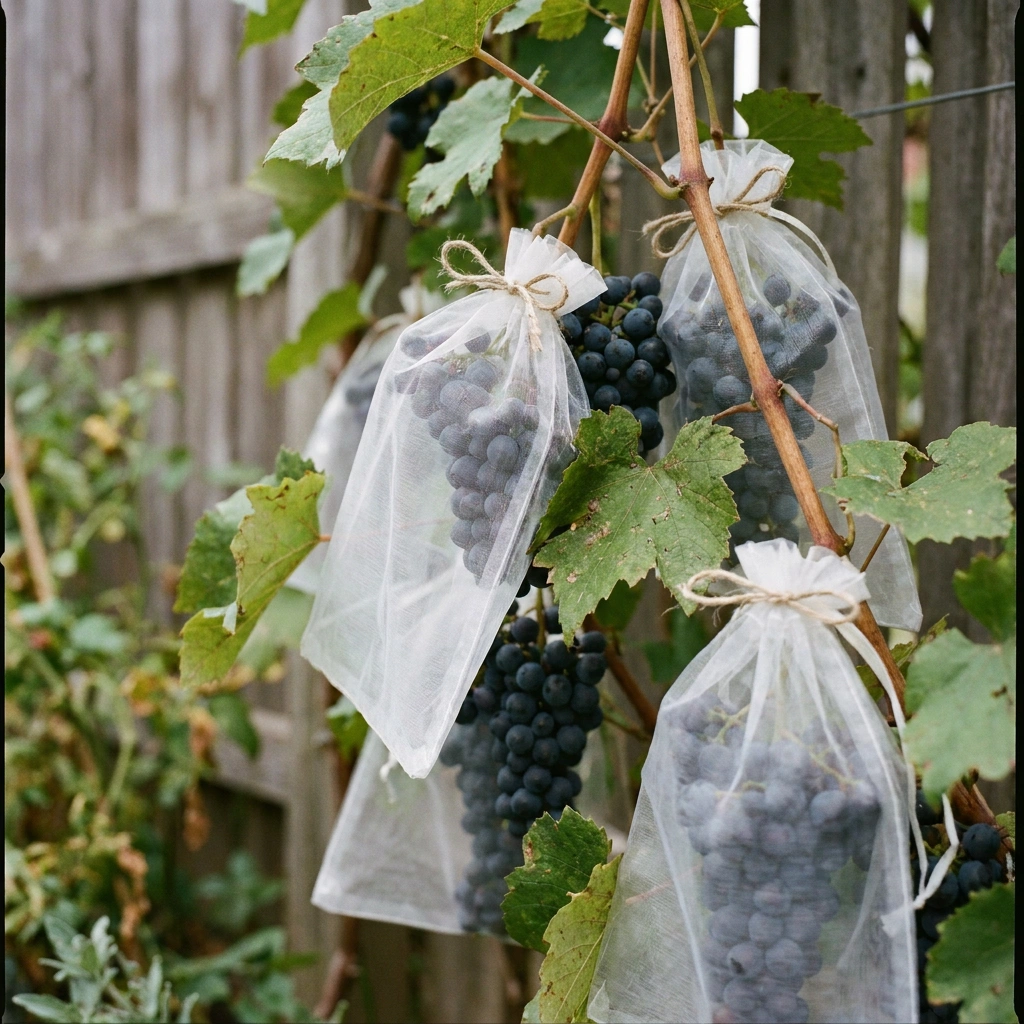
For a small planting of 3-8 vines, individual cluster bags are a satisfying low-tech solution. Slip a white mesh organza bag (4 × 6 inches / 10 × 15 cm works for most clusters) over each cluster once the berries have set, and tie or twist-tie the top closed around the stem. The mesh lets air and sunlight through, so ripening is not dramatically affected.
The downside is time: a mature Marquette vine with 40-60 clusters means 40-60 bags to put on and take off. For 2-3 vines in a backyard, it is perfectly reasonable.
Note on bird welfare: Bag the stem end tightly so no bird can get inside. With drape netting, check the bottom edges daily during the protected period – small birds can occasionally hop under a loose edge and get trapped inside. Loose hems should be clipped or weighted down, not just draped. Birds trapped inside nets can die of stress or injury quickly.
5. Reflective Tape, Fake Owls, and Noise Devices
These are delay tactics at best. A mylar ribbon or spinning owl might spook birds for 3-7 days. After that, birds habituate. Some growers swear by them, but the effect rarely lasts. The University of Minnesota Extension, in its guidance on fruit crop bird management, notes that exclusion netting is the only consistently effective method – all other deterrents are rated “temporary.” Use scare tactics as a supplement between your last spray and when netting goes on, not as a replacement.
How to Install Drape Netting Properly
Installation timing and technique both matter. A net thrown on carelessly, with the mesh resting on the clusters and the bottom edge left open, is nearly useless.
- Net at or just before veraison. Do not wait until you see birds – by then they have already found you. Veraison in cold-climate varieties (Zones 3-5) typically falls between mid-July and mid-August. Mark the week when you see 50% of clusters changing color, and net within 2-3 days.
- Support the net above the canopy. The easiest method: run a wire or rope along the top of the trellis and let the net rest on it, or use conduit pipes extending above the end posts to create a “tent” frame. The net should not sag onto the clusters.
- Drape wide enough. For a standard vertical shoot-positioned trellis that is 5-6 ft (1.5-1.8 m) tall, you need a net at least 14-16 ft (4.3-4.9 m) wide to cover both sides and have enough to secure at the bottom.
- Secure the bottom edge. Use landscape staples, bag clips, or weights to close the bottom hem. This is the step most people skip – and where birds get in.
- Remove for any spray application. If you need to apply a fungicide (especially important for downy and powdery mildew – see pest and disease management), remove the net, spray, let it dry, then re-net. Nets trap humidity and prevent penetration anyway.
- Remove at harvest. Take the net down row-by-row as you pick. Storing it neatly (rolled, not wadded) means it will last 5-8 seasons.
A Note on Wasps and Yellowjackets
As harvest approaches – especially after the first cracked or bird-damaged berry – yellowjackets become aggressive sugar feeders. Bird netting does not stop wasps; mesh is too large. If wasp pressure is significant, hang wasp traps baited with sweet or fermented bait – flat beer or a splash of fermented fruit juice works well – at the ends of rows, away from the clusters. (Protein baits work better earlier in the season, when colonies are in their growth phase; by harvest time, yellowjackets have switched to carbohydrate foraging, so sweet bait is the right choice.) Picking promptly once ripe is the best wasp control: don’t let damaged clusters hang.
A Note on Deer
Bird netting alone will not stop deer. If you have deer pressure, you need a trellis setup that can support a full-height deer fence (8 ft / 2.4 m minimum), or a separate perimeter fence. Bird netting laid over the trellis is too flimsy to deter a deer and will be pulled down, often tearing in the process.
Frequently Asked Questions
What size mesh should I use for grape bird netting?
Use 5/8-inch (15-17 mm) mesh. This size excludes starlings, robins, and cedar waxwings – the main grape thieves – while being light enough to drape easily. Mesh larger than 3/4 inch (19 mm) lets small birds through or allows them to reach in from outside. Mesh finer than 1/2 inch (12 mm) adds weight without meaningfully improving protection and reduces airflow.
When should I put bird netting on grapes?
Net at veraison – when 50% of your clusters begin softening and changing color. For cold-climate varieties in Zones 3-5, this is typically mid-July to mid-August. Don’t wait until you see birds actively feeding; they move fast once they locate a food source. If you’re unsure where your vines are in the ripening window, read the guide on knowing when grapes are ready to harvest.
Do reflective tape and scare devices work for protecting grapes?
Temporarily. Reflective ribbon, predator decoys, and noise makers may delay birds for a few days, but birds habituate quickly – usually within a week. University of Minnesota Extension research classifies exclusion netting as the only consistently effective method for berry crops. Scare devices work as a short-term gap-filler between your last fungicide spray and when netting goes on.
Will bird netting harm birds?
It can, if installed carelessly. The two risks are birds getting trapped inside the net (if bottom edges are left open) and birds tangling in loose or damaged mesh. To prevent this: secure the bottom hem completely, check inside the netting daily, and remove and dispose of any net that is fraying or developing large tears. Keep netting taut and secure the edges properly – loose, floppy netting (regardless of mesh size) is the real entanglement hazard. Fine-mesh improvised netting like floating row cover can also sag more easily, so it shares that risk.
Can I use bird netting on Marquette, Frontenac, or other cold-climate grapes?
Yes – bird netting works identically on cold-climate hybrid varieties. The timing trigger is the same: veraison (color change and softening). Ripening windows differ between varieties, so net each block separately as it hits veraison rather than netting the whole vineyard at once. If you’re not sure your vines will reach full ripeness, check the guide on whether your grapes will ripen before harvest.
🍇 Don’t plant the wrong grape
Vines take years to fruit. Get the free cheat-sheet of varieties that actually survive and ripen in your zone.
By subscribing you agree to our Privacy Policy.