If something is stripping your grapes and it isn’t birds, the pattern of damage usually tells you who did it before you ever catch them in the act. Deer leave torn, ragged shoots and browsed leaves at whatever height they can reach. Raccoons pull down and strip whole clusters overnight, often with claw marks on nearby posts. Wasps and yellowjackets hollow out individual berries that were already damaged by something else. Squirrels and chipmunks take single grapes here and there, sampling several clusters instead of stripping one clean. This guide covers all four – bird damage has its own page if that’s what you’re dealing with.
Read the Damage Pattern First
Before you buy anything, spend five minutes actually looking at what’s left behind. The full symptom-to-cause diagnostic guide covers disease and nutrient problems too, but for animal damage specifically, here’s the quick read:
- Deer: Torn, shredded shoot tips and leaves – not a clean cut – concentrated at whatever height the deer could reach that night. Damage often shows up in spring on tender new growth, then again as clusters ripen.
- Raccoons: Whole clusters missing or stripped to bare stems, usually close to the trunk and cordons where it’s easiest to climb and reach. Look for claw scratches on trellis posts or bent/broken canes near the damage.
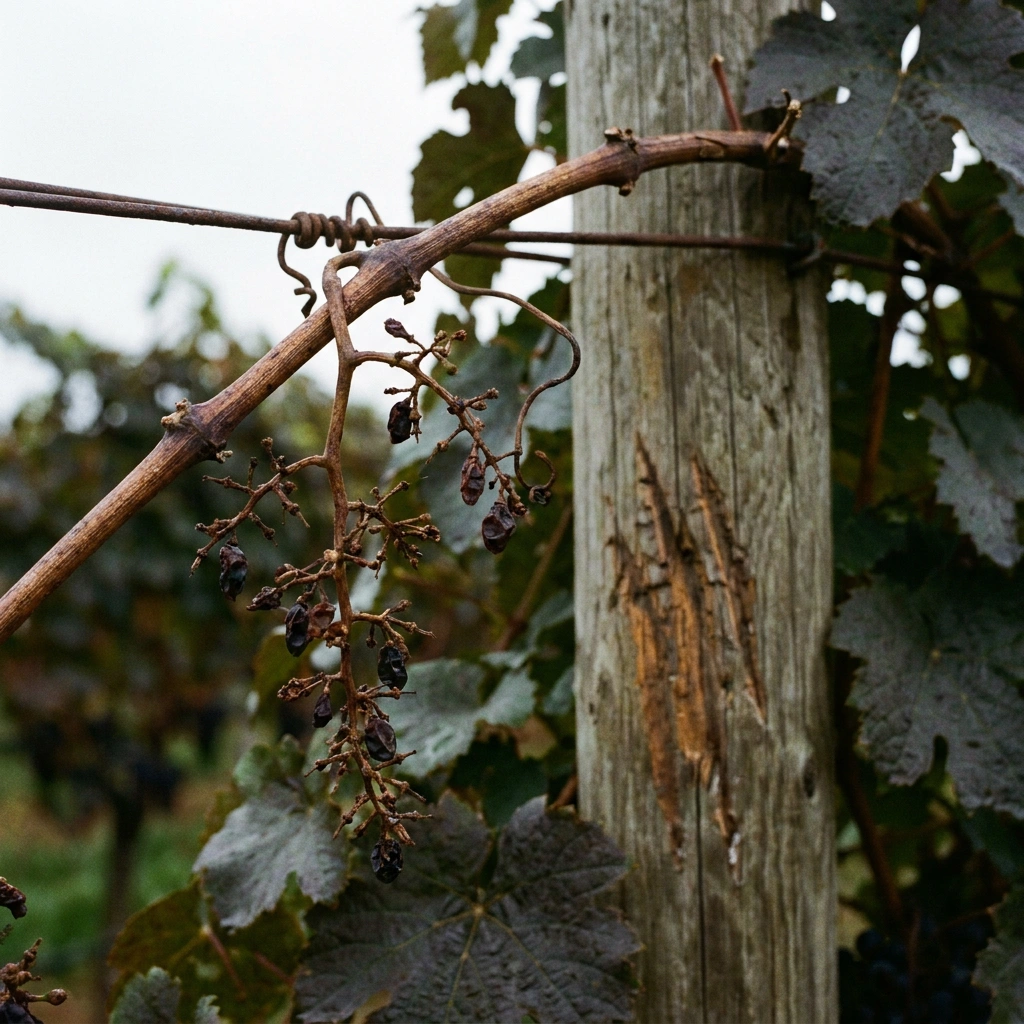
- Wasps and yellowjackets: Individual berries hollowed out with a small entry hole, the papery skin often still hanging on the stem. Almost always starts on berries that were already split, overripe, or pecked by a bird.
- Squirrels and chipmunks: A grape missing here, a bitten-and-dropped one there, spread across several clusters rather than one cluster stripped clean. They tend to sample and move on rather than settle in.
Deer: The Animal Most Home Growers Under-Build For
Deer damage grapevines two ways: browsing tender shoots and leaves in spring – which can set a young vineyard back a full season – and going after ripening clusters as harvest gets close. Because deer lack upper incisors, they tear and shred plant tissue rather than clipping it cleanly, which is the easiest way to rule out rabbits or rodents (Rutgers Cooperative Extension, Plant & Pest Advisory).
Standing on their hind legs, a whitetail can browse up to roughly 6 ft (1.8 m) off the ground, and University of Minnesota Extension notes that browse line can push closer to 9 ft (2.7 m) when deer are working from a deep snowpack. A standard vertical-shoot-positioned trellis puts the fruiting wire around 3 ft (0.9 m) and the canopy well within that range – so almost any home vineyard is an easy reach for a hungry deer.
The Fence Height That Actually Works
This is where most home growers under-build. A 4 ft (1.2 m) garden fence or a drape of bird netting will not stop a deer – they’ll either jump it or push through and tear the material doing it. Rutgers Cooperative Extension and Cornell Cooperative Extension both put the minimum for a true exclusion fence at 8 ft (2.4 m) of woven wire, forming a complete enclosure with no gaps at gates and the bottom pulled tight to the ground so deer can’t crawl under. UC IPM’s guidelines for grape describe the same target a different way: 6 ft (1.8 m) of woven wire topped with a few strands of smooth or barbed wire to bring the total to 7-8 ft (2.1-2.4 m).
For young vines specifically, individual wire mesh cylinders at least 6 ft (1.8 m) tall around each plant protect new growth without fencing the whole planting – a reasonable option if you only have a handful of vines and deer pressure is moderate. For a full planting, a temporary electric fence (solar or battery powered) costs less to install than woven wire and can be moved or taken down between seasons, though it needs more upkeep and a hot, checked line to stay effective.
Raccoons: Climbers That Work Fast, Right Before Harvest
Raccoons are strong climbers and will go straight up a trunk or trellis post to reach fruit, the same way UC IPM describes them climbing cornstalks to reach ears. Damage tends to appear suddenly and close to harvest – UC IPM’s pest notes on raccoons single out sweet corn as a favorite target and note that damage “usually occurs right before harvest,” and grapes tend to follow the same pattern: fine one evening, clusters gone by morning.
Because they’re working at night and are strong enough to pull a cluster free rather than pecking at it, raccoon damage is the animal damage most likely to be confused with theft. Claw marks on wooden posts, smooth worn patches on bark where they’ve climbed repeatedly, and broken canes near the trunk are the tells.
Electric Fencing and Timing
UC IPM’s pest notes on raccoons describe a low two-wire electric fence as effective for excluding them from highly preferred crops: one wire about 6 in (15 cm) above the ground and a second about 12 in (30 cm) above it, run on evenly spaced posts around the planting. The charger only needs to be active from dusk to dawn, which keeps running cost down and avoids any risk to people working the rows during the day.
Timing your picking matters just as much as the fence. Since raccoon damage concentrates in the days right before you’d harvest anyway, picking a little earlier than you’d ideally like – once fruit is ripe but before it’s dead ripe – can mean the difference between a full crop and an empty row.
Wasps and Yellowjackets: A Secondary Problem, Not a Primary One
This is the part worth slowing down for, because it changes what you should actually do. Wasps and yellowjackets are usually opportunists rather than the ones who open the fruit first. Researchers at the University of Georgia Extension viticulture program put it plainly: wasps are “usually attracted initially to damaged fruit,” meaning healthy, intact grapes are less susceptible in the first place. University of Wisconsin-Madison entomology research on Wisconsin vineyards backs up the general pattern but is more careful about how absolute it is – the researchers describe wasps as “often reported as secondary pests utilizing pre-existing holes,” while also noting that wasps have been documented inflicting direct damage to sound, undamaged clusters. In practice, a bird peck, a rain-driven split in an over-ripe berry, or existing bird or insect damage is what opens the door most of the time – the wasps just move in after.
That means the highest-leverage fix isn’t bait or traps, it’s reducing the damage that invites them: address bird pecking, pick promptly once fruit is ripe rather than letting it hang and over-ripen, and remove any split or damaged berries you spot instead of leaving them on the vine. That prompt-picking advice matches general guidance from Iowa State University Extension and Outreach on yellowjacket and paper wasp management: pick fruit as soon as it ripens and clear out overripe or damaged fruit that could draw wasps in.
If You Do Trap: Get the Bait Right
Wasp bait preference genuinely changes over the season, and getting it backwards means an empty trap. Per UC IPM’s pest notes on yellowjackets and social wasps, colonies are raising larvae from spring through midsummer and workers forage mainly for protein to feed them. By late summer, colony growth slows or stops – there are no more larvae to feed – and foraging workers switch hard to sugar to fuel themselves and the next season’s queens. So: protein bait (deli meat, canned fish) earlier in the season, sweet or fermented bait (fruit juice, a splash of flat beer) once you’re into late summer and harvest. Traps work best as a supplement to fruit protection, not a replacement for it – they reduce foraging pressure in the area, but they won’t stop a wasp from investigating fruit that’s already split.
Protect the Fruit: Bags and Sleeves for a Home Vineyard
Since deer, raccoons, wasps, and squirrels are all, in different ways, responding to exposed and accessible fruit, physically covering individual clusters is one of the few controls that helps against several of them at once. Slip a mesh organza bag – roughly 4 x 6 in (10 x 15 cm) works for most clusters – over each bunch once berries have set, and tie or twist-tie it closed around the stem. The mesh lets in air and light so ripening isn’t affected, but it denies wasps a berry to hollow out, makes a squirrel work harder for a single grape, and removes the visual and scent cue that draws raccoons to a specific cluster.
It won’t stop a deer from browsing the shoot the cluster is hanging from, and it won’t exclude a raccoon determined enough to pull the whole cane down – for those two, fencing is still the real answer. But for a small home planting where wasps and opportunistic sampling are the main irritant, bagging is a low-tech method that costs little and takes an evening to set up.
Our pick: reusable mesh organza bags in the 4 x 6 in (10 x 15 cm) size, one per cluster. Check current options on Amazon (fruit protection bags). If deer or raccoons are the bigger problem for your vines, a temporary electric fence kit is the better first purchase – see the fence sections above for the specs to look for.
Squirrels and Chipmunks: Low Damage, High Annoyance
Squirrels and chipmunks rarely do the kind of crop-ending damage deer or raccoons can. The University of California Master Gardener Program describes tree squirrels taking a single bite of ripe fruit and tossing the rest aside rather than eating it through – the same sampling habit shows up on grapes, just at the scale of one berry instead of one plum. Chipmunks forage more broadly across bulbs, seeds, and berries near ground level and rarely climb a full trellis the way squirrels do (University of Wisconsin Extension, chipmunk and ground squirrel ecology).
If this is your only pressure, the organza bags above are usually enough – there’s no need to fence a whole planting for a problem that’s more cosmetic than costly.
A Note on Trapping, Shooting, or Relocating Wildlife
Rules on trapping, relocating, or removing deer, raccoons, or other wildlife vary by state and even by county, and most require a permit. Before doing anything beyond fencing, bagging, or scaring tactics, check with your state wildlife agency or local extension office for what’s legal where you are.
Frequently Asked Questions
What’s eating my grapes if it isn’t birds?
The most common culprits are deer (torn shoots and browsed leaves), raccoons (whole clusters stripped or pulled down, usually right before harvest), wasps and yellowjackets (individual berries hollowed out, almost always starting on fruit already split or pecked), and squirrels or chipmunks (single berries missing across several clusters). Matching the pattern to the list above will usually tell you which one you’re dealing with.
How tall does a deer fence need to be for grapevines?
Plan on 8 ft (2.4 m) of woven wire as a true exclusion fence, per Rutgers Cooperative Extension and Cornell Cooperative Extension. UC IPM’s grape guidelines describe an equivalent option: 6 ft (1.8 m) of woven wire with a few added strands on top to bring the total to 7-8 ft (2.1-2.4 m). Whatever height you use, the fence has to form a complete enclosure with the bottom tight to the ground, or deer will find the gap.
Do wasps cause the first damage to my grapes, or do they just show up after?
Usually, yes – they show up after. University of Georgia Extension describes wasps as opportunists usually drawn first to berries already split, over-ripe, or pecked by birds, and University of Wisconsin-Madison entomology research on vineyard wasps largely agrees, though it notes wasps have also been documented damaging sound, undamaged clusters directly. That’s why protecting the fruit (bagging, prompt picking, addressing bird damage) works better long-term than trying to bait or trap your way out of a wasp problem.
What bait works best for wasp traps near grapes?
It depends on the time of year. UC IPM’s pest notes on yellowjackets and social wasps explain that colonies forage mainly for protein in spring and early-to-mid summer, while raising larvae, then switch to sugar-seeking by late summer once colony growth slows. So use a protein bait (deli meat or canned fish) earlier in the season and a sweet or fermented bait (fruit juice, flat beer) once you’re into late summer and harvest. Traps help reduce pressure but work best alongside fruit protection, not instead of it.
Will an electric fence stop raccoons from getting into my vines?
A properly set low electric fence is the most reliable non-lethal method, according to UC IPM’s pest notes on raccoons: two wires, one about 6 in (15 cm) above the ground and a second about 12 in (30 cm) above it, with the charger running from dusk to dawn. It needs to form a complete perimeter with no gaps, since raccoons are persistent and will find and use any opening.
🍇 Don’t plant the wrong grape
Vines take years to fruit. Get the free cheat-sheet of varieties that actually survive and ripen in your zone.
By subscribing you agree to our Privacy Policy.