When grape berries shrivel on the vine, most home growers assume black rot. In practice, black rot mummies are only one of several causes, and often not the most likely one. The fastest way to sort them out is to check three things: where on the cluster the shriveling started, whether the stem (the rachis) is dead or discolored, and what the berry surface looks like up close – hard and dark, leathery and sunken, or just uniformly wrinkled like a raisin.
This page covers the causes worth ruling in or out: black rot mummies, bunch stem necrosis, sunburn, late-season raisining, frost damage, and water stress. For other vine symptoms – yellowing leaves, no fruit, wilting canes – see the grape vine problems diagnostic guide.
Three Quick Checks Before You Panic
Before you dig into any single cause, look at the cluster (or clusters) with these three questions in mind. Between them they rule out most of the wrong guesses in under a minute.
- Where did it start? Scattered single berries across many clusters, one damaged patch on one side of a cluster, the whole cluster from the stem down, or the entire crop uniformly – each points somewhere different.
- Is the stem (rachis) affected? A dark, sunken, dying stem section above shriveled berries is a specific and useful clue – it rules out sunburn and simple overripening, which never touch the stem.
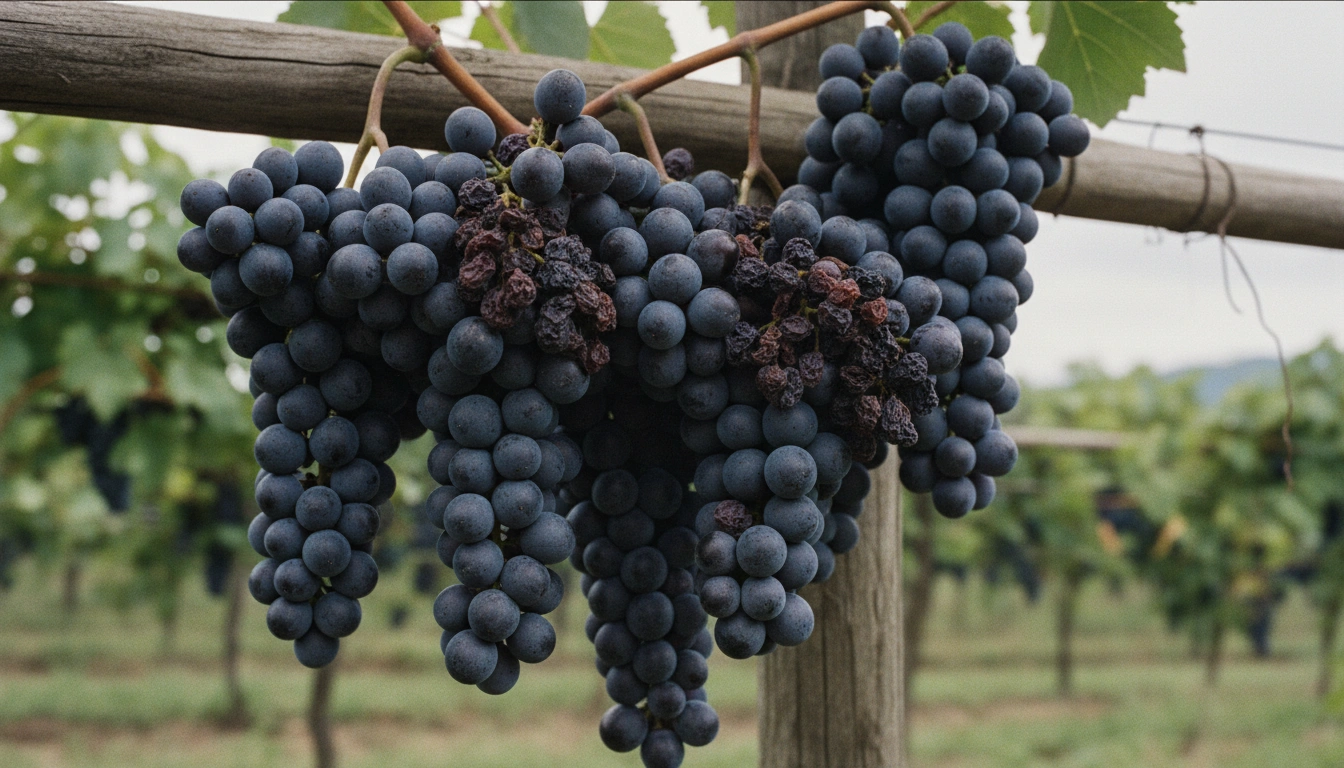
- What does the berry surface look like? Hard, wrinkled, blue-black (sometimes with tiny black dots) means a mummy. A brown, leathery, sunken patch means sun damage. A dull, water-soaked look means recent freeze injury. Uniform wrinkling with no lesion anywhere means the fruit is just overripe.
Black Rot Mummies (the One Everyone Assumes)
Black rot, caused by the fungus Guignardia bidwellii, is real and it does shrivel fruit – but it leaves a specific signature. Infected berries start as a soft brown spot, usually when they’re pea-sized or larger, then within about a week turn entirely brown and shrivel into a hard, wrinkled, blue-black mummy. Those mummies can hang on the cluster all season. Look closely and you’ll often see tiny black dots inside the discolored tissue – those are pycnidia, the fungus’s fruiting bodies, and they’re the single most reliable confirmation. Check nearby leaves too: tan spots about 1/8 to 1/4 inch (3-6 mm) across with a dark brown or black margin are the matching leaf symptom.
Mummies are dry and hard all the way through, and the disease usually shows up on more than one cluster in a wet bloom season. Full identification, spray timing, and sanitation are on the dedicated black rot guide rather than repeated here. White, powdery leaf patches instead of tan spots point to a different disease – see the powdery mildew guide.
Bunch Stem Necrosis: the Stem Dies, Then the Berries Below It
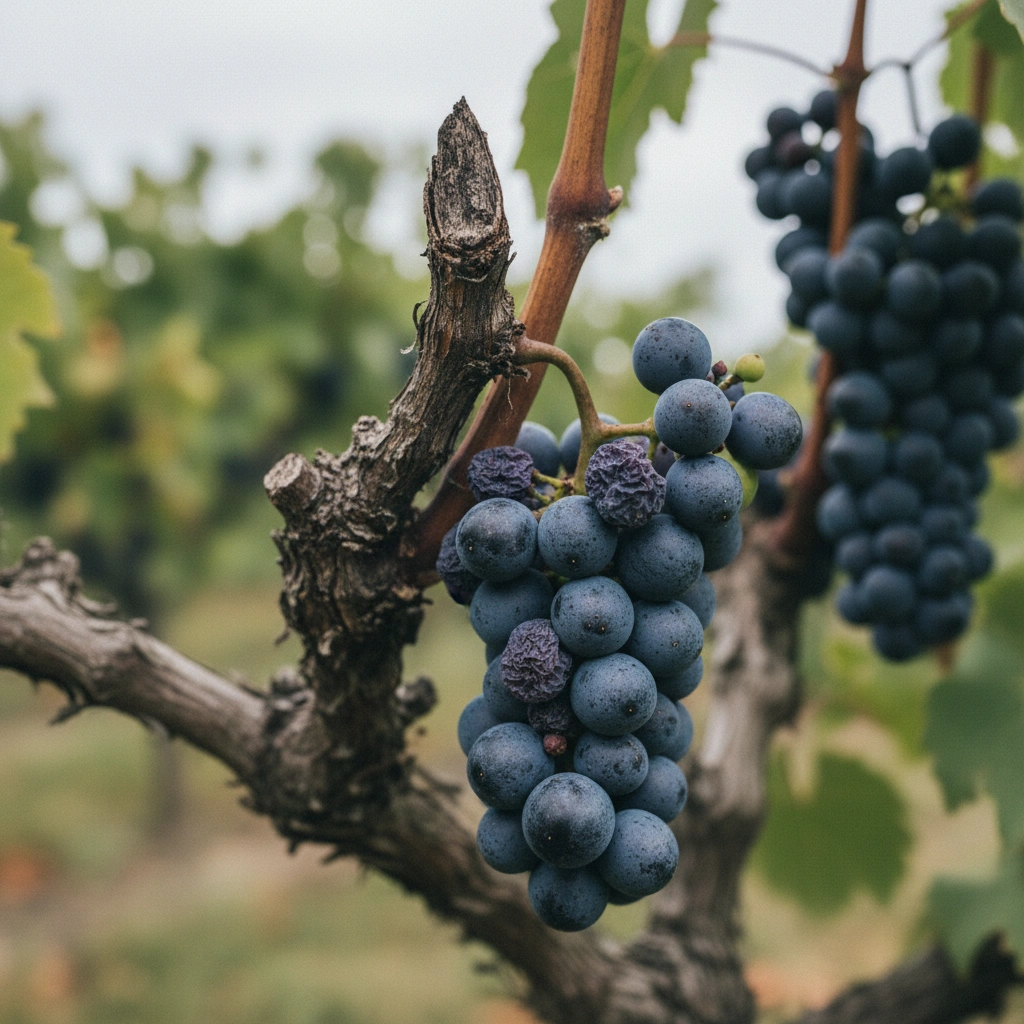
This is the cause that surprises people most, because the vine looks completely healthy otherwise. Bunch stem necrosis (sometimes called late bunch stem necrosis when it shows up close to harvest) is not a disease at all – no pathogen is involved, and fungicide sprays do nothing for it. According to Wisconsin Fruit (University of Wisconsin-Madison Extension), it shows up as sudden shriveling of berries and wilting of clusters, typically two to three weeks before harvest, on vines with otherwise disease-free fruit.
The mechanism is what makes it identifiable: sections of the rachis (the woody stem structure holding the cluster) develop dead tissue that blocks water and sugar movement. The stem itself shrivels first, and berry shrivel follows right behind it, limited to whatever is downstream of the blocked section. That’s why you’ll sometimes see a shriveled shoulder or tip on one cluster while the rest of that same cluster, and every other cluster on the vine, looks fine. University of Minnesota Extension research on Minnesota vineyards has documented the same pattern and also noted aerial roots forming on cordons of affected vines – a sign of underlying vine stress.
Suspected triggers, per Wisconsin Fruit and UMN Extension, include cool, wet weather after veraison, excess soil moisture or poor drainage, and general vine stress. Mineral nutrition has long been suspected too, but a preliminary season of UMN vineyard surveys found no evidence of nutrient deficiency at the Minnesota sites studied. There’s no spray or fix once symptoms appear – the practical response is improving drainage and canopy airflow for future seasons, not treating the current crop.
Sunburn and Heat Dehydration
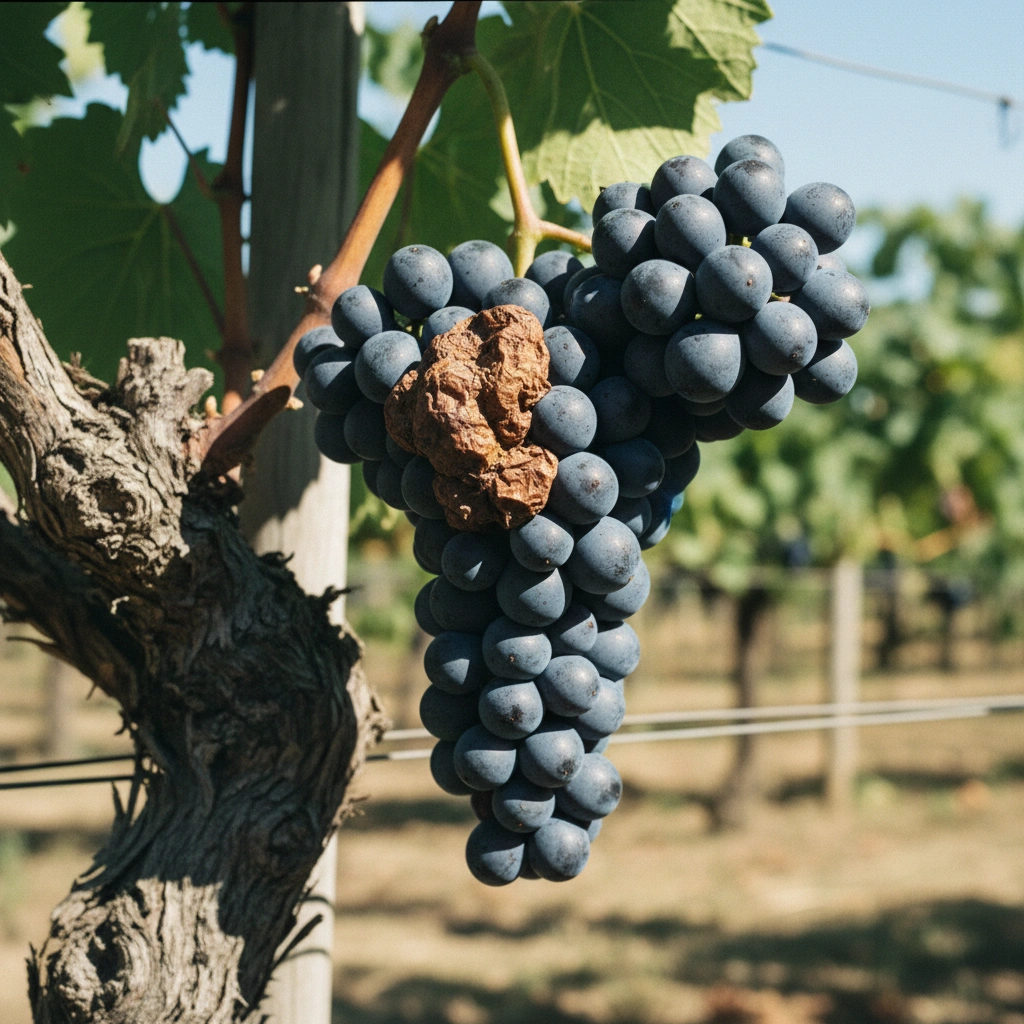
Sunburn is a heat and light injury, not a disease, and it’s easy to place once you know what to look for: it follows the sun. UC IPM (University of California Statewide Integrated Pest Management Program) describes sun-exposed fruit browning on the epidermis and, in severe cases, fully desiccating. In practice that means a brown, leathery, sunken patch on the side of the berry or cluster that faced the afternoon sun – the shaded side of the same cluster is usually untouched.
This is most common right after aggressive leaf pulling exposes fruit that hasn’t had time to acclimate to direct light. UC IPM notes that when leaves are removed earlier, at fruit set, berries have time to develop a thicker cuticle and tolerate sun exposure better than fruit suddenly exposed later in the season. Heat waves compound the problem: high canopy temperature combined with water stress can shrivel and raisin fruit even without a visible burn patch, because the vine simply can’t keep up with fruit water loss.
How to tell it apart: sunburn damage lines up with sun exposure – it’s on the west- or south-facing side of the canopy, or on clusters you recently exposed by pulling leaves. There’s no stem lesion, no black dots, and no wet-weather timing the way there is with black rot or bunch stem necrosis.
Late-Season Raisining (Your Grapes May Just Be Overripe)
Sometimes the honest answer is that nothing is wrong – the fruit hung on the vine past its peak. Once grapes are fully ripe, they keep losing water through the skin while sugar concentration climbs, and given enough time on the vine they’ll wrinkle into something that looks a lot like a raisin. This affects the whole cluster and usually the whole crop fairly evenly, including berries that were never in direct sun, and there’s no dark lesion anywhere – the fruit still smells sweet, not moldy or fermented.
This is more likely if you delayed harvest to chase a higher Brix reading, or if a stretch of bad weather pushed your picking date back. It’s also more likely toward the end of a short growing season, when there isn’t much time margin left before the fruit has to come off. See how to know when grapes are ready to harvest for how to judge ripeness before this becomes a problem next year. Slightly raisined fruit is still usable for juice or wine – it just concentrates sugar and flavor further, which is the entire idea behind late-harvest and straw wine styles. Badly split or moldy fruit is a different matter and should be cut out.
Winter or Frost Damage
If a frost or freeze hits before your fruit is fully ripe, it stops ripening on the spot. Penn State Extension and other cold-climate extension sources note that grapes caught by frost while still hanging need to be harvested promptly, because they will not continue to develop sugar after that point. The visible damage typically shows up over the day or two following the cold snap: ice crystals forming in the berry tissue pull water out of the cells and damage them, so affected fruit first looks dull and water-soaked, then collapses and shrivels as it loses structure.
How to tell it apart: timing is the giveaway – the damage appears right after a specific frost event (below 32°F / 0°C), not gradually over weeks. It tends to hit whole sections of the vineyard at once, especially low spots where cold air pools (“frost pockets”), rather than isolated single clusters. Nearby leaves and young shoots often show frost damage too – blackened, wilted, water-soaked patches – which you won’t see with bunch stem necrosis or sunburn.
Water Stress and Drought
Grapevines are fairly drought-tolerant, but a prolonged dry stretch combined with heat can outpace what the roots supply. UC IPM links high heat plus water stress to reduced berry size and shriveling, since the vine can’t move enough water into the fruit to offset what’s evaporating through the skin. Unlike bunch stem necrosis or sunburn, water stress shows up across the whole vine, not one cluster or side: look for wilting or curling leaves and dry soil at the root zone alongside the shriveled fruit.
Our pick: before you assume disease, check actual soil moisture a few inches down near the root zone rather than guessing from the surface. A simple soil moisture meter takes the guesswork out of it and tells you in seconds whether drought stress is even plausible.
If the soil is genuinely dry, a deep, infrequent watering beats a light daily sprinkle – it encourages roots to grow down into moisture instead of staying shallow.
Side-by-Side: How to Tell Them Apart
| Cause | Where it starts | Stem affected? | Berry surface |
|---|---|---|---|
| Black rot mummy | Individual berries, often several clusters | Not usually the main symptom (occasional small lesions on young shoots early in the season; leaves show separate tan/black-margin spots) | Hard, wrinkled, blue-black; often tiny black dots (pycnidia) |
| Bunch stem necrosis | One cluster’s tip/shoulder, sometimes whole cluster | Yes – dark, dying rachis above the shrivel | Shriveled but no black dots or hard mummy texture |
| Sunburn | Sun-facing side of cluster or canopy | No | Brown, leathery, sunken patch |
| Late-season raisining | Whole cluster, whole crop, fairly evenly | No | Uniformly wrinkled, sweet smell, no lesion |
| Frost/freeze damage | Whole exposed section, right after a cold snap | Nearby leaves/shoots often frost-damaged too | Dull, water-soaked, then collapsed |
| Water stress | Whole vine, tied to dry soil/heat | No | Shriveled/raisined; leaves also wilting |
When to Actually Worry
Treat it as disease and act (remove mummies, plan a spray program) only when you see the black rot signature: hard, dark, wrinkled mummies, ideally with pycnidia, plus matching leaf spots. A dead stem above otherwise-normal fruit is bunch stem necrosis – nothing to spray. Damage tracking sun exposure, recent frost, dry soil, or a long hang time is environmental, and next year’s fix is cultural (shade management, drainage, timely harvest, deep watering), not chemical.
For symptoms elsewhere on the vine – yellowing or reddening leaves, small berries, no fruit at all, or dead-looking canes – the grape vine problems diagnostic guide covers the full symptom-to-cause table.
Frequently Asked Questions
Why are my grapes shriveling but the rest of the vine looks completely healthy?
That pattern points away from disease and toward bunch stem necrosis, sunburn, or simple overripening – all of which can shrivel fruit on an otherwise healthy-looking vine. Black rot and most fungal diseases usually leave matching symptoms on leaves or canes as well, so if you only see damage on the fruit, check the stem just above the shriveled berries for a dead, sunken section before assuming disease.
How do I tell bunch stem necrosis apart from black rot?
Look at the stem and the berry surface. Bunch stem necrosis kills a section of the rachis first, and the berries downstream of that dead section shrivel but stay relatively soft, with no black dots. Black rot mummies are hard, wrinkled, and blue-black, often with visible pycnidia (tiny black fruiting bodies), and the stem itself usually isn’t the primary symptom – matching leaf spots are.
Is bunch stem necrosis a disease I need to spray for?
No. It’s a physiological disorder, not caused by a pathogen, and extension sources are clear that fungicides don’t treat it. The practical response is improving drainage and canopy airflow going forward, not spraying the current crop.
Can I still use shriveled or raisined grapes?
Late-season raisining from simple overripening is fine to use – it just concentrates sugar further, which is the basis of late-harvest wine styles. Cut off sunburned patches and use the rest. Black rot mummies and anything shriveled with mold or a sour, fermented smell should be discarded rather than pressed or eaten.
What should I do if frost hits before my grapes are ripe?
Harvest as soon as practical. Extension guidance is consistent that frost-caught fruit stops ripening – sugar accumulation doesn’t resume after a killing frost, so leaving it on the vine hoping it will finish ripening doesn’t work, and continued exposure only adds further freeze damage.
🍇 Don’t plant the wrong grape
Vines take years to fruit. Get the free cheat-sheet of varieties that actually survive and ripen in your zone.
By subscribing you agree to our Privacy Policy.