Grape vines are not heavy feeders, and in most home vineyard situations less fertilizer is better than more. The first step is always a soil test and a look at your vines – shoot length, leaf color, and overall vigor tell you far more than any generic fertilizing schedule. For most established vines, a modest layer of compost in spring is all the nutrition they need. Over-fertilizing, especially with nitrogen, is one of the most common mistakes home growers make, and in cold climates it can cost you a whole year of hardening.
Heavy feeding in late spring can give you a gorgeous, lush canopy, but vines that keep growing late into fall may barely harden before a hard freeze. Fertilize with a light hand, back it with soil tests, and let the vines tell you what they need.
Why Over-Fertilizing Hurts Grapes
Grapes evolved in lean, well-drained soils – think rocky hillsides in France, not a pampered garden bed. Push them with excess nutrition, especially nitrogen, and several problems follow:
- Excessive vegetative growth. The vine puts energy into shoots and leaves rather than fruit. Canopy becomes dense, shading out clusters and reducing air circulation, which invites fungal disease.
- Delayed or uneven ripening. Dense shade from over-grown canopy means clusters stay cooler and ripen weeks later – a serious problem in short-season climates.
- Poor fruit quality. Excess nitrogen reduces berry color, flavor complexity, and sugar accumulation.
- Reduced winter hardiness. Perhaps most critical for Zones 3-6: vines that keep growing late into the season don’t harden off properly. Late soft wood is vulnerable to early freezes that a well-hardened vine would shrug off. University of Minnesota Extension specifically warns growers to avoid late-season nitrogen for exactly this reason.
The bottom line from Cornell, UMN, and Penn State extension sources is consistent: if vine vigor is already adequate, adding nitrogen can hurt more than help.
Start With a Soil Test (and Read the Vine)
Before you buy a single bag of fertilizer, do two things: get a soil test and look at your vines.
Soil test: A basic test from your state extension service (usually $15-25 / €14-23) tells you pH, organic matter, phosphorus, potassium, and often magnesium. This is the only reliable way to know what your soil actually needs. Grapes prefer a pH of about 5.5-6.5; outside that range, nutrients become less available regardless of what you add. Testing every 3-4 years removes the guesswork entirely.
Read vine vigor: Shoot length is your single best proxy for nitrogen status, according to extension viticulture guidelines. Healthy, adequate-vigor vines produce shoots around 3-5 ft (0.9-1.5 m) by mid-season. If shoots are much longer, the vine has plenty of nitrogen and adding more will only cause problems. If shoots are short and leaves are pale or yellowish, low nitrogen may be a contributing factor – but check soil moisture and drainage first, because those cause similar symptoms.
If you have questions about whether your soil is set up correctly before you start feeding it, our guide on how to prepare your soil and plant a grape vine covers the basics of getting the foundation right.
A reliable soil test kit can tell you pH, nitrogen, phosphorus, and potassium levels before you spend money on fertilizer. Browse soil test kits and grape fertilizers on Amazon →
Nitrogen: Timing, Amount, and When to Skip It
Nitrogen is the nutrient most likely to cause problems when applied carelessly, and it’s the one that needs the most thoughtful timing.
Young Vines (Years 1-3)
Young vines are still establishing their root system and do benefit from a small, targeted nitrogen application to help them grow into their trellis space. UMN Extension recommends modest amounts – on the order of 1-2 oz (28-56 g) of actual nitrogen per vine per year for young vines. A balanced granular fertilizer or a topdressing of compost in early spring works well. Apply it around bud break, not before, and do it once.
Established Vines
Once a vine is mature and filling its allotted trellis space, the question is whether to apply nitrogen at all – not how much to apply. If shoots are reaching their target length and leaves are deep green, your soil likely has adequate nitrogen from organic matter and you can skip it entirely for the year. If vigor seems genuinely low after ruling out other causes, a light spring application around bud break is appropriate.
When you do apply nitrogen to established vines, keep the rate modest. A reasonable starting point is about 1.5-3 oz (40-85 g) of actual nitrogen per mature vine when a soil test or weak vigor calls for it — and many established vines need none. Always defer to your soil test result and vine response rather than applying by default.
Timing: Spring Only
Apply nitrogen once, in spring, at or just after bud break when shoot growth begins. This is when the vine can actually use it efficiently. Avoid any nitrogen application after midsummer – and in cold climates, stop by late May or early June at the absolute latest. Cornell’s viticulture resources echo this: late-season nitrogen interferes with the natural hardening-off process that prepares the vine for winter cold.
Want more context on what drives cluster production? Our article on how to produce more grape clusters covers the full picture, including how vigor management affects fruiting.
Potassium, Phosphorus, Magnesium, and Micronutrients
These should all be applied based on soil or tissue test results, not by default. Here’s what the research says about each:
Potassium (K)
Potassium is important for fruit quality, disease resistance, and winter hardiness. Grapes are relatively heavy users of potassium compared to nitrogen. If your soil test shows potassium levels are low or marginal, amending with sulfate of potash or wood ash (which is high in K) makes sense. Too much potassium, however, can interfere with magnesium uptake, so more is not better here either.
Phosphorus (P)
Phosphorus deficiency is uncommon in established vineyards unless soil pH is very low (which locks it up) or the soil is genuinely depleted. Most soils that have had compost or organic matter added have adequate phosphorus. Apply only if a soil test specifically shows a deficit.
Magnesium (Mg)
Magnesium deficiency shows up as interveinal chlorosis – leaves turn yellow between the veins while the veins stay green. This is more common on sandy, light soils or where high potassium has pushed out magnesium. Dolomitic limestone (when you need to raise pH anyway) or Epsom salt as a foliar spray are common corrective options per Penn State Extension recommendations.
Micronutrients (Boron, Zinc, Manganese)
Micronutrient deficiencies are usually site-specific and show up in tissue tests (leaf petiole analysis) more reliably than standard soil tests. Boron deficiency can cause poor fruit set; zinc affects leaf development. If you’re seeing persistent problems despite adequate macro-nutrition, a tissue test is worth doing. Don’t apply micronutrients without evidence of deficiency – excess boron in particular is toxic to vines.
Organic Options: Compost, Manure, and Cover Crops
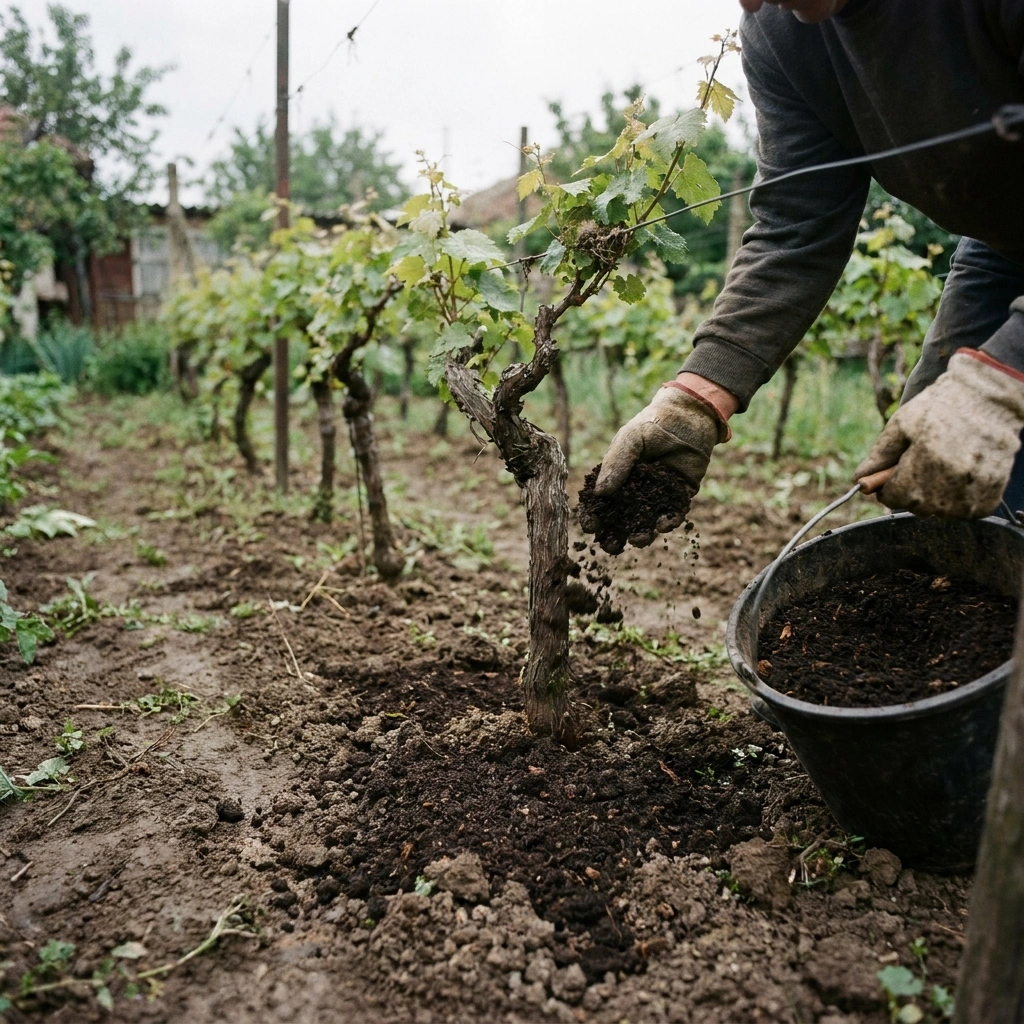
For most home vineyards, organic matter is the most forgiving and beneficial “fertilizer” you can apply. It slowly releases a balanced range of nutrients, improves soil structure and water retention, and feeds soil biology that makes nutrients more available to the vine’s roots.
- Aged compost: Apply 1-2 inches (2.5-5 cm) as a topdress around the vine, keeping it a few inches away from the trunk. Work it in lightly or let rain incorporate it.
- Aged manure: Well-aged (not fresh) chicken, horse, or cow manure is a good source of balanced nutrition. Fresh manure risks burning roots and can introduce pathogens to fruit. Let it compost for at least 6-12 months before using near vines.
- Balanced granular fertilizers: Products labeled for vegetables and fruits (e.g., 5-5-5 or 10-10-10) are suitable if compost alone isn’t enough. Follow label rates for fruit crops, which are typically more conservative than vegetable rates.
- Cover crops: Leguminous cover crops like clover mowed under can add modest nitrogen to the system without an abrupt nutrient spike. This is more of a long-game strategy for larger plots.
For more on improving the soil environment your vines grow in, see our piece on soil aeration methods for grapevines – good aeration makes nutrients more accessible regardless of what you apply.
The Cold-Climate Caution
If you’re growing in Zones 3-6 – northern US, Canada, northern Europe – the cold-climate dimension of fertilizing deserves special attention. In warmer regions, over-fertilizing is mostly a fruit quality and yield problem. In cold climates, it can become a vine survival problem.
Any practice that keeps vines growing vigorously late into the season – excess nitrogen, excessive irrigation, heavy crop load – slows the hardening process. Grapevines harden off in fall by going through a series of physiological changes that allow them to tolerate cold. Canes that are still growing actively when the first hard freeze arrives haven’t completed that process, and the resulting winter injury can set a vine back by years.
Hardy hybrid varieties like Marquette, Frontenac, La Crescent, and Itasca (bred at UMN specifically for Zones 3-5) have better genetic cold hardiness than V. vinifera cultivars, but they still need to harden off properly. Even Marquette, rated to about -30°F (-34°C) under ideal conditions, will suffer unnecessary cane death if it’s still pushing growth in late September because you fertilized in August.
A good rule of thumb: no nitrogen after the summer solstice in Zone 4. If the vine still looks like it needs something in July, look for causes other than nitrogen – drainage, soil pH, compaction. Our article on organic vineyard site selection goes deeper on choosing and managing a site that naturally supports balanced vine growth, and our notes on soil aeration for grapevines cover compaction issues that can mimic nutrient problems.
Frequently Asked Questions
How often should I fertilize grape vines?
Most established grape vines need fertilizer only once a year, if at all. Apply a modest amount of nitrogen in early spring around bud break, then let the vine tell you whether more is needed by watching shoot length and leaf color. Over-fertilizing is a more common mistake than under-fertilizing.
What is the best fertilizer for grape vines?
The best fertilizer is whatever your soil test says you need. For most home vineyards, a couple of inches of aged compost worked into the soil around the vine each spring is enough. If a soil test shows a specific deficiency, a balanced granular fertilizer (10-10-10 or similar) or a targeted amendment for potassium or magnesium may be appropriate. Avoid high-nitrogen fertilizers unless your vines are clearly showing low vigor.
Can I use lawn fertilizer on grape vines?
No. Lawn fertilizers are typically high in nitrogen, which pushes lush vegetative growth in grapes at the expense of fruit production, ripening, and winter hardiness. Use a fertilizer formulated for fruit crops, or better yet, rely on compost and a soil test to guide any amendments.
When should I stop fertilizing grape vines?
Stop any nitrogen fertilization by midsummer at the latest. In cold climates (Zones 3-6), aim for no later than early June. Late-season nitrogen keeps vines growing when they should be slowing down and hardening off, which increases the risk of winter injury to canes and buds.
Do young grape vines need more fertilizer than mature ones?
Young vines (first 1-3 years) benefit from a small amount of nitrogen to help them establish, but the amounts are quite modest – typically 1-2 oz (28-56 g) of actual nitrogen per vine per year. Mature, established vines often need little or no supplemental nitrogen; the priority shifts to maintaining balanced soil nutrients and monitoring vine vigor rather than pushing growth.
🍇 Don’t plant the wrong grape
Vines take years to fruit. Get the free cheat-sheet of varieties that actually survive and ripen in your zone.
By subscribing you agree to our Privacy Policy.