If your grapes are sour and staying that way, the most likely explanation is that they simply have not finished ripening yet – color change happens well before sugar peaks, and that is the single most common reason gardeners think grapes are “done” when they are not. After that, the next most likely culprits are overcropping, a growing season too short for the variety, and heavy shade over the fruit zone. And for cold-hardy hybrids specifically, some of that tartness is simply the variety doing what it was bred to do – these vines carry genetics for winter survival, not for matching the sugar-to-acid balance of a warm-climate wine grape.
This question shows up every August and September: the grapes have turned color – purple, red, blue-black, whatever the variety calls for – and they still taste like something between a green apple and a lemon. It is one of the more common frustrations in cold-climate growing, and also one of the more misunderstood, because color is doing a lot of misleading work. Below is what university extension research says is actually going on, reconciled against the Brix and acidity numbers already published on this site, plus how to tell “not ripe yet” from “this variety is just tart” by measuring instead of guessing.
Your Grapes Are Probably Not Actually Ripe Yet
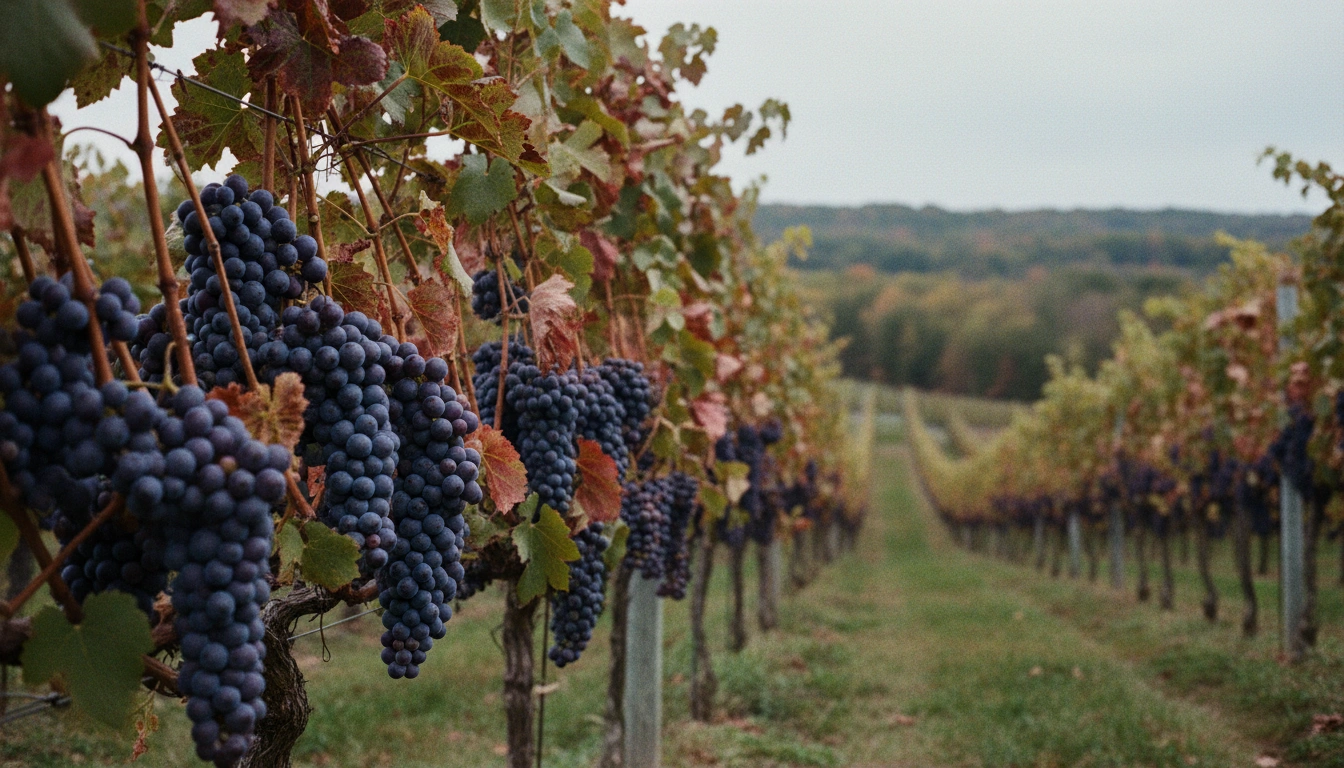
Color change in grapes – called veraison – marks the start of the ripening phase, not the end of it. Once berries switch from green to their variety’s ripe color, they still need several more weeks on the vine to finish accumulating sugar and shedding acid. A grape that looks fully colored in early August can genuinely be weeks away from a workable Brix reading, especially in a cold-climate season where cool nights slow sugar accumulation even after color break is complete.
This is why color alone is such an unreliable ripeness signal, and why the full harvest-readiness checklist on this site leans on seed color, stem lignification, and taste alongside an actual Brix reading rather than skin color by itself. If your grapes are colored but sour, the honest first assumption should be “not ripe yet,” not “something is wrong.”
Other Reasons Your Grapes Might Stay Sour
Overcropping Stalls Ripening
A vine has a fixed amount of leaf area, and leaf area is what produces the sugar that ripens fruit. When a vine is carrying far more clusters than its canopy can support, every cluster gets a smaller share of that sugar and none of them fully ripens on schedule. University of Minnesota Extension recommends estimating crop load shoot by shoot and dropping the weakest clusters at veraison if the vine is clearly overloaded – most home vineyards do better carrying one to two clusters per shoot rather than three or four.
Not Enough Season for the Variety
Every grape variety has a heat requirement, tracked as growing degree days (GDD, base 50°F / 10°C) from budburst to harvest. A cool spring, an overcast summer, or simply planting a variety that needs more heat than your site reliably provides can leave a vine several hundred GDD short by the end of the season – and a vine that is short on GDD is a vine that is short on ripening, acid included. Use the Will My Grapes Ripen? GDD calculator on this site to check whether your variety and location are actually a realistic match before assuming something else is wrong.
Shade and Leaf-Area Problems
Fruit sitting in shade ripens more slowly and holds onto more acid than fruit with direct sun exposure – a dense, unmanaged canopy does this even on a vine that is not technically overcropped. A tight canopy also traps humidity around the clusters, which compounds disease pressure on top of the ripening delay. Pulling leaves around the fruit zone from mid-July on, focused mainly on the morning-sun (east-facing) side of the row, is one of the higher-return moves for getting sun onto the clusters – go easier on the afternoon-sun (west-facing) side, since that side is more prone to sunburning fruit once its leaf cover is gone.
The Variety’s Acidity Really Is Just High
This is the part warm-climate growing guides rarely mention, because it does not apply to them: cold-hardy hybrids like Frontenac, Marquette, and La Crescent carry wild Vitis riparia in their breeding, bred in specifically for winter survival, and that parentage brings genuinely higher natural acidity than Vitis vinifera. Even once these varieties reach their target Brix, titratable acidity commonly still sits around 9-16 g/L, depending on variety – see the acid note on our Brix to Alcohol Calculator – well above the roughly 5-8 g/L typical of warm-climate vinifera at harvest. If your fruit is genuinely at target Brix, tastes balanced rather than green, and the seeds have browned, some residual tartness may simply be the variety’s honest character rather than a problem to fix in the vineyard. For winemakers, that acid load is manageable after the fact; see our guide to cold-climate acidity and deacidification for what to do about it post-harvest.
How to Measure Instead of Guessing
Taste and color are useful early signals, but they are not precise enough to separate “not ripe” from “just tart” with any confidence. Two cheap, fast measurements settle the question.
Brix with a Refractometer
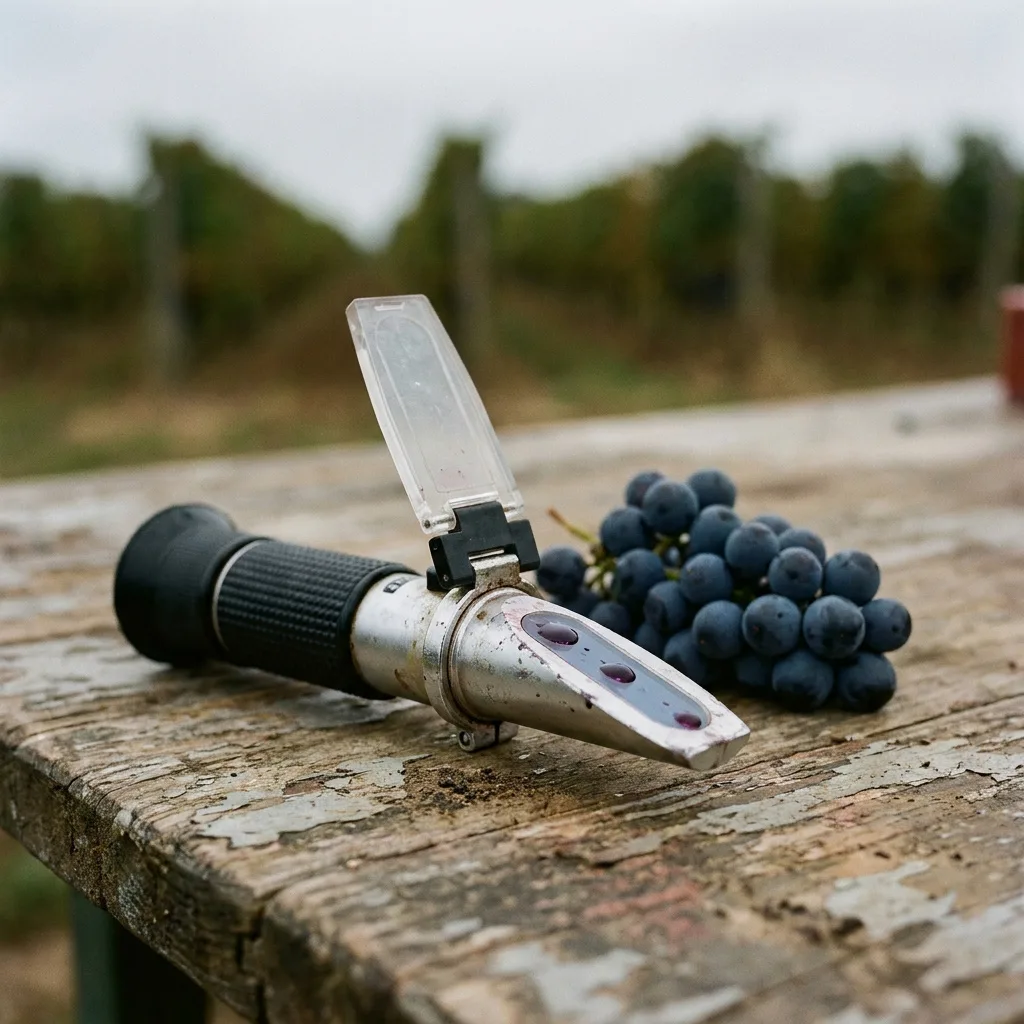
Brix measures the percentage of dissolved solids – mostly sugar – in the juice. A handheld refractometer with automatic temperature compensation (ATC) reads it from a single drop: crush a berry or two from a few different clusters around the vine, place a drop of juice on the prism, close the cover plate, and read the scale in daylight. Sampling several berries from several clusters matters – sugar accumulation is uneven across a vine, and one sweet berry from a south-facing cluster can be misleading.
Why Titratable Acidity Matters as Much as Sugar
Brix alone does not tell you whether fruit will taste balanced, because sweetness is perceived relative to acid, not in isolation. Titratable acidity (TA) measures the total tartaric and malic acid in the juice, and it is the number that explains why two grapes at the same Brix reading can taste completely different – one balanced, one mouth-puckering. General winemaking targets, discussed on our harvest-readiness guide, are pH 3.2-3.5 for red hybrids and 3.0-3.3 for whites, with TA around 6-9 g/L being the winemaking goal; cold-hardy hybrids commonly still sit at 9-16 g/L even at full ripeness, which is a variety trait rather than a sign the fruit was picked too early. A basic pH/TA test kit costs around $20-25 and removes the guesswork a refractometer alone cannot resolve.
Realistic Target Ranges – Table Use vs Winemaking
What “ripe enough” means depends entirely on what the fruit is for:
- Fresh eating (table grapes): roughly 15-18° Brix, with TA low enough that the fruit tastes sweet rather than tart out of hand.
- Dry wine, general cold-hardy hybrid range: 20-26° Brix depending on variety; University of Minnesota Extension puts Marquette’s wine sweet spot at 22-24° Brix specifically.
- TA at harvest for wine: 6-9 g/L is the general winemaking target; cold-hardy hybrids commonly still land at 9-16 g/L even at full ripeness, which is where post-harvest deacidification or malolactic fermentation comes in rather than more hang time.
Chasing a lower TA by leaving fruit on the vine past its Brix target rarely works in a short season – you run out of frost-free days before the acid drops meaningfully, and you risk losing the crop entirely. It is usually more productive to pick at target Brix and correct acid afterward than to gamble on hang time you may not have.
What to Do When the Season Runs Out on You
Some years the calendar wins regardless of what you do in the vineyard. If a hard freeze (below 28°F / -2°C) is closing in and your fruit is still under target Brix, you are not out of options – chaptalization, blending with a riper lot, or shifting toward a wine style built for high-acid, lower-sugar fruit (rose, off-dry, or a sparkling base) can all turn an “underripe” harvest into a good result. Fruit picked a little early and put to good use beats fruit left on the vine and lost to a hard freeze. The full frost-versus-ripeness decision tree, including exactly when to pick rather than wait, is in our guide to grapes that won’t ripen before frost.
Sour fruit is only one branch of the decision tree. If what you are chasing turns out not to be about ripeness at all, the symptom-to-cause diagnostic guide works through the rest of the vine, from leaf color to shriveled clusters.
Frequently Asked Questions
Why are my grapes still sour even though they have turned color?
Color change (veraison) marks the start of ripening, not the finish. Grapes typically need several more weeks after color break to finish accumulating sugar and shedding acid, so colored-but-sour fruit is usually just not ripe yet rather than a sign of a problem.
What Brix should table grapes be to taste sweet?
Aim for roughly 15-18° Brix for fresh eating. Below that range, most people perceive the fruit as tart even if it technically has some sugar in it.
Do cold-hardy hybrid grapes always taste more sour than store-bought grapes?
Often yes, even at full ripeness. Cold-hardy hybrids like Frontenac, Marquette, and La Crescent carry Vitis riparia in their breeding for winter survival, and that parentage brings naturally higher acidity – commonly 9-16 g/L titratable acidity at harvest, depending on variety, versus roughly 5-8 g/L in warm-climate table and wine grapes. It is a variety trait, not a ripening failure.
Can I fix sour grapes after picking?
Not for fresh eating – acid does not drop after harvest. For winemaking, yes: cold stabilization, malolactic fermentation, chemical deacidification, and blending can all reduce measured acidity in the must or finished wine after the fact.
How long after veraison do grapes finish ripening?
It varies by variety and climate, but several weeks to a month or more is typical in cold-climate growing regions, with sugar accumulation continuing until a hard freeze or the grower’s harvest decision ends it.
🍇 Don’t plant the wrong grape
Vines take years to fruit. Get the free cheat-sheet of varieties that actually survive and ripen in your zone.
By subscribing you agree to our Privacy Policy.