Short answer: Red or purple grape leaves usually mean one of five things: a phosphorus or potassium shortage, a virus (leafroll or red blotch), physical damage that’s pinching off the trunk or a cane, drought stress, or – most often, if you grow a red or dark-fruited variety – completely normal fall color. The three clues that separate them are which grapes your vine actually makes (red-fruited varieties redden, white-fruited ones yellow instead), where on the vine the color shows up, and whether the leaf veins stay green. Only a lab test can confirm a virus – no amount of squinting at a leaf will do it.
The Fast Diagnostic: Three Questions Before You Panic
Before you get into causes, answer these three questions. They’ll narrow things down faster than any single photo comparison.
- What color are the grapes? Red and dark-fruited hybrids (Marquette, Frontenac, St. Croix) redden under stress, deficiency, or normal fall color. White and green-fruited varieties (Itasca, La Crescent, Niagara) yellow instead – they don’t carry the same leaf pigment.
- Where is the color showing up? A nutrient deficiency reliably starts on older, lower leaves and spreads upward as it worsens. Girdling damage shows only on the growth above the injury point, not the whole vine. Location is a weaker clue for the two viruses – extension sources note that both leafroll and red blotch can appear on basal leaves early and then spread unpredictably through the canopy, so lean on vein color and leaf-margin curling (below) rather than position alone.
- Are the veins still green? Color between the veins with green veins points to potassium deficiency or leafroll. Veins turning red too points to red blotch. Uniform, whole-leaf color late in the season is usually just fall senescence.
For symptoms beyond leaf color – spots, shriveled fruit, wilting canes – our symptom-to-cause diagnostic guide covers the whole vine.
Phosphorus and Potassium Deficiency
Nutrient shortages are the most common non-virus cause of red or purple leaves, and they’re fixable once you know what you’re dealing with. Both potassium and phosphorus are “mobile” nutrients – a short vine pulls what it has out of the older leaves and sends it to new growth first. That’s why deficiency symptoms almost always start on the older, lower leaves, not the shoot tip.
Potassium (K) deficiency
Per University of Maryland Extension and Rutgers Cooperative Extension, potassium deficiency in red varieties shows up as reddening between the veins, starting at the margins and spreading inward – veins stay green at first. White varieties show pale yellow chlorosis instead of red. It typically appears on older, lower-canopy leaves in early-to-late summer; as it worsens, margins curl upward and turn brittle or necrotic. Target petiole potassium at bloom is roughly 1.5-2.5%, and a petiole tissue test – not just a soil test – is how you confirm it. Potassium matters for fruit quality and winter hardiness, but more is not automatically better: excess potassium can interfere with magnesium uptake and create its own deficiency.
Phosphorus (P) deficiency
Phosphorus deficiency is less common in established vineyards – it mostly shows up where soil pH is very low (locking phosphorus up chemically) or the soil is genuinely depleted. When it happens, University of Maryland Extension notes interveinal reddening starting at the margins in red varieties, and the same chlorotic pattern in white varieties. Target petiole phosphorus runs about 0.13-0.30% (unlike potassium, this range isn’t split by bloom vs. later-season sampling in the extension guidance). Phosphorus doesn’t move through soil easily, so correcting a real deficiency means working it into the root zone rather than a surface application; timing is flexible since it doesn’t leach out the way nitrogen does.
Magnesium deficiency can also cause interveinal reddening in red varieties (a wedge-shaped pattern from the leaf edge inward) and is worth ruling out too – we cover all three, with correction rates, in our grape vine fertilizing guide.
Our pick: Test before you fertilize – guessing wastes money and can push another nutrient out of balance. A basic home soil test kit flags pH and major nutrient levels; for a real K or P call, follow up with a petiole test through your state extension lab. Browse soil test kits on Amazon.
Leafroll Virus (Grapevine Leafroll-Associated Virus)
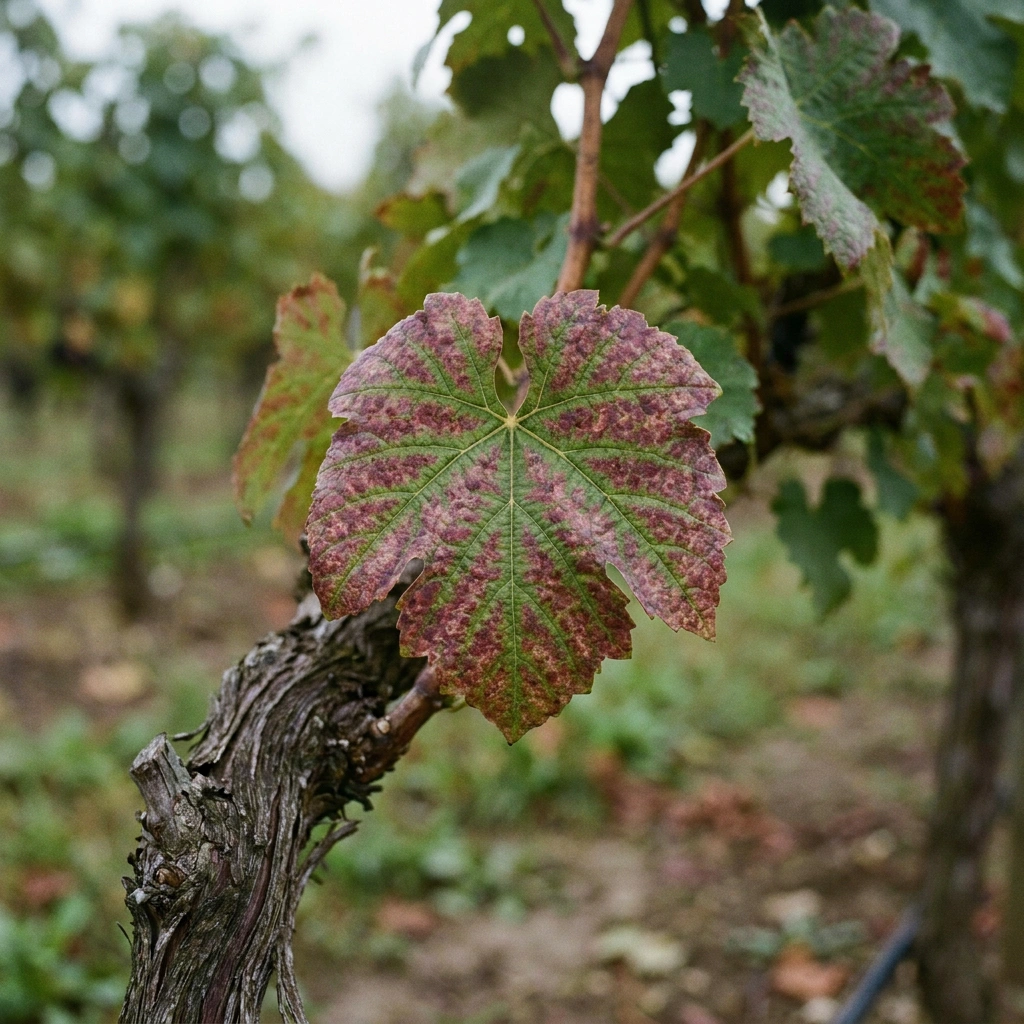
Grapevine leafroll disease is the classic viral cause of red leaves, and it’s the one most people mean when they say “I think my vine has a virus.” In red varieties, University of Maryland Extension describes red-to-purple discoloration developing between the veins – the veins themselves stay green, the single most useful visual clue. As the season goes on, leaf margins characteristically cup or curl downward. White varieties show no reddening at all – just pale, dull interveinal chlorosis with yellowish veins.
Symptoms typically become obvious around veraison (the onset of fruit ripening) and intensify through harvest. University of Maryland and Rutgers Extension both note the discoloration tends to develop randomly through the canopy rather than moving predictably from old leaves to new the way a nutrient deficiency does – one more reason vein color and cupping are the more trustworthy clues here than location. The virus spreads via mealybugs and certain scale insects. It won’t kill the vine outright, but it does real damage over the years the vine carries it: delayed ripening, lower sugar accumulation, poorer fruit color, reduced yield. There’s no cure – extension guidance is to remove (“rogue out”) a confirmed-infected vine and replant with certified virus-tested stock before it spreads further through the planting.
Red Blotch Virus
Grapevine red blotch is newer to the conversation than leafroll, and it’s genuinely easy to confuse with it – both redden leaves on red-fruited varieties. The distinguishing details, per University of California Cooperative Extension (Sonoma County) and University of Maryland Extension: with red blotch, the leaf veins turn red too instead of staying green, and the leaves don’t cup or curl downward the way leafroll-infected leaves do. Red blotch tends to show up as blotches scattered somewhat randomly across the leaf and vine rather than the neat interveinal pattern of a nutrient deficiency, and it isn’t tied as tightly to veraison – it can appear earlier. Not every leaf on an infected vine shows it equally.
Like leafroll, red blotch has no cure. It slows or stalls sugar accumulation in the fruit, so berries may never reach full ripeness even when the rest of the season looks normal. Confirming it requires a PCR test from a certified plant diagnostics lab – visual symptoms alone aren’t reliable, especially since red blotch, leafroll, and plain potassium deficiency can all produce a similar-looking red leaf on the same vine in the same season.
Why Only a Lab Test Confirms a Virus
To be straightforward: no article, chart, or photo comparison online can reliably tell you whether a red leaf is leafroll, red blotch, or a potassium shortage, just by looking at it. University of Maryland Extension is blunt about this too – symptom overlap makes visual ID alone unreliable, and the recommended sequence is the cheap checks first: inspect the trunk and graft union for damage, pull a petiole sample, and only pursue virus testing through a certified lab once deficiency and trunk damage are ruled out. A vine that keeps reddening the same way every year despite a clean test and no trunk damage is exactly the case a lab test is for.
Trunk or Graft-Union Damage (Girdling)
Sugar made in a leaf normally travels down through a thin layer of living tissue just under the bark (the phloem) to feed the roots and the rest of the vine. Anything that crushes, cuts, or constricts that layer at one point traps sugar in the leaves above the injury, and trapped sugar converts into red anthocyanin pigment – the same way it does in a ripening berry. Research on deliberate vine girdling (a technique some table-grape growers use to boost fruit color) confirms this: leaves above a girdle turn visibly red as the excess sugar backs up.
In a home vineyard, the usual culprits are less deliberate: voles or rabbits gnawing bark at the trunk base under snow cover, a training tie or wire never loosened as the trunk thickened, deer rubbing antlers on a young trunk, or – per University of Maryland Extension – crown gall (a bacterial infection, often triggered by winter injury) and canker diseases like Botryosphaeria or Eutypa that colonize the wood from the inside. The tell: reddening shows up only on the shoot or cane above the injury point, not evenly across the whole vine. Walk the trunk and look for a girdling ring, a sunken patch of bark, or a gall before assuming it’s nutritional or viral. Our guide on checking whether a vine is dead or alive covers the same trunk inspection, including the scratch test for live tissue.
Water Stress
Drought stress rarely produces the clean interveinal red pattern that deficiency or leafroll does. Per NC State Extension’s vineyard water relations guidance, the more typical sequence is tendril drying (often the earliest sign), midday wilting, then – as stress becomes severe – leaves curling, browning at the margins, and dropping early. More broadly, sustained drought can also push red-fruited vines into early, uneven senescence: patchy red and brown color well ahead of a normal fall, especially on the sun-facing side or in shallow, fast-draining soil. Wilting, curled edges, or drying tendrils alongside the red color point to water stress before deficiency or disease – the fix is supplemental watering during dry stretches, not a soil amendment or a lab test.
Normal Autumn Color in Red-Fruited Varieties
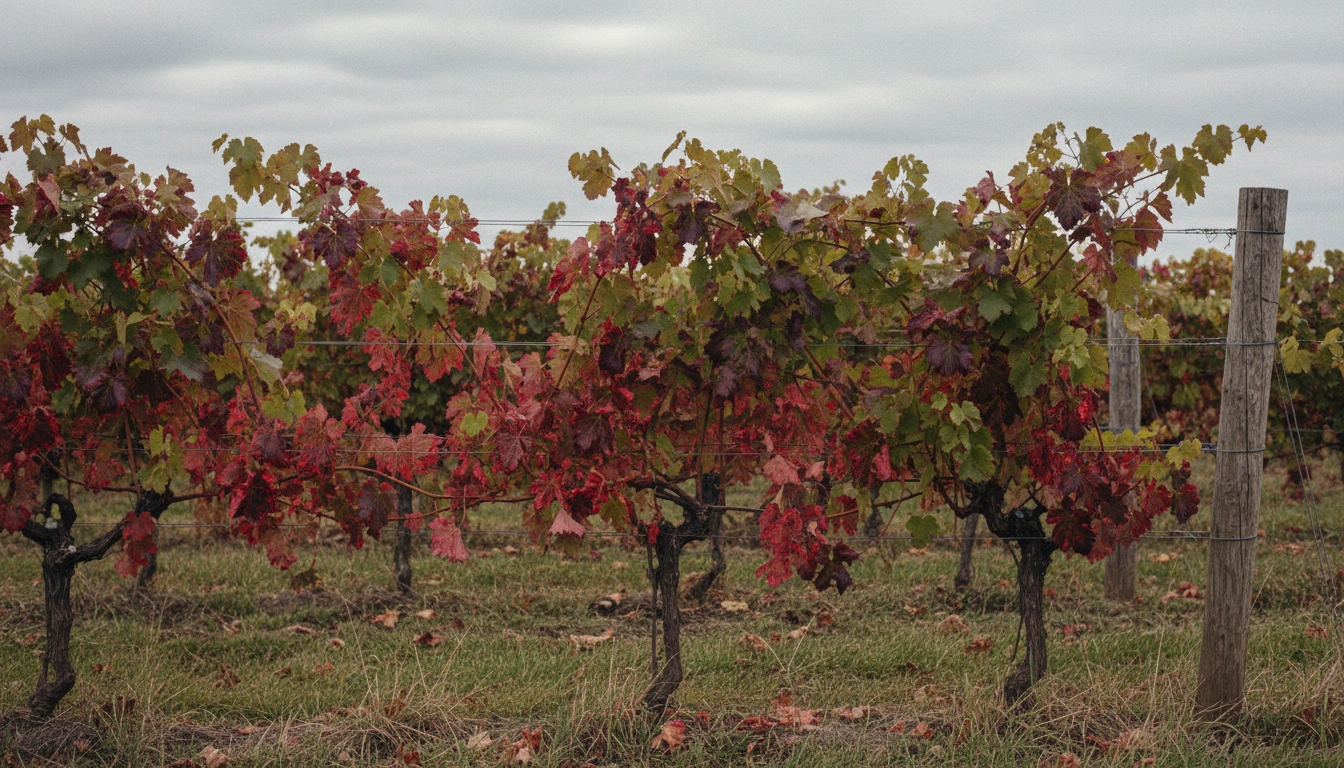
This is the explanation that turns out to be true most often, and it’s good news: as the season winds down, chlorophyll (the green photosynthesis pigment) breaks down faster than it’s replaced. In red and dark-fruited varieties, that unmasks – and can even trigger new production of – the same red anthocyanin pigments that color the fruit, so the whole leaf turns shades of red, burgundy, or purple. White and green-fruited varieties don’t carry that pigment pathway in their leaves, so the same process shows up as yellow instead, from carotenoid pigments that were there all along, just hidden by the green.
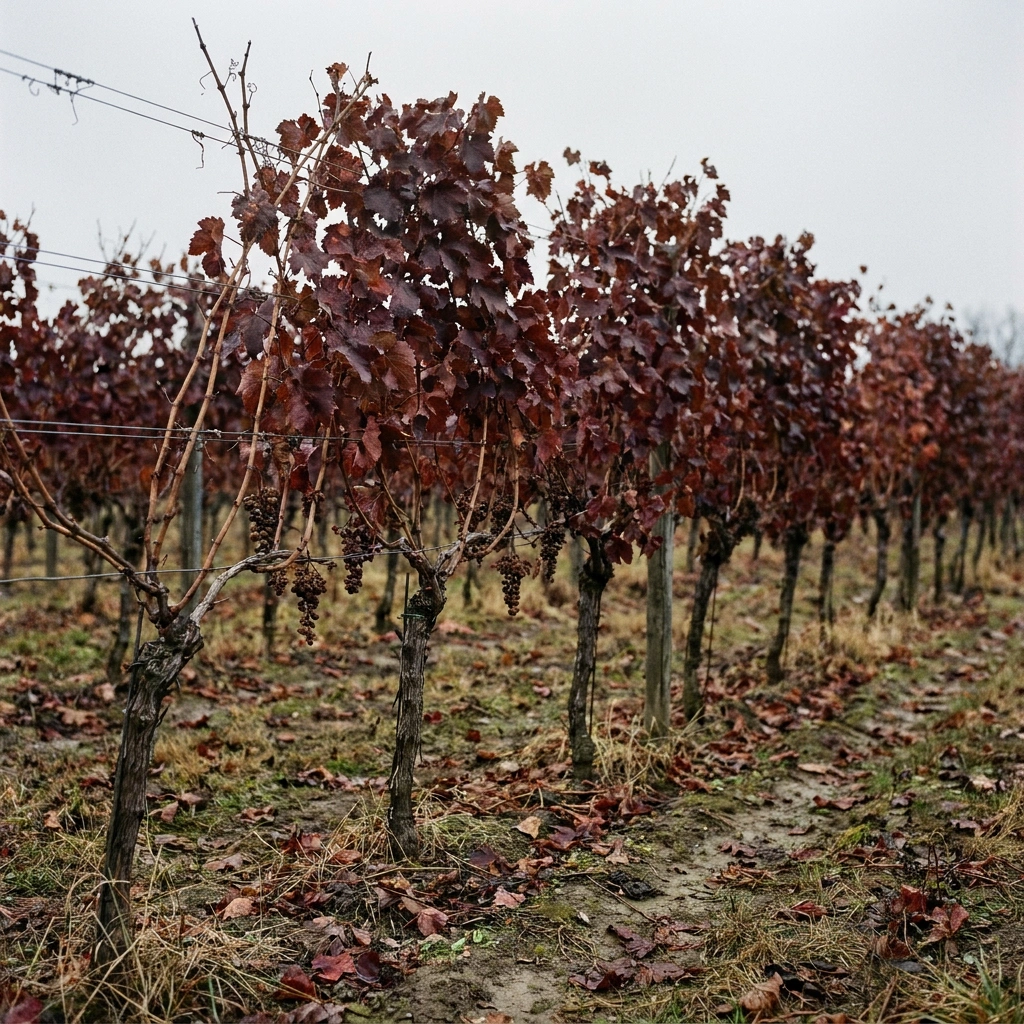
The tell is timing and uniformity: normal fall color arrives late (at or after harvest), spreads across the whole vine rather than one cane or the older leaves only, and eventually takes the veins with it rather than leaving them green. In red-fruited hybrids like Marquette and Frontenac, this typically shows as a deep, uniform red across the whole canopy as the days shorten – not a problem to solve. It’s the same pigment shift as fall color on a maple, just happening in a plant that also makes wine.
Quick Recap: When to Act, When to Relax
- Relax: whole-vine, uniform red/burgundy on a red-fruited variety, arriving after veraison or post-harvest, veins included.
- Test and fix: interveinal reddening on older/lower leaves in mid-to-late summer, veins staying green – pull a petiole sample.
- Check the trunk: reddening confined to one cane or above one spot – look for girdling, a tie, gnaw marks, or a gall first.
- Rule out drought: red color alongside wilting, curled margins, or drying tendrils in a dry stretch.
- Consider a lab test: an unexplained interveinal or vein-included pattern that returns yearly despite a clean nutrient test and no trunk damage.
If red leaves are just one symptom among several – spotting, shriveled fruit, dieback – start from the grape vine problems diagnostic guide, or the deeper pest and disease control overview, rather than forcing everything into a leaf-color explanation.
Frequently Asked Questions
Can I tell leafroll virus from red blotch virus just by looking at the leaves?
Not reliably. The rule of thumb: leafroll leaves stay green-veined and curl downward at the margins, while red blotch turns the veins red too without the downward curl. But symptoms overlap and vary enough between vines that extension services recommend a PCR lab test rather than a visual call whenever it matters – before removing a vine, for instance.
Why do my white-fruited grape varieties turn yellow instead of red?
White and green-fruited varieties don’t produce the red anthocyanin pigments in their leaves that red-fruited varieties do. So the same underlying triggers – potassium or phosphorus deficiency, leafroll virus, or normal fall senescence – show up as chlorosis (pale yellow) in white varieties instead of the reddening you’d see on a red-fruited vine.
Is potassium deficiency in grapevines serious?
It’s common and usually correctable once confirmed with a petiole tissue test. Left unaddressed it can affect fruit quality and winter hardiness, but it isn’t an emergency the way a vascular disease is. Correct it based on test results rather than applying potash on a guess – too much potassium can interfere with magnesium uptake and create a new deficiency.
What does it mean if only the leaves above one spot on the trunk or cane are red?
That localized pattern points to physical damage, not a vine-wide deficiency or virus – something is constricting the phloem at that spot: a girdling wire, rodent gnawing, a canker disease, or crown gall. Inspect the trunk and cane below where the red growth starts for a ring, wound, or gall before treating the whole vine as diseased.
When in the season should red leaves worry me?
Reddening that shows up in mid-to-late summer, well before your variety’s normal fall color, is worth investigating – that’s the typical window for both potassium deficiency and the onset of leafroll symptoms. Color that arrives late in the season, spreads evenly across a red-fruited vine, and eventually takes the veins along with it is almost always just normal autumn senescence.
🍇 Don’t plant the wrong grape
Vines take years to fruit. Get the free cheat-sheet of varieties that actually survive and ripen in your zone.
By subscribing you agree to our Privacy Policy.