Cold-climate hybrids like Frontenac, La Crescent, and Marquette ripen beautifully in short seasons – but they carry a heavy acid load, often 9-16 g/L total acidity (TA) at harvest depending on variety, compared to roughly 5-8 g/L in warm-climate vinifera generally (Cabernet Sauvignon specifically runs about 6-8 g/L). That sharp, mouth-puckering bite is the defining winemaking challenge for northern home vintners. The good news: you have four practical tools – malolactic fermentation, chemical deacidification, cold stabilization, and careful blending – and most hybrid wines benefit from using at least two of them together.
For many northern home winemakers, acid management is the steepest part of the learning curve. This guide pulls together what the University of Minnesota, Iowa State, the Australian Wine Research Institute, and other research programs actually recommend.
Why Cold-Climate Grapes Are So Acidic
Grapes contain two primary organic acids: tartaric acid and malic acid. In warm climates, malic acid is metabolized by the vine during ripening – warm nights are especially important for this process. In cold climates like Minnesota or Wisconsin (Zones 3-6), short growing seasons and cool night temperatures slow that malic acid breakdown dramatically. You end up with fruit that has all the sugar you need for fermentation, but still carries a large malic acid burden.
University of Minnesota enologists describe juice from these hybrids as high in acid and often low in pH. Pulling together university and breeder data, you can expect:
- Total acidity (TA): 9-16 g/L at harvest, depending on variety (expressed as tartaric acid equivalents) – versus the roughly 6-9 g/L that general winemaking guidance aims for, with reds usually toward the lower end
- pH: often low, but it varies by variety: UMN’s harvest target for La Crescent is pH 2.9-3.2, while Iowa State reports Frontenac at pH 3.35-3.46 even with 11.9-13 g/L TA. High TA doesn’t always mean low pH, so measure both
- Malic acid: often 4-8 g/L of that total, making it a prime target for reduction
Tartaric acid is more stable and harder to reduce without chemistry; malic acid is the winegrower’s lever. Once you understand that distinction, the strategies below make a lot more sense.
Related: How to Know When Your Grapes Are Ready to Harvest – getting Brix and pH right at pick time is the first line of acid defense.
Strategy 1: Malolactic Fermentation (MLF)
Malolactic fermentation is the most powerful acid-reduction tool available to the home winemaker working with high-acid hybrids. It converts sharp malic acid into softer lactic acid through the action of lactic acid bacteria – most commonly Oenococcus oeni. The chemical equation is straightforward: one molecule of malic acid (dicarboxylic, two acid groups) becomes one molecule of lactic acid (monocarboxylic, one acid group) plus carbon dioxide. You lose half the acid groups – and the sensory result is a noticeably softer, rounder mouthfeel.
What MLF actually does to your numbers:
- Lowers TA by about 0.56 g/L for every 1 g/L of malic acid converted (AWRI), so the drop depends on how much malic acid is left when MLF starts: 3 g/L of malic takes TA down about 1.7 g/L, and a high-malic hybrid lot can drop more
- Raises pH – often by 0.1-0.3 units – because lactic acid is weaker than malic acid. In a very low-pH wine that rise is usually welcome for taste, but it doesn’t make the wine more stable: higher pH makes sulfite less effective. The stability gain comes from using up the malic acid, so bacteria can’t start MLF later in the bottle (the AWRI calls MLF crucial to microbiologically stabilizing most red wines)
- Adds buttery, creamy, or nutty aromatic compounds (primarily diacetyl) – desirable in fuller red styles, sometimes unwanted in crisp aromatic whites like La Crescent
When to Use MLF (and When Not To)
Reds (Frontenac, Marquette, Petite Pearl): MLF is standard practice. The high malic acid load in these varieties almost always benefits from the conversion. Inoculate with a commercial MLF starter (Novonesis, formerly Chr. Hansen, Lallemand/Scott Labs, and White Labs all make suitable strains) after primary fermentation completes, or co-inoculate 24-48 hours after yeast pitch if you’re confident in your sulfite levels. Target temperature 65-72°F (18-22°C) – MLF stalls below 59°F (15°C). MLF bacteria also struggle at very low pH (the AWRI lists pH below 3.1 as unfavorable), so check the culture’s rated pH against your wine.
Whites (La Crescent, Itasca, Brianna): More nuanced. Full MLF can mute the fresh fruit aromas and floral character that make these varieties interesting. University of Minnesota enologists note that white wines are typically discouraged from going through MLF, though complete or partial MLF done with experience and intention can soften the texture. If you want only part of the effect, the more controllable route is to put a portion through complete MLF and blend it back, rather than trying to stop a running MLF halfway with SO₂. Either way, a wine that still holds malic acid can start MLF in the bottle, so protect it with sulfite and, ideally, sterile filtration. Many aromatic whites skip MLF entirely and lean on residual sugar and blending instead.
Track it: Use paper chromatography (Accuvin test strips work too) or an Accuvin malic acid test to confirm MLF completion. Don’t assume it finished because the wine stopped bubbling – incomplete MLF in bottle = re-fermentation, pushed corks, and ruined wine.
Strategy 2: Chemical Deacidification
When MLF alone isn’t enough, or when you’re working with a white that you don’t want to put through MLF, chemical deacidification is your next tool. The two main agents are:
Potassium Bicarbonate (KHCO₃)
This is the most commonly recommended option for home winemakers. It neutralizes acid (releasing carbon dioxide, so expect some fizzing), and the added potassium then pairs with tartaric acid and drops out as potassium bitartrate crystals. That makes it a tartaric-side tool: the acid it actually takes out of the wine is tartaric, because potassium malate stays dissolved (the Australian Wine Research Institute notes that the potassium and calcium salts of malic acid are soluble in wine). The AWRI’s dosing figure is about 0.9 g of potassium bicarbonate per liter to lower TA by 1 g/L (versus 0.6 g/L for potassium carbonate and 0.67 g/L for calcium carbonate). Since much of the excess in hybrid must is malic acid, keep bicarbonate for modest corrections (University of Minnesota enologists also warn that heavier carbonate doses can mute aroma, flavor, and mouthfeel), and always bench-trial first; actual results vary with pH, buffering capacity, and the wine’s acid make-up.
Best practice: Bench trial first. Take 100 mL samples, add calculated doses in small increments (0.5 g/L steps), measure TA and pH after each addition, then scale up. Always deacidify in stages – it’s much easier to remove more acid than to add it back. Then cold-stabilize, so the potassium bitartrate formed in the reaction drops out before bottling.
Calcium Carbonate (CaCO₃) and “Acidex” (Double-Salt)
Calcium carbonate is cheaper and widely available. Used the ordinary way, it also removes only tartaric acid (as calcium tartrate, which the AWRI warns is slow to form and can take several months to drop out, sometimes after bottling), and heavy doses can leave the wine tasting flat or chalky. Double-salt products such as Acidex are calcium carbonate with seed crystals, used differently: you treat only a calculated portion of the juice, enough to push that portion’s pH above 4.5, where a calcium tartrate-malate “double salt” can precipitate, then blend it back (the AWRI notes the double salt only forms above pH 4.5). That is the one carbonate method that removes malic acid along with tartaric, which makes it the chemical option for high-malic juice, ideally before fermentation. It takes the two out in roughly equal molar amounts, though, so juice that is short on tartaric acid limits how much malic it can remove (Iowa State reports Frontenac’s tartaric-to-malic ratio at 0.38-0.51).
Important caution: Chemical deacidification raises pH – sometimes significantly (in AWRI trials, about 0.2 pH units for each 1 g/L of potassium bicarbonate). A higher pH reduces the effectiveness of SO₂ as a preservative (you need more free SO₂ to protect the wine at higher pH) and can create microbial instability. Always recalculate your SO₂ additions after any deacidification treatment.
Strategy 3: Cold Stabilization
Cold stabilization is a gentler form of deacidification that home winemakers in northern climates can often do for free. Chilling the wine to near-freezing – 28-32°F (-2 to 0°C) – causes potassium bitartrate (cream of tartar) crystals to precipitate out of solution. This removes tartaric acid only, and the effect on TA is modest: in a Virginia Tech enology guide, Bruce Zoecklein and Kenneth Fugelsang put the decrease at up to 2 g/L, with the actual drop depending on the wine’s potassium and tartrate levels. It does nothing to the malic acid that makes up much of the excess in hybrids like Frontenac.
If you’re in Minnesota or Wisconsin, this is almost a free step in late November – move your carboy to the unheated garage or an outbuilding for two to four weeks, then rack off the crystals. The effect on TA is smaller than MLF or chemical deacidification, but cold stabilization also improves clarity and long-term tartrate stability in the bottle (no gritty crystals surprising your guests).
Strategy 4: Amelioration and Blending
Amelioration (Water Addition)
Amelioration means adding water (sometimes with sugar to restore the Brix) to dilute the acid. It is a real tool: University of Minnesota enologists list balanced water additions as one option in their acid-balancing toolkit for Minnesota wines, and US federal rules allow it at wineries within limits: only for juice or wine above 5.0 g/L fixed acid, never taking it below 5.0 g/L, and with the ameliorating material (water, sugar, or both) capped at 35% of the final volume (27 CFR 24.178). EU wine law goes the other way: adding water in winemaking is prohibited except where a specific technical necessity requires it (Regulation (EU) No 1308/2013, Annex VIII, Part II).
We don’t recommend leaning on water, even with a sharp lot of Frontenac, because the acid drop is small for what it costs in flavor and body: adding water equal to 10% of the must volume cuts TA by only about 9%, so a 14 g/L must lands near 12.7 g/L and still needs MLF or deacidification. UMN likewise frames water as an additional tool rather than the primary fix, so where your rules allow it, treat a modest addition as a trim alongside MLF, deacidification, blending, and residual sugar.
Blending
Blending a high-acid lot with a lower-acid grape wine – or a small amount of a neutral wine made from lower-acid fruit such as pear – can smooth the final balance without adding water or chemicals. For aromatic whites, residual sugar often does the balancing instead: UMN notes that La Crescent is often made off-dry or sweet, with the sugar balancing its acid. Also consider: letting fruit hang longer lowers your starting acid, since acids generally fall as grapes ripen – harvest timing decisions are the first deacidification decision you make each year.
See also: Our home wine-making walkthrough – covers the full process from crush to bottle.
A High-Acid Frontenac Plan: A Practical Walkthrough
Here’s one way to approach a typical high-acid Frontenac harvest, step by step.
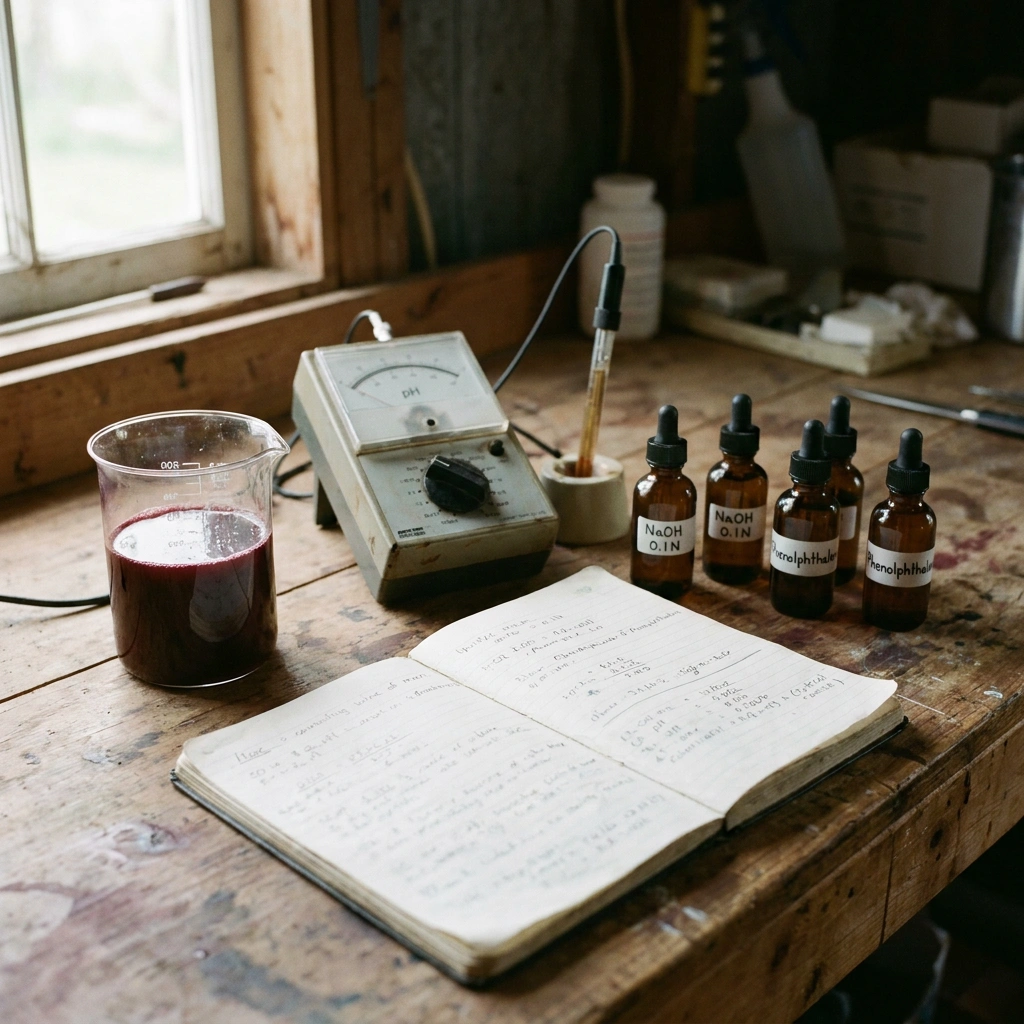
Step 1 – Measure before you do anything. At crush, take TA and pH readings on the must, using the standard NaOH titration method. Phenolphthalein indicator (endpoint = pink) works on white juice, but in dark red Frontenac must the color hides the change, so titrate to pH 8.2 on the meter instead. If TA is above 12 g/L and pH is below 3.1, plan on a multi-step approach.
Step 2 – Pre-ferment potassium bicarbonate addition (optional). If TA is extremely high (14+ g/L), add potassium bicarbonate to the must before fermentation – keeping it to a modest cut of about 1 g/L. Bicarbonate only takes out tartaric acid, and Frontenac doesn’t have much to spare, so if the must needs a bigger cut, a double-salt treatment fits better. Do a bench trial first on 200 mL of must: stir, let the fizzing settle, and re-measure. Much of the drop shows right away, and the rest follows as potassium bitartrate falls out in the cold.
Step 3 – Primary fermentation. Pitch yeast (Lalvin 71B is a good fit for Frontenac – Lallemand rates it to metabolize 20-40% of the malic acid on its own, which gives a small bonus reduction). Monitor temperature; keep it in the 65-75°F (18-24°C) range.
Step 4 – Inoculate for MLF. After pressing and racking off gross lees, pitch an Oenococcus oeni culture rated for the wine’s pH. Read the label: Lallemand rates Enoferm Alpha for pH above 3.2 and Lalvin VP41 for pH above 3.1, so a sharper, lower-pH lot needs the more tolerant strain. Keep the wine warm (65-70°F / 18-21°C), minimize SO₂ until MLF completes. Paper chromatography every two weeks to track progress.
Step 5 – Cold stabilize. Once MLF is confirmed complete and you’ve added 30-40 ppm free SO₂, the wine goes outside (or into a cold garage) for four to six weeks in November-December. Rack off the tartrate crystals in January.
Step 6 – Final TA/pH check and adjustment. Measure again. If TA is still above target (a reasonable target for a Frontenac red is 6.5-7.5 g/L), make a second small potassium bicarbonate addition, followed by another spell in the cold so the new crystals drop out before bottling. If it’s already in range, leave it. Then recalculate and adjust free SO₂ for the final pH.
To do this reliably, you need a decent pH meter and a titration kit. Here’s what to look for:
Our Pick: pH Meter + Acid Titration Kit
A calibrated pH meter and a simple NaOH titration kit are the two non-negotiable tools for cold-climate winemakers. Without them, you’re guessing – and guessing wrong on acid corrections can ruin a batch. Look for a kit that includes the indicator dye, NaOH solution, and a calibrated syringe.
Related tools on this site: Brix to Alcohol Calculator – convert your Brix reading to estimated alcohol, plan any sugar addition, and enter your TA and pH for a quick acid check.
More tools for cold-climate growers:
Frequently Asked Questions
How much does malolactic fermentation lower acidity in hybrid wines?
MLF lowers total acidity (TA) by about 0.56 g/L for every 1 g/L of malic acid converted (AWRI), so the drop depends on how much malic acid is left when MLF starts. A wine with 3 g/L of malic drops about 1.7 g/L; high-malic hybrids like Frontenac can drop more. MLF also raises pH by roughly 0.1-0.3 units, which softens the taste but makes sulfite work less well, so recheck your SO₂ afterward.
Can I use potassium bicarbonate on grape must before fermentation?
Yes – pre-fermentation potassium bicarbonate addition is a standard practice. The Australian Wine Research Institute’s figure is about 0.9 g of potassium bicarbonate per liter to lower TA by 1 g/L (bench-trial first, since actual results vary by buffering capacity and initial acid profile). The reaction releases CO₂, and the potassium drops out with tartaric acid as potassium bitartrate during cold stabilization. It does not remove malic acid, so keep it for modest corrections. Avoid over-treating: raising the pH too high before fermentation can cause microbial stability problems.
Should I do MLF on La Crescent or other aromatic white hybrids?
It depends on your style goal. Full MLF on La Crescent will reduce TA and raise pH, but it can also add buttery (diacetyl) notes and mute the variety’s apricot, citrus, and tropical aromas. University of Minnesota enologists note that white wines are typically discouraged from going through MLF, and UMN describes La Crescent as often made off-dry or sweet, with residual sugar balancing its acid. If you want some softening, put a portion through complete MLF and blend it back, then protect the blend with sulfite and, ideally, sterile filtration, since any wine still holding malic acid can start MLF in the bottle.
What’s the difference between tartaric and malic acid in grapes?
Both are naturally occurring organic acids in grapes. Tartaric acid is more stable – it doesn’t metabolize during ripening and is harder to remove without chemical intervention. Malic acid is “apple acid” (it’s the dominant acid in green apples) and decreases as grapes ripen, particularly in warm climates. Cold-climate hybrids retain high malic acid because cool nights and short seasons limit the vine’s natural malic acid metabolism. MLF targets malic acid directly; cold stabilization primarily removes tartaric acid as potassium bitartrate crystals.
Is it safe to do both MLF and potassium bicarbonate addition?
Yes, and for very high-acid hybrids it’s often necessary to use both. One approach is a modest potassium bicarbonate addition pre-fermentation to bring TA down from, say, 14 g/L to about 13 g/L, then MLF post-fermentation for a further drop (about 0.56 g/L per 1 g/L of malic acid converted). The important caution is that each step raises pH, so monitor pH carefully throughout and recalculate your free SO₂ requirements after each intervention. To reach the same protective molecular SO₂ level, a wine at pH 3.5 needs roughly two and a half times the free SO₂ of a wine at pH 3.1 (see our potassium metabisulfite guide for the numbers).
🍇 Don’t plant the wrong grape
Vines take years to fruit. Get the free cheat-sheet of varieties that actually survive and ripen in your zone.
By subscribing you agree to our Privacy Policy.