If your grapes are stuck at 16-18 Brix and the first hard freeze is days away, here is what to do: check your local frost forecast to determine whether you have a light freeze or a hard freeze coming. If it is a light frost (28-32°F / -2 to 0°C), your grapes may survive and continue ripening – assess the damage first. If a hard freeze below 28°F (-2°C) is imminent, pick now and plan to chaptalize. Whatever Brix you have, you can still make wine – it just takes a different approach than a warm-climate harvest.
The not-ripe-in-time panic is real. Here is exactly what is happening and what you can do about it – right now and next season.
What Brix Do You Actually Need?
Brix is the percentage of sugar in grape juice by weight. For dry table wine, most winemakers and extension programs target 20-24 Brix at harvest, which converts to roughly 11-14% potential alcohol after fermentation. The University of Minnesota Extension puts the sweet spot for cold-hardy hybrids in the 21-23 Brix range for quality table wine.
In cold climates – Zones 3 through 6 – it is entirely normal to see 16-19 Brix as your window closes. That is not a disaster. It is a wine-style decision, not a crop failure. You just need to know your options.
Use the Brix to Alcohol Calculator to see exactly what potential alcohol your current reading will yield, and what Brix you would need after chaptalization to hit your target.
Why Did Your Grapes Fall Short?
There is almost always more than one reason. Here are the main culprits – and recognizing them now helps you prevent it next year.
Not Enough Growing Degree Days (GDD)
Grapevines accumulate heat – measured in growing degree days (GDD, base 50°F / 10°C) – from budburst through harvest. Every grape variety has a GDD requirement to fully ripen. A late, cold spring or a cool summer can leave you 200-400 GDD short at the end of the season. Cornell’s viticulture program uses GDD tracking as the primary ripening predictor for northeastern and Great Lakes growers.
The Will My Grapes Ripen? GDD Calculator on this site lets you enter your location and variety to estimate whether you can realistically reach harvest Brix before your first frost date. If you have not used it yet, bookmark it for next spring – starting it at budburst gives you weeks of warning, not days.
Overcropping – Too Many Clusters Per Vine
A vine has a fixed photosynthetic capacity. When too many clusters compete for those sugars, none of them gets enough. In cold climates where the season is already short, overcropping is probably the single most common reason grapes stall below 20 Brix. University of Minnesota Extension recommends shoot-by-shoot crop estimation and dropping clusters at veraison (color change) if the vine is carrying more than it can ripen. Read more about managing cluster load: how crop load affects grape quality.
Dense Canopy Shading the Fruit Zone
Fruit in the shade ripens more slowly, retains higher acidity, and builds sugar more slowly than sun-exposed clusters. A tight, leafy canopy also traps humidity and restricts airflow, which compounds disease pressure. Pulling leaves around the fruit zone – especially on the east and west sides of the row – is one of the highest-return practices you can do mid-season to speed up Brix accumulation.
Variety Mismatch for Your Zone
Some varieties simply need more season than your climate offers. Chambourcin, for example, can struggle in Zone 5 because it needs long warm autumns. Cold-hardy hybrids bred specifically for short seasons are purpose-built for this situation – but their heat requirements differ more than most growers realize. Marquette is the common benchmark, ripening in late September in Minnesota at roughly 2,500-2,600 GDD (base 50°F/10°C) according to University of Minnesota Extension data. Frontenac actually needs more heat than Marquette, not less – the UMN fact sheet lists it as one of the latest-harvested varieties in Minnesota, ripening in October. Petite Pearl also ripens 1-2 weeks after Marquette and requires approximately 2,600 GDD, despite its reputation as a “cold-climate” variety. The earlier-ripening options in this group are Itasca and La Crescent, both of which typically reach harvest in mid-to-late September, slightly ahead of Marquette in most years. See the Cold-Hardy Grape Varieties guide for a full comparison.
Type your town. We work it out from 10 years of daily weather for that spot (NASA POWER).
Takes about 5 seconds. No email, no sign-up.
Your Options Right Now (Frost Is Imminent)
Option 1: Assess the Frost – It Might Not End Things
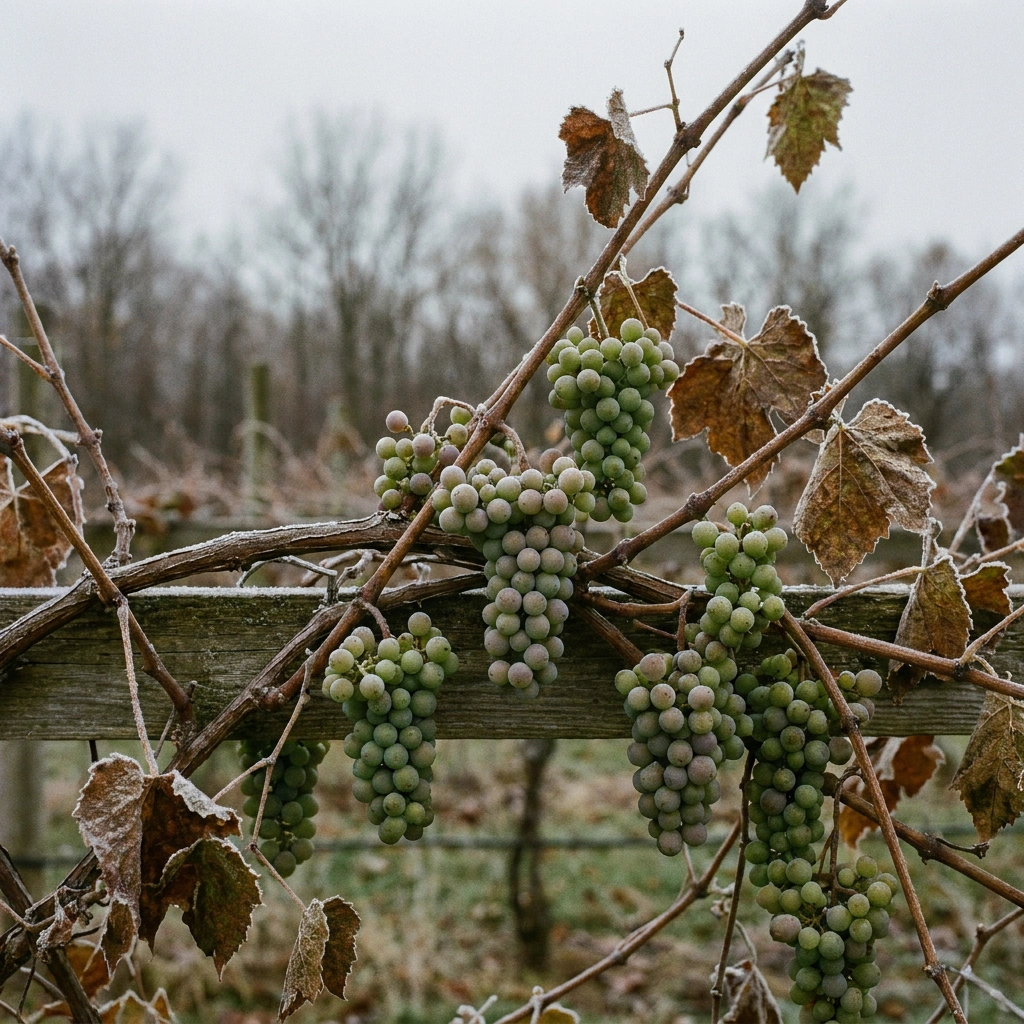
Not all frosts are equal. A light frost – temperatures hovering around 28-32°F (-2 to 0°C) for a few hours – can actually benefit some cold-hardy varieties. It softens skins, concentrates sugars slightly, and the vine often rebounds. Watch the forecast carefully: one frosty night followed by a warm week of Indian summer is common in the Midwest and Great Lakes, and that extra week can push you from 18 to 21 Brix.
A hard freeze – sustained temperatures below 28°F (-2°C), especially below 25°F (-4°C) – will freeze the berries solid, rupture cell walls, and cause rapid oxidation when they thaw. At that point, you need to pick immediately, even if Brix is low.
After a light frost, walk the vineyard and taste clusters from different parts of the row. If they taste sweet and the skin integrity is good, leave them. If they are soft, mushy, or starting to look brown at the tip of the cluster, pick within 24 hours.
Check the full harvest-readiness guide for hands-on assessment tips beyond just Brix.
Option 2: Pick and Chaptalize
Chaptalization is the addition of sugar to must (grape juice) before fermentation to raise potential alcohol. It is a standard winemaking practice in cool-climate wine regions – Burgundy, Germany, northern France – and completely legitimate for home winemakers in cold climates.
The math is straightforward: each 1.7-1.8 grams of sugar per 100 mL of must raises Brix by approximately 1 degree. If you are at 17 Brix and want to reach 22 Brix, you need to add roughly 85-90 grams of pure cane sugar per liter of must. Cornell’s winemaking resources and the University of Minnesota Extension both discuss chaptalization as a practical tool for cold-climate vintners.
Use the Brix to Alcohol Calculator to plan your chaptalizing additions before you start.
Option 3: Change the Wine Style
Low Brix does not mean bad wine. It means a different wine. Grapes at 16-18 Brix with high acidity make:
- Off-dry or semi-sweet wine: Stop fermentation early (cold crashing, sulfite addition, filtering) to retain residual sugar. This naturally balances high acidity, and the style works beautifully with cold-climate hybrids like La Crescent and Itasca.
- Rosé: Cold-climate reds at 16-17 Brix with high natural acidity are outstanding for rosé. The lower alcohol (9-10%) is a feature, not a bug, in a dry rosé style.
- Sparkling wine base: Traditional-method sparkling wine (Champagne style) is deliberately picked at low Brix – typically 17-19 Brix – because the secondary fermentation in bottle adds about 1.2% alcohol and carbonation. Your “underripe” harvest may be a sparkling wine base.
- Fruit wine blends: Blend with apple juice, elderflower, or other fruit to create a unique product that showcases your harvest’s character rather than apologizing for it.
Option 4: Blend with Higher-Brix Fruit
If you grow multiple varieties and some ripened fully while others did not, blending is a time-honored solution. Frontenac, for example, often reaches 23-25 Brix even in short seasons – blending it with an underripe Marquette lot at 17 Brix can pull the blend into the 20-21 range before any chaptalization. Some of the most interesting cold-climate wines come from necessity blends like this.
Preventing It Next Season
Now that you know why it happened, here is how to change it before next harvest.
Choose the Right Variety for Your Zone
This is the highest-leverage change you can make. If your current variety consistently struggles to ripen, consider replanting or adding earlier-ripening varieties better suited to your GDD budget. Use the Grape Variety Finder on this site to filter by hardiness zone and GDD requirement. Itasca and La Crescent ripen slightly earlier than Marquette, while Somerset Seedless is also an earlier option – all tolerate Zone 4/5 winters. Note that Petite Pearl ripens 1-2 weeks after Marquette, so it is not an earlier-season choice despite its cold-hardiness.
Thin the Crop at Veraison
At veraison – when berries shift from green to their ripe color – walk the vineyard and drop any clusters that look behind (still entirely green when neighbors have colored), any third or fourth clusters on a single shoot, and any clusters touching the ground. A well-thinned vine carries one to two clusters per shoot depending on vine size and vigor. The remaining clusters will ripen 7-14 days faster, and Brix at harvest is typically 2-3 degrees higher than on an unthinned vine – a well-documented effect across multiple university extension trials.
Open the Canopy
Starting in mid-July, pull leaves in the fruit zone – one to two leaves per shoot on the east and west sides of the row (not the top, to avoid sunburn). This exposes clusters to direct morning and afternoon light, improves airflow, and speeds sugar accumulation.
Track GDD From Budburst
Do not wait until September to wonder if your grapes will ripen. Start the GDD tracker at budburst in May. By mid-August you will have an early warning signal if the season is running 200-300 GDD behind – time enough to thin the crop hard and pull leaves aggressively to compensate, rather than watching helplessly in October.
Frequently Asked Questions
What Brix is too low to make wine?
There is no absolute floor, but below about 14 Brix, natural fermentation may struggle and the resulting wine will likely be very thin and sour without significant correction. Most cold-climate home winemakers consider 16 Brix the practical minimum for a workable wine, especially if you plan to chaptalize. Below 16 Brix, consider making a rosé, a fruit wine blend, or a sparkling wine base rather than a dry red or white.
Will a light frost hurt my grapes?
A light frost – temperatures briefly at 28-32°F (-2 to 0°C) – usually does not destroy grapes, especially cold-hardy hybrids. Thin-skinned varieties like Pinot Noir are more vulnerable. Cold-hardy hybrids (Marquette, Frontenac, La Crescent) can often tolerate one or two light frosts and may benefit from slight sugar concentration as berries shrink. A hard freeze sustained below 28°F (-2°C) will rupture cell walls and you need to pick immediately.
Is chaptalization legal for home winemakers?
For personal home winemaking (non-commercial), chaptalization is legal in all US states and most countries. Commercial winemaking regulations vary by country and appellation – in the EU, for example, it is permitted in cool-climate regions but prohibited in warmer zones. As a home winemaker, you can chaptalze freely. Use pure cane or beet sugar; corn sugar (dextrose) also works but adds about 10% more by weight to reach the same Brix target.
How much does chaptalization affect wine quality?
Done in moderation – adding 2-4 Brix worth of sugar to must that is already in the 16-19 range – chaptalization has minimal impact on flavor and aroma. The fermentable sugar is chemically identical to grape sugar in how yeast processes it. Overchapalizing (adding 6+ Brix) can produce a “hot,” thin-bodied wine because you are boosting alcohol without adding flavor compounds. Most cold-climate winemakers limit chaptalization to roughly 2-3 Brix worth of added sugar (about 1.5-2% potential alcohol) to avoid producing a hot, thin-bodied wine where alcohol has been boosted without a corresponding increase in fruit flavor. EU regulations for cool-climate wine regions permit chaptalization up to 2-3.5% in certain zones, but home winemakers using cold-hardy hybrids generally get the best results by keeping additions moderate.
What cold-hardy varieties ripen earliest for Zone 4/5?
Among whites, Itasca and La Crescent are among the earlier-ripening choices, typically reaching harvest in mid-to-late September in Minnesota. Among reds, Frontenac Gris (for rosé and white-style wine) also ripens early to mid-September. Marquette, as the common benchmark red, ripens in late September at roughly 2,500-2,600 GDD (base 50°F). Petite Pearl – despite its cold-climate reputation – actually ripens 1-2 weeks after Marquette, also requiring around 2,600 GDD, so it is not an earlier option; it is a later one. Frontenac (red) is later still, typically an October harvest. See the full comparison in the Cold-Hardy Grape Varieties guide.
🍇 Don’t plant the wrong grape
Vines take years to fruit. Get the free cheat-sheet of varieties that actually survive and ripen in your zone.
By subscribing you agree to our Privacy Policy.