Short answer: Don’t pull that vine yet. Grapevines are among the last plants to leaf out in spring – a bare vine in April or even early May is completely normal in cold climates. Before you give up on it, do a quick scratch test: nick the bark with your thumbnail and look at the layer underneath. Green means alive. Then check the buds and the flexibility of the canes. Most vines that look dead have at least some live tissue, and even a vine with a dead trunk can come back from the roots.
Step One: Wait Longer Than You Think
Around the first week of May, when everything else in the yard is green but the grapevines still look like sticks, it’s easy to get a sinking feeling. Remember: grapes are late.
According to University of Minnesota Extension, grapevines – especially cold-hardy varieties like Marquette, Frontenac, and La Crescent – commonly don’t push significant leaf growth until mid-to-late May, and sometimes into early June in Zone 4-5. This is actually a protective feature: late budbreak reduces the vine’s exposure to late spring frosts. So if it’s still April, or even the first two weeks of May, put down the shovel. Check again in a few weeks.
The one exception: if you had an unusually hard winter (sustained temps below −20°F / −29°C for several nights) or a severe late frost after the vine had already leafed out 2-4 inches (5-10 cm), there’s more reason to investigate now. But even then – use the tests below, don’t assume.
The Three Tests to Check If Your Vine Is Alive
These are the three checks to run every spring, in order from quickest to most definitive. You don’t need any tools – just a thumbnail and your hands.
Test 1: The Scratch (Cambium) Test
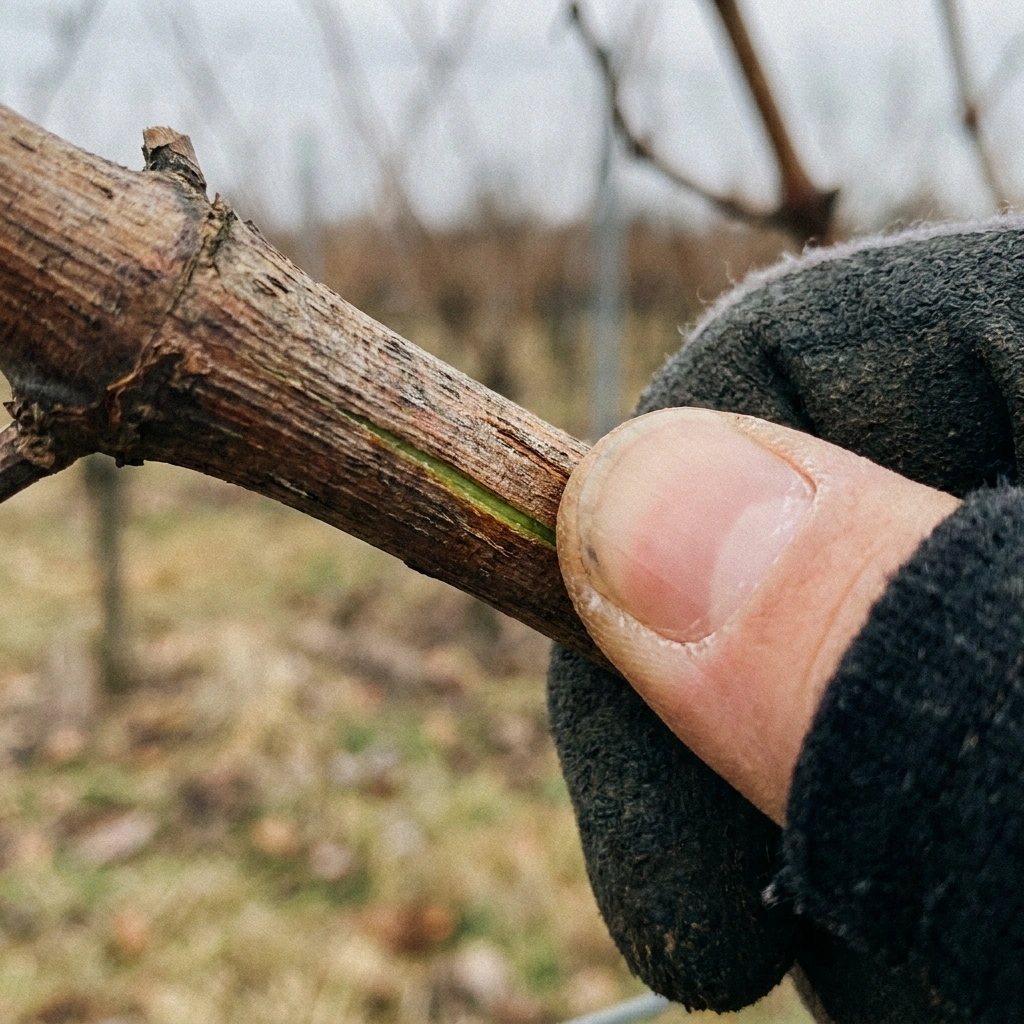
This is the gold-standard check used by viticulture extension specialists at Cornell and UMN alike. Find a cane – start near the tip – and use your thumbnail (or the edge of a knife) to scratch away a small patch of the outer bark. Look at the thin layer directly underneath, called the cambium:
- Bright green or cream-green: Live tissue. The vine has vascular activity here. Good news.
- Brown, dry, or dark: Dead tissue. That section is gone.
If the tip is brown, don’t panic – work your way down the cane toward the trunk. Often the wood at the base of a cane (the spur, near the cordon) is still alive even when the tips are winter-killed. Keep scratching at 6-inch (15 cm) intervals. The line between brown and green is where you’ll eventually prune back to.
Do the same scratch test on the trunk itself if you’re worried about a severe winter-kill event. A live trunk will show green just under the bark. A completely brown trunk with no green anywhere – even at the base near the soil – is the worst-case scenario, but even that isn’t always the end (more on that below).
Test 2: Bud Check
Look closely at the buds along the canes. In a healthy vine emerging from dormancy, buds should be:
- Plump, slightly swollen, with a waxy or reddish-brown outer scale: Alive and on their way to breaking.
- Already showing a green tip or tiny leaf: Definitely alive.
- Shriveled, shrunken, black inside when cut: Dead. The primary bud was killed by cold.
Worth noting: each grape bud cluster contains three buds – a primary and two smaller secondaries. Cold winters often kill the primary bud while leaving the secondaries intact. A secondary bud will still push growth and produce a reduced crop. So a bud that looks “flat” or small isn’t necessarily dead – scratch it open gently with a knife tip and look for any green tissue inside.
Test 3: Flexibility Test
Gently bend a cane between your hands. Live wood is flexible and slightly springy – it bends without snapping. Dead canes are brittle: they snap with a dry crack and the break is clean and fibrous. A live cane might crack the outer bark a bit when bent hard but won’t break cleanly. This test is most useful for confirming what the scratch test suggests, especially on smaller shoots that are hard to scratch.
Winter-Kill vs. Spring Frost: What Each Damages (and How Vines Recover)
These two problems sound similar but behave differently, and understanding the difference helps you respond correctly.
Winter-Kill (Cold Injury From Deep Winter Cold)
Winter-kill happens when sustained cold damages dormant buds, cordons, or trunks. For cold-hardy varieties like Marquette and Frontenac, widespread bud and cordon damage generally takes sustained temperatures below about −25°F to −30°F (−32°C to −34°C); some injury can begin around −20°F in a poorly-hardened vine or an unusually harsh season, but a normal −15°F winter usually won’t kill these varieties. (UMN notes Frontenac can take around −35°F with little damage.) According to UMN Extension, when cold injury does occur it commonly follows this progression from least to most severe:
- Primary bud kill: Most common. Secondary buds survive; the vine pushes growth, produces a lighter crop. No action needed beyond adjusting your pruning to leave more canes.
- Cordon/arm kill: The main horizontal arms are killed but the trunk survives. Retrain new cordons from healthy shoots growing from the trunk.
- Trunk kill (top-kill): The trunk above the snow line is dead. Vines often survive at or near the graft union or crown. Look for vigorous green shoots emerging from the base. These can be used to train an entirely new trunk.
- Root kill: Rare in established vines with soil insulation, but can happen in a severe winter without snow cover. The vine won’t push any growth at all.
The key point: grapevines are remarkably good at surviving at their base. Even a vine that loses its entire above-ground structure to cold can re-shoot from the crown and rebuild. It sets you back 1-3 years, but the vine isn’t dead in the sense that means “buy a new one.” Give it the full season before making that call.
Spring Frost Damage (Late Frost After Budbreak)
Spring frost damage is different: it hits green, actively growing tissue. When a late frost (28°F / −2°C or below) strikes after the vine has pushed 1-4 inches (2.5-10 cm) of shoot growth, those tender shoots freeze and die back – they turn black and collapse within 24-48 hours.
This looks alarming. But spring frost damage almost never kills the vine itself. Here’s why: the vine still has its root system, trunk, and dormant secondary and tertiary buds that were sheltered inside the bud cluster. After a spring frost kills the primary shoots, the vine will push secondary growth within 1-2 weeks. This growth tends to be less vigorous and produces fewer grape clusters – you’ll likely have a reduced harvest that year – but the vine recovers fully by the following season.
Cornell Cooperative Extension notes that cold-hardy hybrid varieties (the ones we focus on here) are generally more resilient to spring frost events than vitis vinifera varieties, partly because they’re bred in climates where late frosts are normal.
What to Do: Prune Back, Retrain, Be Patient
Once you’ve confirmed what’s dead and what’s alive, here’s the action plan:
Prune Back to Live Wood
Using the scratch test as your guide, cut back to where the cambium is green. Don’t leave dead stubs – they can invite disease – but don’t cut into live wood either. Make clean cuts with sharp bypass pruning shears. A pair of Felco-style bypass shears is worth the investment for clean cuts that heal faster and reduce disease entry points. If you don’t have a good pair yet:
Our pick: A quality pair of bypass pruning shears makes the scratch test easier and clean cuts heal faster on grapevines. Browse bypass pruning shears on Amazon – look for forged steel blades with a replaceable spring.
For detailed timing and technique on pruning cold-climate vines, see our full guide on grape pruning.
Retrain From the Base If the Trunk Died
If trunk kill happened – meaning the trunk above soil level is brown throughout – look for vigorous shoots emerging from the crown (the base of the plant, just at or below soil level). Select the strongest one or two and stake them upright. You’re essentially growing a new trunk. Tie loosely to your trellis wire and let it grow vigorously all season – your goal is developing wood, not fruit. Pinch off any flower clusters to keep the vine’s energy focused on building structure.
This is also the year to revisit your trellis setup and winterizing approach. Check our post on cold-hardy grape varieties if you’re wondering whether a variety change makes sense after repeated winter damage.
The Grafted Vine Caveat: Watch Those Basal Shoots
This is important. Most commercially sold grapevines are grafted – your named variety (e.g., Marquette, Concord, Riesling) is grafted onto a rootstock (often a phylloxera-resistant wild grape species). The graft union is typically 2-4 inches (5-10 cm) above the soil.
When a vine suffers severe trunk kill, it often pushes vigorous shoots from below the graft union – from the rootstock. These shoots look healthy and grow fast, but they are the rootstock variety, not your named variety. If you train one of these up as a new trunk, you’ll eventually get fruit – but it won’t be what you paid for, and it may not have the cold hardiness or flavor of your original variety.
How to tell the difference: find the graft union (look for a slight bulge or angled join scar on the trunk near soil level). Shoots emerging from below that scar are rootstock. Shoots from above it are your variety. Always select shoots from above the graft union when retraining – or if you’re growing own-rooted vines (common with many cold-hardy hybrids), this isn’t a concern at all.
If you’re planning to propagate your surviving vine, have a look at our guide on taking grape vine cuttings – doing this before you prune dead wood lets you save wood from any healthy sections for propagation.
Should You Rip It Out?
Only if the entire vine – trunk, crown, and root zone – shows zero live cambium anywhere, and it fails to push any growth by mid-June. Even then, leave it until late June or early July in cold climates. Vines are stubborn survivors.
If you do decide to replant, read our post on how to prepare your soil and plant a grape vine before you dig the new hole.
Frequently Asked Questions
How late can grapevines leaf out in spring?
In cold climates (USDA Zones 3-5), grapevines commonly don’t show significant leaf growth until mid-to-late May, and sometimes not until early June. This is normal – late budbreak is a cold-adaptation feature that reduces spring frost exposure. Don’t assume a bare vine is dead before mid-May in Zone 4-5.
What does the cambium scratch test look like when a vine is alive?
Scratch a small patch of bark with your thumbnail or a knife tip. The thin layer immediately beneath the bark (the cambium) should be bright green or creamy green if the vine is alive. Brown, tan, or dry tissue indicates that section is dead. Work down the cane toward the trunk to find where live tissue begins.
Can a grapevine survive if the entire trunk above ground is dead?
Yes, often. Grapevines can survive severe winter kill at the crown (graft union area) or in their root system and re-sprout entirely new shoots from the base. The vine will need 1-3 years to rebuild its trunk structure, but the root system – the hardest-to-replace part – can remain intact. Look for vigorous basal shoots in late spring and select one or two to train as new trunks.
My vine had green shoots in April and they all died after a frost. Is it dead?
Almost certainly not. Spring frost damage kills the first flush of green shoots (primary buds), but the vine retains secondary and tertiary buds that were still dormant inside the bud clusters. These will push new growth within 1-2 weeks after the frost. The vine will likely produce a reduced crop that season but will recover fully. No intervention needed beyond waiting.
How do I know if the shoots growing from the base are the right variety?
Find the graft union – typically a scar or bulge 2-4 inches (5-10 cm) above soil level. Shoots emerging from below this point are the rootstock variety and should be removed (unless you want the rootstock). Shoots from above the graft union are your named variety. Own-rooted vines (common with many cold-hardy hybrids) don’t have this issue – any basal shoot is true to variety.
More from the Cold-Climate Vineyard:
🍇 Don’t plant the wrong grape
Vines take years to fruit. Get the free cheat-sheet of varieties that actually survive and ripen in your zone.
By subscribing you agree to our Privacy Policy.