The short answer: most cold-hardy hybrid grape varieties (Frontenac, Marquette, Valiant, La Crescent) can survive a northern winter without special protection as long as you stay within their rated hardiness zone. If you’re growing tender Vitis vinifera – Cabernet, Riesling, Chardonnay and relatives – or half-hardy hybrids in Zone 3-5, you do need to take a few deliberate steps in fall. The good news: the methods are straightforward and they work.
This guide pulls together guidance from the University of Minnesota Extension and Cornell Cooperative Extension – the two best cold-climate grape research programs in the country.
- Grape Variety Finder – see which varieties suit your zone
- Vineyard Pruning Calendar – zone-based timing guide
- Will My Grapes Ripen? – heat-unit calculator
Do Your Vines Actually Need Winter Protection?
Before you haul out the burlap and straw bales, ask: what are you growing, and where?
Fully cold-hardy hybrids – generally no extra protection needed. Varieties like Frontenac, Marquette, Itasca, Petite Pearl, Valiant, Swenson Red, and La Crescent were bred specifically for the Upper Midwest and Canada. Frontenac and Marquette are rated to about -30°F (-34°C); Valiant pushes even colder. If you’re in Zone 3-5 and growing these varieties, you’re in the clear in most winters – that’s literally the point of selecting them. This is the cold-climate advantage. The University of Minnesota Horticultural Research Center trials show these varieties consistently overwinter without burial or cane protection in Zone 4 conditions.
Half-hardy hybrids (Zones 5-6 for hardier types, Zone 4 for marginal). Varieties like Marechal Foch, Baco Noir, Seyval Blanc, and Vidal Blanc occupy middle ground. They’re more cold-tolerant than vinifera but can suffer primary bud damage in harsh winters below about -10°F to -15°F (-23°C to -26°C). In Zone 5, they often come through unscathed; in Zone 4, a severe January can cause partial bud loss. Protecting these makes sense in colder zones.
Tender Vitis vinifera – protection is essential in cold zones. European wine grape varieties and their direct crosses have cane bud cold hardiness that generally bottoms out around -5°F to -10°F (-20°C to -23°C) for the hardiest among them; many are damaged above 0°F (-18°C). If you want to grow Cabernet Franc, Riesling, Pinot Noir, or similar varieties in Zones 3-5, you need an active winter protection strategy. In Zone 6 and milder, they typically need no special treatment.
See our full breakdown of cold-hardy grape varieties by zone if you’re not sure what you have.
Protecting the Root Zone (Everyone Should Do This)
Here’s a fact that surprises people: grape roots are significantly less cold-tolerant than the canes above ground. Published root-hardiness research (including work in the American Journal of Enology and Viticulture) indicates that V. vinifera roots begin dying at soil temperatures around 20-25°F (-7 to -4°C) – far warmer than the cane-hardiness thresholds those same varieties show above ground. Roots of some wild species (like V. riparia) are hardier, reaching roughly 11°F (-12°C), but documented figures for cultivated cold-hardy hybrids are less settled. The bottom line: the canes of cold-hardy hybrids can handle -20°F or colder; their roots cannot tolerate nearly as much. Young vines with shallow root systems and vines in containers are especially at risk.
The practical upside: soil itself is a tremendous insulator, and a few simple measures keep root-zone soil temperatures well above damaging levels even in brutal winters.
Mulching the Root Zone
This is the single most universally useful winter step for grapes in cold climates. Wait until the ground has started to freeze – typically after a few hard frosts in late fall – then apply 4-6 inches (10-15 cm) of organic mulch over the root zone out to about the drip line (roughly 2-3 feet / 60-90 cm from the trunk). Good mulch options include:
- Straw – a popular choice. Cheap, airy, easy to remove in spring.
- Wood chips – excellent insulator, but break down over seasons.
- Shredded leaves – works well if not compacted too tightly.
- Compost – adds organic matter but is heavier and may encourage early break of dormancy in warm spells.
Timing matters: mulch too early (before the ground starts to freeze) and you may keep soil warm enough to delay full dormancy or encourage rodent nesting under the mulch. The University of Minnesota Extension recommends waiting until after several killing frosts.
Snow Cover – Free Insurance
Snow is an excellent insulator. Even 6 inches (15 cm) of snow cover keeps soil far warmer than the air above it, and a foot or more can hold soil near or above freezing through hard cold. If you get reliable snow cover in your area, that alone often protects root zones on established vines. Don’t rely on it alone in low-snow climates – but factor it in. Many Upper Midwest growers skip the root mulch entirely on mature, established vines precisely because snow does the job.
Container Vines – Extra Care Required
Potted vines are far more vulnerable because roots are exposed to air temperatures on all sides of the container, not insulated by ground depth. In Zone 5 and colder, container vines should be either: (a) moved to an unheated but frost-moderated space like an unheated garage or shed where temperatures stay above about 10°F (-12°C), or (b) buried container and all in the ground or heavily mulched over. See our dedicated guide to growing grapes in containers for a full treatment of this.
Type your town. We work it out from 10 years of daily weather for that spot (NASA POWER).
Takes about 5 seconds. No email, no sign-up.
Hilling, Burial, and Cane Protection Methods
For tender vinifera and more marginal hybrids, protecting the above-ground portions matters just as much as the roots. Here are the main approaches, roughly ordered from least to most intensive.
Hilling / Mounding the Graft Union
If you’re growing vinifera on grafted rootstock (common in commercial settings, less so in home gardens), the graft union sits just above soil level and is particularly cold-sensitive. Mounding 6-12 inches (15-30 cm) of soil over the graft union after the vine is dormant protects this critical junction. Remove the mound carefully in spring before bud swell to prevent crown rot. This method alone doesn’t protect the canes – it just ensures the vine can regenerate from the crown even if canes die back.
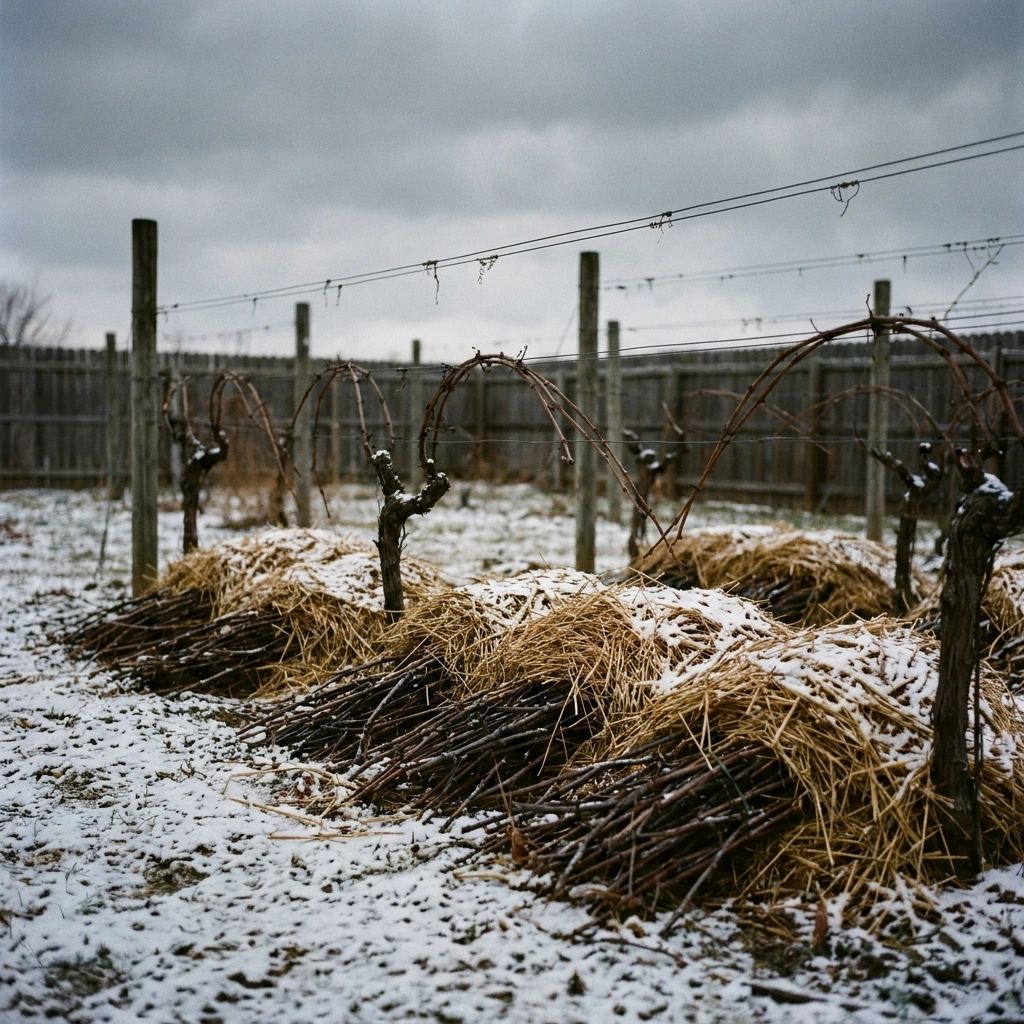
Cane Burial – The Traditional Cold-Climate Method
In regions like parts of the Finger Lakes, the northern Midwest, and Canada, grape growers have traditionally buried canes for winter. This is labor-intensive but highly effective for tender varieties. The steps:
- Wait for full dormancy – after leaf drop and a few hard frosts. Canes become more flexible as temperatures drop slightly below freezing, making them easier to lay down without snapping. In Zone 4, this is typically late October to mid-November.
- Loosen the canes from the trellis – remove ties, leaving the cordon or long canes free.
- Lay canes gently to the ground – bend slowly. Young canes on first- or second-year vines are pliable; older, thicker cordons can snap, so do this when temps are just below freezing (around 28-30°F / -2°C), which softens the wood slightly.
- Cover with soil, straw, or geotextile fabric – a 4-6 inch (10-15 cm) layer of soil works well, as does straw held in place with netting, or a purpose-made row-cover geotextile. Soil burial provides the most complete protection but is more work to remove.
- Secure the covering – use U-stakes, boards, or wire hoops to keep fabric in place and straw from blowing away.
Geotextile / Row-Cover Fabric
Purpose-made frost protection fabric (geotextile, also called row cover or frost cloth) is a practical middle ground – less protection than burial but far less work. Wrap canes after loosening them from the trellis and securing them into a loose bundle, or use a hoop system to drape fabric over an entire row. Fabric typically adds 4-8°F (2-4°C) of frost protection to the air temperature around canes. That’s meaningful for a Zone 6 vinifera in a typical Zone 5 winter, but insufficient for Zone 4 conditions with a tender variety.
The Multiple-Trunk Strategy – Built-In Insurance
One of the best passive winterization strategies is training your vine to multiple trunks from the start. If one trunk winterkills, you have one or two backups already in place. The University of Minnesota Extension explicitly recommends a two- or three-trunk system for cold-climate viticulture precisely for this reason – it adds almost nothing to annual labor but dramatically cuts the recovery time after a bad winter. Losing one trunk on a two-trunk system means you lose roughly half a season’s production on that vine, not the entire vine. A single-trunk vine that winterkills requires two to three years to rebuild from a sucker.
More on trunk renewal and dormant pruning: grape pruning guide.
When to Apply and Remove Winter Protection
Apply protection after: the vine has dropped its leaves and been through several hard frosts (below 28°F / -2°C). The vine needs to properly harden off before you cover it. Rushing protection while the vine still has leaves or is not fully dormant can trap heat, promote fungal disease, or cause the vine to break dormancy prematurely during a warm spell. In Zone 4, that typically means covering after mid to late October.
Remove protection when: the worst cold is reliably past and bud break is approaching, but before buds actually swell. In Zone 4 Wisconsin, that typically means late March to mid-April, depending on the year. Leaving protection too long encourages mold, premature warming under the covering, and potential crown rot if soil is mounded. Remove gradually if you can – uncover one side first for a few days, then remove fully. Watch the 10-day forecast; if a hard freeze (below 28°F / -2°C) is coming after you’ve uncovered, hardy hybrids will be fine, but tender varieties may need temporary re-covering.
Fall Prep Mistakes to Avoid
The preparation for winter actually starts in summer. Mistakes made from July onward can undermine the vine’s cold hardiness regardless of what you do in November.
- Applying nitrogen fertilizer late in the season. High nitrogen pushes lush vegetative growth that doesn’t harden off properly. Stop nitrogen applications by early July in cold zones. Late growth is soft growth – it’s the first to die in a freeze.
- Overwatering or irrigating heavily in late summer. The vine needs to experience a degree of summer water stress to trigger the onset of dormancy. Damp, lush conditions late in the season delay hardening.
- Pruning too early in fall. Wait until the vine is fully dormant before any pruning. Pruning while the vine is still active can stimulate growth; and wounds made in early fall are slower to callus than wounds made in late dormancy. See our pruning guide for timing specifics.
- Skipping the soil prep step in spring. This isn’t a fall mistake, but it belongs here: soil with poor drainage puts roots at greater risk. Water that sits around roots and then freezes is damaging. See our guide on preparing your soil for grape planting if you’re establishing a new vineyard bed.
- Removing protection too early after a warm spell. A warm week in February is not spring. Buds that break early on a tender vine have effectively zero cold hardiness – a subsequent frost at 28°F (-2°C) destroys them. Watch the 10-day forecast, not the current temperature.
Frequently Asked Questions
Do I need to winterize Concord grapes?
Concord is a Vitis labrusca variety rated to approximately -20°F (-29°C) in hardiness. In Zone 5 and warmer, no special protection is needed. In Zone 4, protect the root zone with mulch and consider a two-trunk system. In Zone 3, Concord may suffer cane damage in severe winters, and some growers in those areas treat it like a half-hardy variety.
Can I leave my grape vines on the trellis all winter in Zone 5?
For cold-hardy hybrids (Frontenac, Marquette, La Crescent, Valiant) and American varieties like Concord – yes, leave them on the trellis. They’re bred for it. For tender vinifera in Zone 5, a mild winter may allow them to survive on the trellis, but a cold one will damage or kill the canes. If you’re growing vinifera in Zone 5, either choose your variety carefully (some are marginally hardier, like Cabernet Franc) or plan to protect the canes by bundling and wrapping with fabric.
How cold can grape roots tolerate?
Grape roots are considerably less cold-hardy than the canes. Published root-hardiness research indicates V. vinifera roots can begin dying at soil temperatures around 20-25°F (-7 to -4°C) – much warmer than cane-hardiness limits. Roots of cold-hardier wild species tolerate colder soil, and cultivated hybrid roots likely fall somewhere in between, though precise data are limited. In practice, deep soil and snow cover keep root zone temperatures far above dangerous levels in most gardens. Young vines with shallow roots and container-grown vines are the most vulnerable because they lack the thermal mass and depth that protect established roots.
When should I remove winter protection in spring?
Remove protection before bud break, once you’re confident the coldest weather is past. In Zone 4, that’s typically late March to mid-April. In Zone 5, often late March. Check a 10-day forecast before removing – if a hard freeze below 28°F (-2°C) is coming, leave the covering in place. Remove gradually if possible: uncover the southern exposure first for a few days to harden off the buds before full exposure.
Should I fertilize grapes in fall to help them survive winter?
No – and in fact the opposite. Avoid nitrogen fertilizer after early July in cold climates. Fall nitrogen stimulates soft, succulent growth that hardens off poorly and is the first tissue to winterkill. If you want to support vine nutrition in fall, a potassium-only fertilizer (potassium sulfate) applied in very early fall can help, as potassium is associated with improved winter hardiness in woody plants. But the most important nutrient decision is timing: stop nitrogen early.
🍇 Don’t plant the wrong grape
Vines take years to fruit. Get the free cheat-sheet of varieties that actually survive and ripen in your zone.
By subscribing you agree to our Privacy Policy.