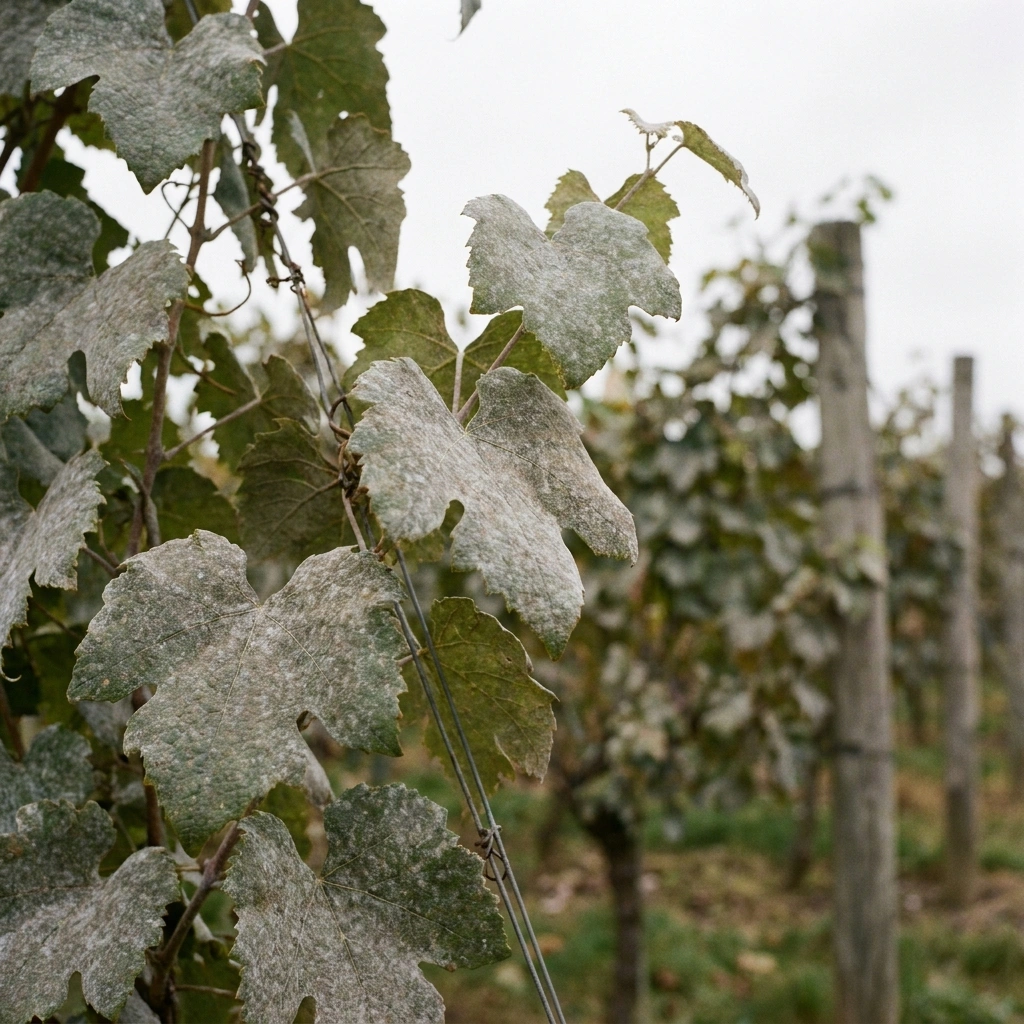
Powdery mildew on grapes is caused by the fungus Erysiphe necator (formerly known as Uncinula necator). If you see a white to grayish powdery coating spreading across your vine leaves, shoots, or young berries, that’s your culprit. The good news: sulfur-based sprays and smart canopy management together give you solid control without reaching for harsh synthetics. Start early – pre-bloom through fruit set is the window that matters most.
Quick tool links: Grape Variety Finder | Pruning Calendar | Will My Grapes Ripen?
How to Identify Powdery Mildew on Grapes
Infected leaves can look as if they’ve been dusted with flour. Here’s what to look for:
- Leaves: White to grayish powdery fungal growth on both the upper and lower leaf surfaces. Young, expanding leaves are especially vulnerable.
- Shoots and tendrils: A similar white powder can coat new shoot tissue, sometimes turning the affected tissue brown and stunted.
- Berries: This is where real damage happens. Infected young berries develop a powdery coating, then russet (turn brown and rough), crack open, or fail to ripen properly. A characteristic musty or unpleasant odor may be noticeable when you crush affected clusters.
- Flower clusters: Infection at bloom is devastating – it can cause poor fruit set and shriveled berries throughout the season.
Don’t confuse it with downy mildew, which produces a more cottony, soft growth primarily on the undersides of leaves and always requires wet conditions to spread (more on that distinction below).
Why Powdery Mildew Spreads Even Without Rain
This is the part that surprises most home growers. Unlike downy mildew or black rot, Erysiphe necator does not need free water or rainfall to infect your vines. It actually thrives in warm, humid-but-dry conditions, specifically in the range of about 68-85°F (20-30°C), with moderate relative humidity. (UC Davis IPM.)
According to the UC Davis IPM guidelines and the Cornell Cooperative Extension viticulture resources, powdery mildew is actually suppressed by heavy rainfall and temperatures consistently above about 95°F (35°C). So a rainy stretch in your forecast isn’t necessarily good news for downy mildew – but it’s not going to wash away your powdery mildew problem.
What it loves is a dense, shaded canopy with poor airflow and warm daytime temperatures. That describes a lot of backyard vines that get exuberant summer growth. The fungus overwinters in dormant buds and bark, releasing spores in spring when temperatures reach around 50°F (10°C). Those spores spread by wind, not water splash – which is why a dry summer can still see a bad outbreak.
For cold-climate growers in Zones 3-6: shorter seasons mean a compressed growth period, but the warm, humid days of July and August are prime infection windows. Watch for the first signs right around bloom time – that’s when to be spraying, not after you see a problem spreading.
Organic and Cultural Controls
1. Open the Canopy – Your First Line of Defense
No spray program replaces good canopy management. Powdery mildew hates sunlight and airflow. Practical steps from the PNW Disease Management Handbook:
- Leaf pulling: Remove leaves in the fruit zone (the lower canopy around your clusters) after fruit set. This improves air circulation and light penetration directly around berries – where infection does the most damage.
- Shoot positioning: Keep shoots upright and properly spaced on your trellis. A crowded, drooping canopy traps humidity and blocks sunlight. See our guide on grape trellis systems for the setup that works best for disease management.
- Summer pruning: Trim excessive lateral shoots. Don’t let your vine become a wall of foliage. Good pruning practices through the season reduce disease pressure significantly.
2. Sulfur – The Workhorse Organic Fungicide
Sulfur is the most reliable and widely-used organic-approved control for powdery mildew, and it has been for well over a century. Wettable sulfur or sulfur dust applied preventively every 7-14 days during the critical pre-bloom through fruit set window gives excellent protection. Cornell’s viticulture program consistently rates sulfur as one of the highest-efficacy options available to home growers.
Browse Sulfur Fungicides on Amazon →
Important safety notes: Do not apply sulfur within 2 weeks of horticultural oil sprays – the combination can cause serious phytotoxicity (leaf burn). The PNW Handbook warns of leaf burn above about 85°F (29°C), while UC Davis cites 100°F (38°C) as the threshold; to be safe, avoid sulfur above ~85°F or right before a hot spell, and never within 2 weeks of an oil spray. Always read and follow the label.
3. Potassium Bicarbonate
Potassium bicarbonate (products like Kaligreen or MilStop) is an OMRI-listed organic option that has both preventive and some eradicant (after-infection) activity. It works by raising the surface pH on the leaf, making it inhospitable to the fungus. It’s gentler than sulfur and safe in hot weather (no phytotoxicity risk like sulfur above ~85°F), making it a good backup when temperatures spike. Efficacy is somewhat lower than sulfur as a standalone, so it works best as part of a rotation rather than a replacement.
4. Horticultural and Neem Oils
Horticultural oils (summer/superior oils) and neem oil also show eradicant activity against powdery mildew – they can knock back existing infections somewhat. The critical rule: never mix oil and sulfur, and leave at least a 2-week gap between applications. Oils also work best in cooler temperatures (under about 85°F / 29°C). One option is to use oil early in the season when sulfur might be overkill, then transition to sulfur as growth accelerates.
Conventional Fungicide Options and Resistance Management
If you’re dealing with a severe outbreak or a particularly susceptible variety, conventional (synthetic) fungicides can step in. The most commonly used classes include:
- DMIs (Demethylation Inhibitors): Products like myclobutanil (Immunox for home use). Highly effective, systemic, eradicant + protectant. However, Erysiphe necator has a well-documented tendency to develop resistance to DMIs – the UC Davis and Cornell programs both flag this clearly. Never rely on DMIs exclusively.
- SDHI fungicides (succinate dehydrogenase inhibitors): Newer class, effective, also resistance-prone if overused.
- Rotation is essential: Alternate between fungicide classes with different modes of action every 1-2 applications. This slows resistance development. Check the FRAC code on your product label and rotate between FRAC groups.
For most home growers with 1-20 vines, sticking to the organic rotation (sulfur + bicarbonate + oil, rotated) is entirely adequate and avoids the resistance management headache. We only recommend synthetics for growers with historically heavy pressure on susceptible varieties or for commercial situations. See the broader pest and disease control overview for a complete program.
Resistant Varieties – The Long-Term Solution
If powdery mildew is a recurring problem, the most sustainable fix is to grow varieties that resist it. This is where cold-climate hybrid varieties shine compared to Vitis vinifera (European wine grapes), which are notably susceptible to powdery mildew and need the full spray program religiously.
From the University of Minnesota breeding program and regional extension resources, here’s how some popular cold-hardy varieties stack up on powdery mildew resistance:
- Itasca: Noted as having good powdery mildew resistance – one of the reasons it’s a top recommendation for low-spray home vineyards in cold climates.
- Marquette: Good resistance (Purdue/UMN rating) – meaningfully better than vinifera. Preventive sulfur is still a sensible precaution.
- Frontenac (and Frontenac Gris / Frontenac Blanc): Moderate resistance. Generally manageable with a basic spray program.
- La Crescent: Good disease resistance overall, including powdery mildew.
- Petite Pearl: Generally good disease package for a cold-climate variety.
- Vitis vinifera varieties (Chardonnay, Pinot Noir, etc.): Highly susceptible. Full spray schedule is essentially mandatory.
If you’re in Zones 3-6 and tired of fighting powdery mildew season after season, choosing a resistant variety from the start is the single best investment you can make. See our complete guide to cold-hardy grape varieties to compare options by zone, flavor profile, and disease resistance.
Spray Timing Summary
Based on the Cornell and UC Davis IPM recommendations, here’s the critical spray calendar for powdery mildew on grapes:
- Bud break through pre-bloom: Begin preventive sulfur or oil sprays. This is when the overwintered fungus releases its first spores.
- Bloom through fruit set (most critical window): Maintain consistent spray coverage every 7-14 days. Missing this window is where most home growers get burned – berry infection at this stage causes the worst cosmetic and quality damage.
- Post-fruit set through veraison: Continue protection, especially if conditions are warm. Intensity can taper after berries harden (roughly 8°Brix).
- After harvest: No spray needed for disease control, but good sanitation (remove mummified clusters, rake debris) reduces inoculum for next year.
For a full season pest and disease plan including timing charts, head to the vineyard pest and disease control hub.
Frequently Asked Questions
Can powdery mildew spread without rain?
Yes – unlike downy mildew and black rot, Erysiphe necator does not require free water or rainfall to infect grape vines. It spreads via airborne spores and thrives in warm (68-85°F / 20-30°C), moderately humid but dry conditions. (UC Davis IPM.) Heavy rain and temperatures above about 95°F (35°C) actually suppress it.
Is sulfur safe to use on grapes for powdery mildew?
Yes, sulfur is one of the most effective and widely used organic-approved fungicides for powdery mildew on grapes and has been for generations. However, two cautions apply: (1) never apply sulfur within about 2 weeks of horticultural oil sprays, as the combination causes phytotoxicity; (2) the PNW Handbook warns of leaf burn above about 85°F (29°C), while UC Davis cites 100°F (38°C); to be safe, avoid sulfur above ~85°F or right before a hot spell. Always follow the label.
What grape varieties are resistant to powdery mildew?
Cold-hardy hybrid varieties from the University of Minnesota breeding program – including Itasca, La Crescent, Marquette, Frontenac, and Petite Pearl – generally carry better powdery mildew resistance than European vinifera varieties like Chardonnay or Pinot Noir, which are highly susceptible. Itasca and La Crescent are often cited as having especially good disease resistance among the cold-hardy options.
When should I start spraying for powdery mildew?
Start preventive sprays at bud break, and maintain coverage through the critical bloom-to-fruit-set window every 7-14 days. This is when powdery mildew infection does the most damage to berry quality and yield. Cornell and UC Davis IPM programs both emphasize that waiting until you see symptoms means you’re already behind – protection is much more effective than cure.
Can I eat grapes that had powdery mildew?
Mildly affected berries with surface powder are generally safe to eat after washing, though they may taste musty or off. Severely affected berries that have cracked, russeted, or shriveled are best discarded – they typically make poor eating and even worse wine, as the fungus imparts off-flavors. For winemaking, even low levels of powdery mildew infection significantly affect wine quality, so prevention is strongly preferable.
🍇 Don’t plant the wrong grape
Vines take years to fruit. Get the free cheat-sheet of varieties that actually survive and ripen in your zone.
By subscribing you agree to our Privacy Policy.