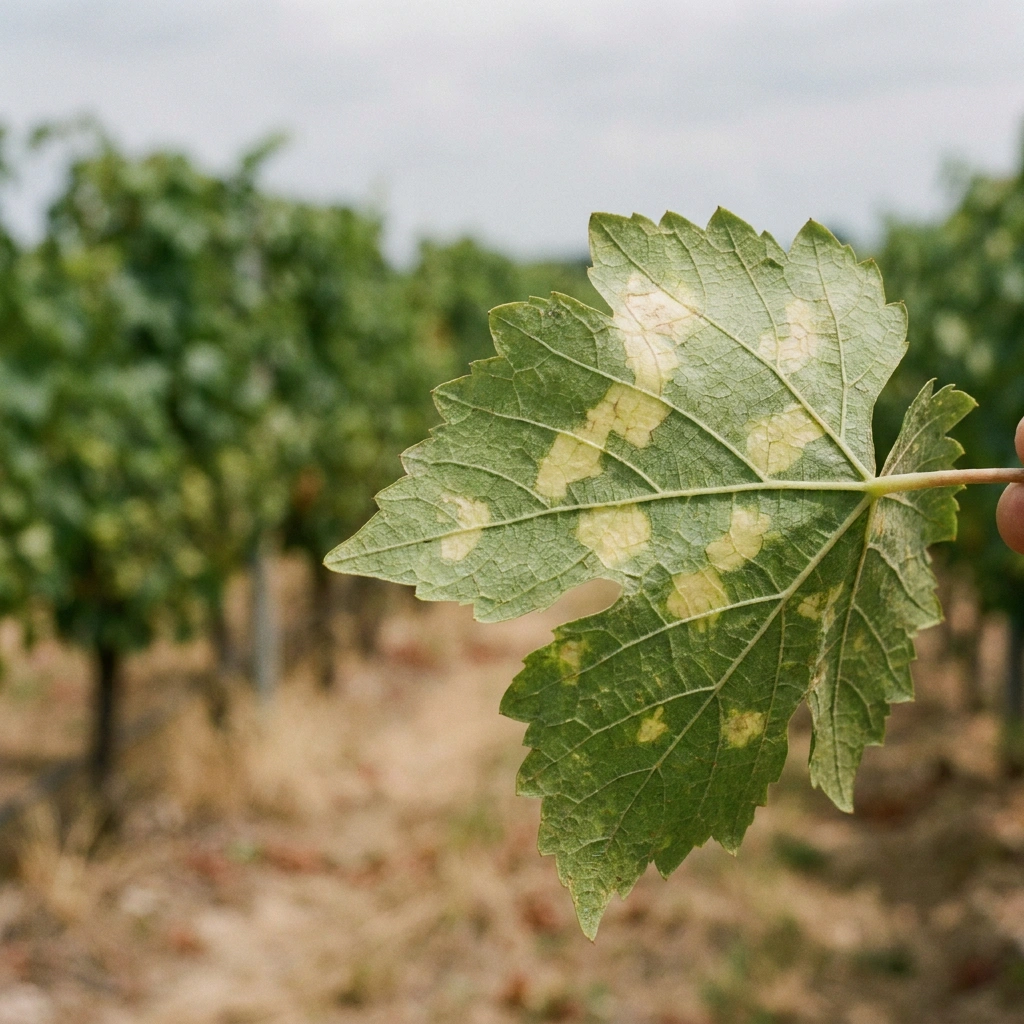
If you grow grapes in a wet climate, sooner or later you’ll find pale yellow patches on your leaves – almost like the color was bleached out in irregular blobs. Flip the leaf over during humid weather and you’ll see white, downy fuzz underneath. That’s downy mildew, and it’s one of the most destructive grape diseases in cool, rainy regions.
The quick answer: Downy mildew is caused by Plasmopara viticola, an oomycete (water mold) – not a true fungus. That distinction matters a lot for how you control it. It needs free water (rain or dew) and warm, humid conditions to infect your vines. Copper-based fungicides are your best bet, while sulfur – which works well against powdery mildew – does nothing against this disease. Frontenac and other cold-hardy hybrids have excellent resistance. Vinifera varieties are highly susceptible.
- Grape Variety Finder – check disease resistance ratings before you plant
- Pruning Calendar – canopy work that reduces disease pressure
- Will My Grapes Ripen? – season planning by zone
What Is Downy Mildew? (It’s Not a True Fungus)
Downy mildew of grapes is caused by Plasmopara viticola, which belongs to the oomycetes – a group sometimes called water molds. Oomycetes look a lot like fungi and cause similar problems, but they’re more closely related to algae than to true fungi. This is more than a trivia point: oomycetes have a different cell wall composition (cellulose, not chitin), which means many standard fungicides simply don’t work against them.
Sulfur, for example, is a classic contact fungicide that grape growers use against powdery mildew. Against downy mildew it’s essentially useless. University extension programs such as Cornell and Michigan State emphasize this distinction when guiding growers toward effective controls. If you spray sulfur hoping to stop a downy outbreak, you’ll waste time and money while the disease spreads.
The pathogen overwinters as oospores in infected leaf litter on the vineyard floor. When spring temperatures warm and rainfall wets the soil, these oospores germinate and release zoospores that splash onto young leaves. From there, infection cycles through the season every time conditions are right – and in a cool, wet spring in Zones 4-6, conditions can be right a lot.
How to Identify Downy Mildew on Grapes
Upper Leaf Surface: Yellow Oil Spots
The first sign most growers notice is on the top side of the leaf: pale greenish-yellow patches with irregular, slightly oily-looking margins. These are called “oil spots” and they appear where the fungal-like pathogen has infected the leaf tissue from below. Early spots may be small (a centimeter or two across); under favorable conditions they expand and merge. As lesions age, they can turn reddish-brown.
Underside of Leaf: White Cottony Sporulation
Flip the leaf over during humid or wet weather and you’ll see the diagnostic feature: a white, downy or cottony coating on the underside, directly beneath the oil spots above. This is the sporulating growth of Plasmopara viticola. It looks almost furry under good light. In dry conditions the white coating may be less visible, but the oil spots on top will still be present. Michigan State University Extension describes this dual symptom – yellow above, white below – as the classic field identification for downy mildew.
Infected Shoots and Berries
Downy mildew doesn’t stop at leaves. Young shoots and tendrils can be infected, turning brown and distorted. Young berries are highly susceptible right after bloom through about the time seeds begin to harden (berry touch stage). Infected berries turn grayish-brown, shrivel, and become leathery – this is sometimes called “brown rot” of the berry, though it’s caused by P. viticola, not a separate rot organism. Larger, more mature berries are generally less susceptible, but an early-season outbreak near flowering can wipe out significant fruit before the season even gets going.
Why Wet, Humid Weather Triggers Downy Mildew
This is where downy mildew is the exact opposite of powdery mildew: it requires free moisture on the leaf surface to infect. Rain, heavy dew, or extended periods of high relative humidity (above 90%) are what allow the zoospores to swim to stomata and penetrate the leaf. Warm temperatures – roughly 10-30°C (50-86°F), with an optimum around 20-25°C (68-77°F) – accelerate the infection cycle.
This is why downy mildew is rarely a problem in arid wine regions like Napa Valley or parts of Spain – but it’s a serious annual threat in the eastern United States, the Midwest, central Europe, and the Baltic region, including Lithuania. Wet springs and humid summers are essentially a downy mildew incubator.
The primary infection periods in the upper Midwest and Baltic region typically run from late May through July, during bloom and early fruit set – exactly when you can least afford canopy damage. Cornell’s IPM guidelines recommend starting a monitoring program at bud break and paying close attention during any stretch of rain followed by warm weather.
How to Control Downy Mildew: Copper, Canopy, and Resistant Varieties
1. Copper Fungicides (and Why Sulfur Doesn’t Work)
Copper is the backbone of downy mildew management – it’s organic-approved, effective against oomycetes, and has been used in viticulture for well over a century (the original Bordeaux mixture was copper sulfate + lime, developed in France in the 1880s). Copper works as a contact protectant: it must be on the leaf surface before infection occurs, so timing and coverage matter a great deal.
Other effective fungicides for downy mildew include:
- Mancozeb – broad-spectrum contact fungicide, effective protectant
- Phosphorous acid / phosphonates – systemic activity, can be applied after early infection; often used in combination programs
- Captan – another contact option often used in rotation
- Mandipropamid, cymoxanil – newer systemic options with kickback (post-infection) activity
Sulfur does NOT control downy mildew. Sulfur is the workhorse against powdery mildew (a true fungus), but it has no meaningful activity against oomycetes. This is one of the most common mistakes home growers make – spraying sulfur for a problem that sulfur can’t fix. Cornell, Penn State, and Michigan State all make this point clearly in their downy mildew management guides.
Browse copper fungicides on Amazon
Always follow the label. Copper can build up in soil over time – rotate with other modes of action when possible.
2. Canopy Management and Airflow
Because downy mildew needs moisture, anything you can do to reduce how long leaves stay wet cuts disease pressure dramatically. Good trellis design and canopy management are your first line of defense:
- Shoot positioning and tucking – keep the canopy open so air moves through and leaves dry quickly after rain
- Leaf removal in the fruit zone (modest, not aggressive) – improves airflow around clusters and reduces humidity
- Avoid overhead irrigation – drip irrigation at the root zone is far better than overhead sprinklers, which wet foliage and trigger infection windows
- Don’t plant in frost pockets or low-lying sites where cold air pools and morning dew persists longest
3. Sanitation: Remove Infected Leaves and Mummified Berries
The oospores that start the season’s first infections survive in fallen leaves on the vineyard floor. In fall, raking and removing infected leaf litter – or mowing it thoroughly to speed decomposition – reduces the pool of inoculum that will survive the winter. It’s not glamorous work, but it’s free and it sets you up for a cleaner spring.
4. Resistant Varieties: Your Best Long-Term Defense
If you’re planning a new planting or adding varieties, this is where cold-hardy hybrids shine. Many of the varieties grown in Zones 3-6 carry natural resistance to downy mildew inherited from their American Vitis parentage – Vitis riparia and related species evolved with downy mildew in North America and developed substantial tolerance.
Frontenac (University of Minnesota) has excellent downy mildew resistance and is one of the most reliable performers in cold, wet regions. If you’re looking at cold-hardy varieties, Frontenac’s disease resistance profile is one of its best features alongside winter hardiness to around -30°F (-34°C).
La Crescent (also from UMN) is generally considered to have some downy-mildew susceptibility (more than Frontenac), so keep up a protectant program in wet years – though precise resistance ratings haven’t been formally published in primary extension literature. Marquette has good overall disease resistance including to downy mildew. European vinifera cultivars (Vitis vinifera) are generally highly susceptible and require a rigorous spray program wherever downy mildew pressure is significant.
For a full resistance comparison and zone suitability guide, see the Cold-Hardy Grape Varieties page. And for a broader look at how downy mildew fits into the overall disease management picture alongside black rot and powdery mildew, the Grape Pests and Diseases overview is a good starting point.
Frequently Asked Questions About Downy Mildew on Grapes
What does downy mildew look like on grape leaves?
Downy mildew shows up as pale yellow or greenish-yellow oily-looking patches (“oil spots”) on the upper surface of grape leaves. In humid conditions, the underside of the leaf beneath those spots develops a white, cottony or downy coating – this is the sporulating growth of the pathogen. Young shoots and berries can also be infected, turning brown and leathery.
Is downy mildew on grapes the same as powdery mildew?
No – they are completely different diseases caused by different organisms. Powdery mildew is caused by a true fungus (Erysiphe necator) and thrives in warm, dry weather. Downy mildew is caused by Plasmopara viticola, an oomycete (water mold), and requires free moisture and humid conditions. They need different fungicides: sulfur and potassium bicarbonate work against powdery mildew but not downy mildew; copper works against downy mildew.
Does sulfur control downy mildew on grapes?
No. Sulfur is effective against powdery mildew (a true fungus) but has no meaningful activity against downy mildew (an oomycete). Using sulfur alone in an attempt to control a downy mildew outbreak is one of the most common spray-program mistakes. Use copper-based fungicides, mancozeb, phosphonates, or labeled systemic oomycide products instead.
Which grape varieties are resistant to downy mildew?
Cold-hardy hybrid varieties bred from American Vitis species tend to have much better downy mildew resistance than European vinifera. Frontenac (University of Minnesota) has excellent downy mildew resistance and is a reliable choice for wet, cool climates in Zones 3-6. Marquette also shows good disease resistance. La Crescent is generally considered to have some downy-mildew susceptibility (more than Frontenac) – keep up a protectant program. European vinifera cultivars are generally highly susceptible and require a full spray program wherever downy mildew pressure is high.
What is the best fungicide for downy mildew on grapes?
Copper-based fungicides (copper hydroxide, copper sulfate, Bordeaux mixture) are the most widely used and are organic-approved. They work as contact protectants and must be applied before infection. Other options include mancozeb (contact protectant), phosphorous acid/phosphonates (systemic with some post-infection activity), and captan. Always follow label rates; copper can accumulate in soil with repeated use, so rotating modes of action is good practice.
🍇 Don’t plant the wrong grape
Vines take years to fruit. Get the free cheat-sheet of varieties that actually survive and ripen in your zone.
By subscribing you agree to our Privacy Policy.