Black rot on grapes is a fungal disease caused by Guignardia bidwellii that can wipe out your entire crop in a wet summer if you’re not ready for it. The two things that actually work are sanitation (pulling every last mummified berry off the vine and out of the ground) and a well-timed fungicide spray from early shoot growth through about six weeks after bloom. Get both right and black rot stays manageable. Let either one slip and you’ll be staring at a vineyard full of little black raisins that were supposed to be wine.
I’ve been growing grapes in Wisconsin (USDA Zone 4b) for over a decade. Black rot shows up here most years, especially after a rainy June. Below is everything I’ve learned – backed by Cornell and Penn State extension research – about identifying, timing treatments, and keeping this disease from taking your harvest.
- Grape Variety Finder – find cold-hardy varieties with better disease resistance
- Vineyard Pruning Calendar – prune on time to reduce overwintering inoculum
- Will My Grapes Ripen? – heat unit calculator for Zone 3-6 growers
How to Identify Black Rot on Grapes
Black rot attacks leaves, shoots, and fruit – but the fruit losses are what really hurt.
Leaf Symptoms
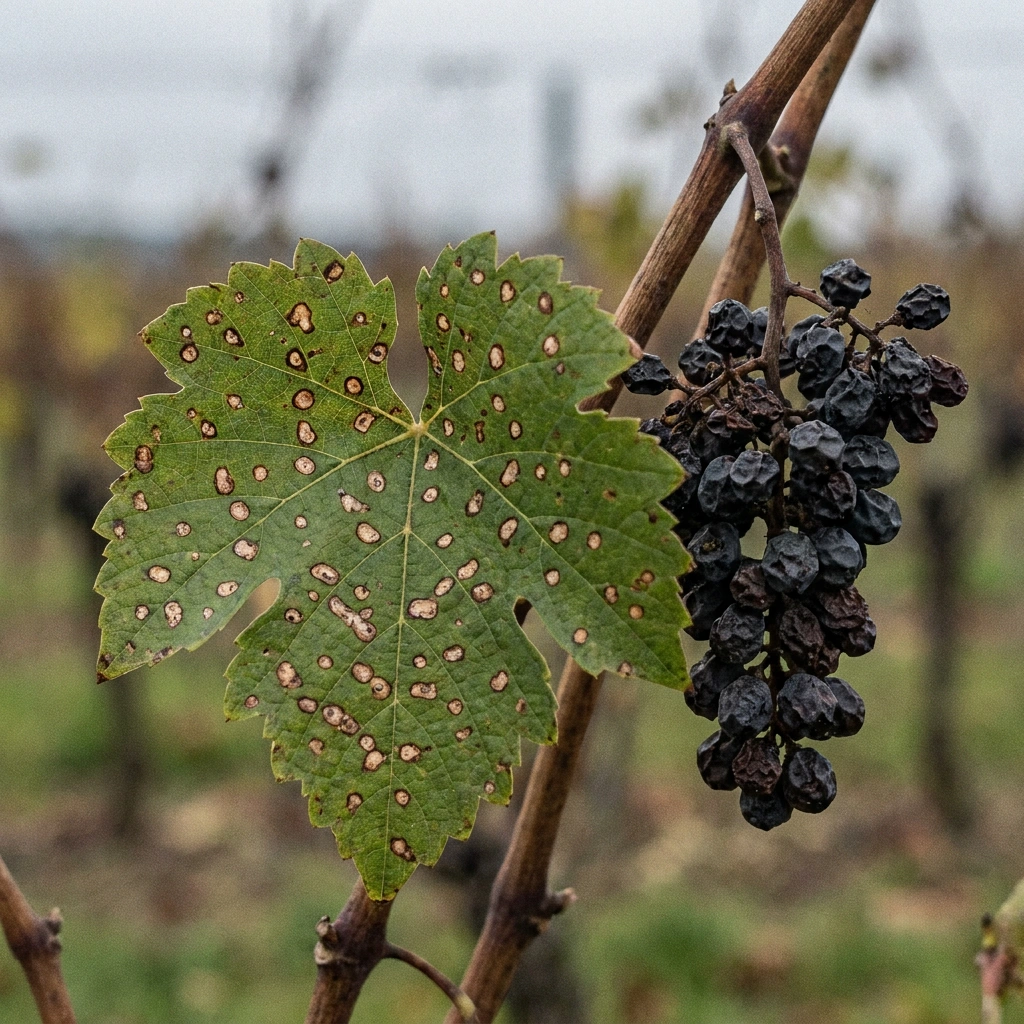
Look for small, circular spots on the upper leaf surface – usually tan or reddish-brown in the center with a distinct dark brown or black margin. The spots are typically 1/8 to 1/4 inch (3-6 mm) across. Within a week or two, you’ll see tiny black dots appear inside the tan area: those are the pycnidia (fungal fruiting bodies) that are busy producing the spores that will spread the disease. This is the key diagnostic detail – tan spots + tiny black dots inside = black rot, not something else.
Berry Symptoms (the Devastating Part)
Infected berries start as a soft, brown spot – usually appearing when berries are pea-sized or larger. Within a week, the berry turns entirely brown, then shrivels into a hard, wrinkled, blue-black “mummy.” Those mummies can hang on the cluster all season or fall to the ground. Either way, they’re packed with fungal spores that will overwinter and reinfect your vineyard next spring.
Shoot and tendril lesions show up as elongated, dark, slightly sunken cankers. They’re less visible than leaf spots but they’re a significant source of overwintering inoculum – another reason why good pruning practices matter.
Why Black Rot Spreads: The Disease Cycle
Understanding the lifecycle is what makes timing your spray program so much easier. Here’s the short version, as laid out by Cornell’s viticulture extension:
- Overwinters: The fungus survives Wisconsin winters in mummified berries (both on the vine and in the soil) and in infected cane lesions. The mummies are the biggest source – they can remain infectious for two or more years.
- Spring release: When temperatures warm and rain arrives, the mummies and cane lesions release ascospores (and later conidia from pycnidia on overwintered mummies). Cornell research puts the main ascospore release window from roughly bud break through about 6 weeks post-bloom.
- Infection conditions: Infection requires a wet period (rain or heavy dew) combined with warm temperatures. At 50°F (10°C) leaves need about 24 hours of leaf wetness to infect; at 60°F (15°C) about 9 hours; at 70°F (21°C) about 7 hours; at 80°F (27°C) just 6 hours is enough. (MSU IPM infection table, Spotts 1977.) This is why early-summer rain events are the danger window.
- Fruit is most vulnerable: Berries are most susceptible from just before bloom through roughly 4-6 weeks after bloom (some cold-climate sources say up to 6-7 weeks), according to Penn State Extension. After that they become increasingly resistant as they approach veraison – but they’re never completely immune until they’re fully ripe.
- Secondary cycles: Pycnidia in infected leaves and berries produce conidia all summer, so infections can keep happening as long as there’s rain and susceptible tissue.
The practical takeaway: your spray program has to be in place before the first rain event after shoot emergence. Waiting until you see disease is waiting too long.
The Critical Spray Window
Timing is everything with black rot fungicides. According to Penn State and Cornell extension, the high-risk window runs from 3-inch (7.5 cm) shoot growth through 4-6 weeks after bloom. After that, the risk drops substantially because the fruit has hardened off.
In my Zone 4b vineyard, that usually means spraying from mid-May through the first week of July, depending on the year. Here’s how I structure it:
- Early shoot growth (3-5 inches / 7-12 cm): First protective spray. This covers the early leaf tissue and sets you up before the ascospore season peaks.
- Pre-bloom (5-7 days before flowering): Critical timing. Clusters are exposed and vulnerable.
- Post-bloom (7-10 days after 50% bloom): This is arguably the most important spray. Berries are at peak susceptibility right after they set.
- Second post-bloom (10-14 days after first post-bloom): Continues protection through the highest-risk window.
- Continue every 10-14 days through approximately 4-6 weeks post-bloom, then ease off as risk declines.
Apply sprays before a rain event when possible, or reapply after heavy rain that washes off residue. Check your product label for specific rain-fastness windows.
Sanitation: The Step Most Home Growers Skip
No fungicide program will work well if your vineyard is loaded with overwintering mummies and infected canes. Sanitation is non-negotiable, and it’s something you can do right now regardless of budget.
Here’s the sanitation checklist I run every late winter / early spring before bud break:
- Remove all mummies – pick every shriveled berry cluster off the vine and trellis wires. This is tedious but worth the time. Studies cited by Missouri Botanical Garden and Cornell both point to mummy removal as the single most effective sanitation practice.
- Rake and dispose of ground debris – mummies on the ground are just as infectious as ones on the vine. Bag them and trash them; don’t compost.
- Prune out infected canes – look for elongated dark lesions on last year’s wood during dormant pruning. Remove and dispose of infected material; don’t leave it in the row.
- Open up canopy structure – better airflow means faster drying after rain, which directly shortens infection periods. This is another reason I favor VSP (Vertical Shoot Positioning) trellis systems for disease management. See the vineyard setup guide for trellis basics.
Sanitation alone won’t eliminate black rot in a high-pressure year, but it dramatically reduces the amount of inoculum you’re fighting in spring – which means your spray program doesn’t have to work as hard.
Fungicide Options: Synthetic, Organic, and What Actually Works
Let me be direct here: organic options for black rot are significantly weaker than synthetic fungicides. If you’re in a region with wet springs and have had black rot before, a synthetic program is the most reliable path to a harvestable crop. That said, here’s the full picture:
Synthetic Fungicides
The active ingredients with the best efficacy against black rot, per Cornell and Penn State extension recommendations:
- Myclobutanil (Rally, Immunox): A DMI (sterol inhibitor) fungicide with excellent activity against black rot. It also has some curative activity (works up to 72-96 hours after infection). Widely available as Spectracide Immunox in consumer products. Check labels carefully for pre-harvest interval (PHI) and application rates.
- Mancozeb (Manzate, Dithane): A broad-spectrum protectant fungicide with solid black rot efficacy. No curative activity – must be applied before infection. Good for rotation to reduce resistance risk. PHI is typically 66 days for wine grapes; check your specific product label.
- Captan: Protectant activity against black rot, less potent than myclobutanil but widely available. Useful as a rotational partner. PHI varies – read the label.
- Trifloxystrobin + other QoI/strobilurin products: Also effective; Penn State lists these as good options. Rotate with different mode-of-action products to prevent resistance buildup.
My go-to for home growers: For a small home vineyard, I use Spectracide Immunox (myclobutanil) during the critical window – it’s effective, widely available, and has a shorter PHI than mancozeb. Always read the full label for mixing rates, PHI, and re-entry intervals. If you need mancozeb, it’s often only available in larger quantities from farm supply stores.
Organic Options (Limited Efficacy)
Sulfur is the most commonly cited organic fungicide for grapes, but Cornell extension notes that it is relatively weak against black rot compared to its efficacy against powdery mildew. It can serve as part of an organic program but should not be your primary defense.
Copper-based fungicides (copper sulfate, Bordeaux mixture) have some activity against black rot and have been used in organic viticulture for over a century. Copper has environmental accumulation concerns with repeated use, so many organic programs limit its applications per season.
If you’re committed to organic production and black rot pressure is high in your area, the honest advice is to focus extra hard on sanitation, canopy management, and resistant variety selection – and accept that some crop loss is likely in bad years.
What About Resistant Varieties?
This is a question I get a lot, especially from cold-climate growers who are already growing Marquette, Frontenac, or similar hybrid varieties. Here’s the honest answer:
Marquette has better black-rot resistance than vinifera (Purdue rates it “good”), and Frontenac is also more tolerant than European grapes – but neither is immune, and in a warm, wet, high-pressure year both still need a spray program. In a mild year with good sanitation, some growers manage Marquette with reduced spray programs. In a wet year, you’ll need full protection regardless of variety.
For a full breakdown of cold-hardy variety characteristics – including disease resistance ratings – see the cold-hardy grape varieties guide.
For the broader picture of pests and diseases that affect your vineyard – not just black rot – check the vineyard pest and disease control overview, which covers the full management calendar.
Black Rot Management Summary
- Sanitation first: Remove every mummy, rake debris, prune infected canes. Do this every dormant season – it’s the foundation everything else rests on.
- Spray window: 3-inch shoots through 4-6 weeks post-bloom. Don’t skip the critical pre- and post-bloom sprays.
- Fungicide choice: Myclobutanil is the most practical choice for home growers. Rotate with mancozeb or captan to reduce resistance risk.
- Canopy management: Open, airy canopy reduces wet periods and gives your sprays better coverage.
- Resistant varieties help, but don’t eliminate the need for sprays – Marquette has good black-rot resistance (Purdue rating) and Frontenac is more tolerant than vinifera, but neither is immune.
Black rot is controllable. It just requires getting organized before spring, not reacting to it after you see berries shriveling in July.
Frequently Asked Questions
What causes black rot on grapes?
Black rot is caused by the fungus Guignardia bidwellii. It overwinters in mummified berries and infected cane lesions from the previous season, then releases spores during spring rains to infect new growth.
When is black rot most dangerous for my grape crop?
The highest-risk period is from just before bloom through roughly 4-6 weeks after bloom (some cold-climate sources say up to 6-7 weeks), per Penn State and Cornell extension. During this window, berries are most susceptible to infection. After berries approach veraison, resistance increases significantly.
Can I treat black rot organically?
Organic options exist but are significantly weaker than synthetic fungicides. Sulfur has limited activity against black rot (it works better on powdery mildew). Copper has some efficacy but comes with environmental accumulation concerns. If organic production is your goal, focus heavily on sanitation, canopy airflow, and resistant variety selection – and expect some crop loss in high-pressure years.
Are cold-hardy hybrid grapes like Marquette and Frontenac resistant to black rot?
Marquette has good black-rot resistance (Purdue rates it “good”), and Frontenac is also more tolerant than European vinifera – but neither is immune. In a warm, wet, high-pressure year both still need a spray program. Their disease-resistance advantage over European vinifera is real, including against black rot, though neither variety eliminates the need for sprays in bad years.
What do I do with the black mummies on my vine?
Remove and destroy them. Pick every mummified berry cluster off the vine and canopy structure, rake up any that fell to the ground, and bag them for trash disposal. Do not compost them – the fungus survives composting. Mummies are the primary source of overwintering inoculum and removing them is the single most impactful sanitation step you can take.
🍇 Don’t plant the wrong grape
Vines take years to fruit. Get the free cheat-sheet of varieties that actually survive and ripen in your zone.
By subscribing you agree to our Privacy Policy.