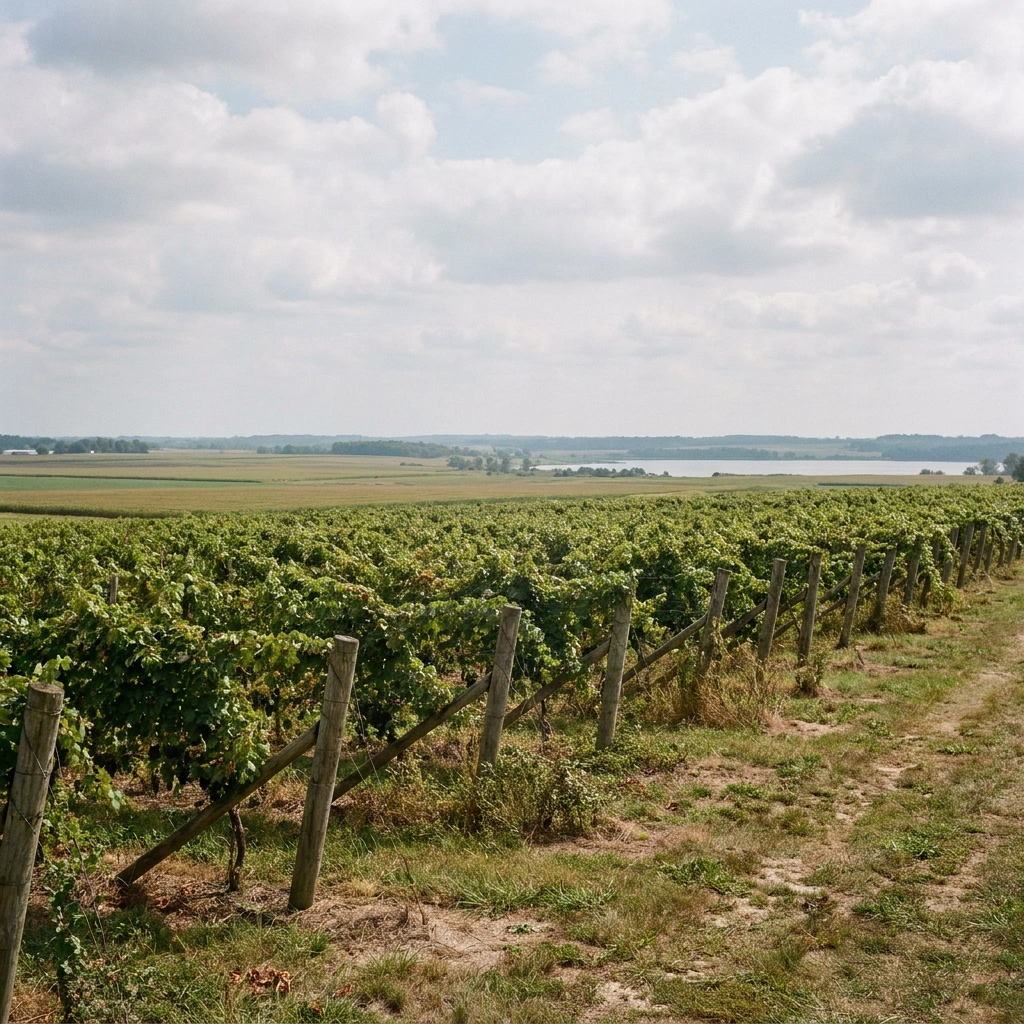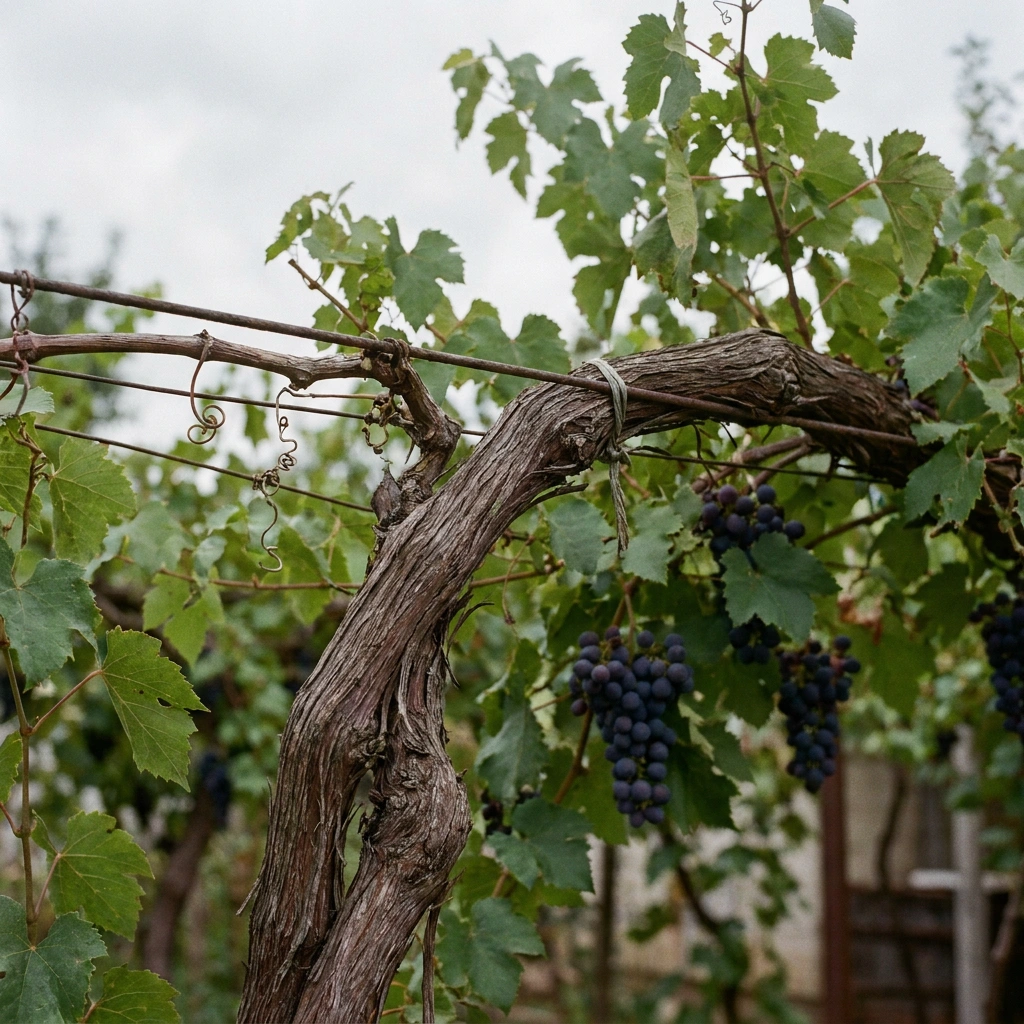
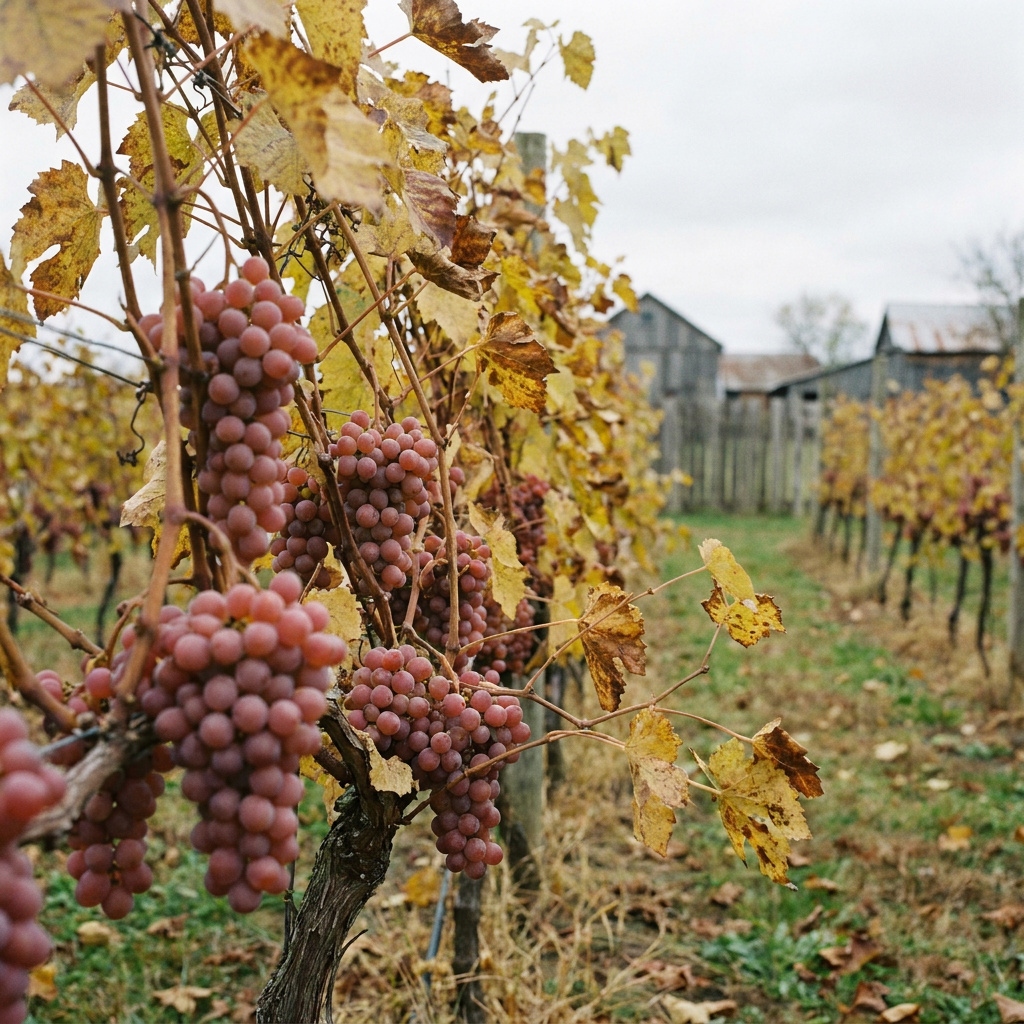
Catawba is one of the oldest and most storied wine grapes in North America – a pink-berried American hybrid with a foxy, rich flavor that powered an entire Ohio wine industry in the 1800s. It’s reasonably cold-hardy (USDA Zones 5-6), and it makes excellent off-dry rosé, sparkling wine, grape juice, and jelly. The catch for cold-climate growers: Catawba needs a long season – roughly 155-165 frost-free days, with picking typically in mid-to-late October – to ripen properly. If you’re in Zone 4 or have a short growing season, you need to plan carefully before planting, and this guide is upfront about that.
Catawba at a Glance
| Type | Pink/red American grape (Vitis labrusca × vinifera), slip-skin, foxy flavor |
|---|---|
| Hardiness | USDA Zone 5 reliably (Zone 6 too); hardiness floor about -15°F to -20°F (-26°C to -29°C). Marginal in Zone 4 with winter protection. |
| Ripening Season | Very late – roughly 155-165 frost-free days; picking typically mid-to-late October |
| Typical Brix at Harvest | 17-20 °Bx (22 only in exceptional years) |
| Acidity | High acidity, typically about 0.7-1.0 g/100 mL – a natural fit for sparkling wine styles |
| Disease Susceptibility | Highly susceptible to black rot and downy mildew; moderate susceptibility to powdery mildew; Phomopsis also a watch-list disease – a regular spray program is needed in humid regions |
| Best Uses | Off-dry rosé wine, sparkling wine, grape juice, jelly, fresh table grape |
| Plant Spacing | 6-8 ft (1.8-2.4 m) between vines; 8-10 ft (2.4-3 m) between rows for home vineyards |
History and Background: America’s Sparkling Wine Grape
Catawba has a fascinating origin story. The variety is thought to have been discovered growing wild or as a chance seedling near Asheville, North Carolina, around 1801, and it rose to prominence through the work of Cincinnati vintner Nicholas Longworth in the 1830s through the 1850s. Longworth commercialized Catawba sparkling wine in Ohio – a style that was celebrated across the United States and even in Europe before Prohibition and a devastating downy mildew epidemic ended that golden era. Henry Wadsworth Longfellow even wrote an ode to Longworth’s “Catawba Wine” in 1854.
Today Catawba is grown throughout the Eastern U.S. – particularly in New York’s Finger Lakes region, Ohio, and the Mid-Atlantic states. It’s classified as a Vitis labrusca hybrid (with some vinifera background), which gives it that characteristic “foxy” or “grapey” flavor note familiar from Concord grape juice. Unlike purely labrusca varieties, Catawba’s partial vinifera parentage contributes a bit more complexity to the wine.
Choosing a Site and Preparing the Soil
Like most grapes, Catawba wants full sun – at least 6 hours of direct sunlight daily, and 8+ is better. In cold climates, choose the warmest microclimate you have: a south- or southeast-facing slope, or a spot near a building that holds heat. Air drainage matters too – low spots where cold air pools on frost nights can wipe out an early crop or damage canes.
Soil: well-drained loam or sandy loam is ideal. Grapes tolerate a range of soils but hate wet feet – standing water kills roots and invites disease. If drainage is poor, plant on a raised bed or mound. Soil pH of 6.0-6.5 is the target. Get a soil test through your county extension office before planting any new vine – it’s cheap and removes the guesswork on lime and fertility adjustments.
Spacing: plan on 6-8 ft (1.8-2.4 m) between vines and 8-10 ft (2.4-3 m) between rows. Tighter spacing can work but restricts air flow, which worsens disease pressure on a susceptible variety like Catawba. Giving Catawba a little more room than you think it needs helps reduce disease. See our guide on cold-hardy grape varieties for comparisons on spacing needs across different vine types.
Planting Catawba Grapevines
Plant in early spring, as soon as the soil is workable and hard frosts are mostly behind you. Bare-root vines ship in late winter/early spring and establish readily. Potted vines can go in through early summer.
- Dig a hole wide enough to spread the roots without bending them.
- Set the graft union (the knobby bump near the base) 2-3 inches (5-8 cm) above soil level – burying it can cause crown rot or allow the scion to root, losing the rootstock benefit.
- Backfill with native soil. No fertilizer in the planting hole – fresh roots are easily burned.
- Water in well. Stake the young vine immediately so wind doesn’t rock and disturb the new roots.
- Cut the top back to 2-3 healthy buds at planting. This redirects energy to root establishment.
In the first year, your only goal is root establishment. Don’t worry about fruit. Resist the urge to let the vine run wild – train one strong shoot up to the first wire and pinch off any competing shoots at the base.
Training and Pruning Catawba
Catawba is most commonly trained on a high-cordon or 4-cane Kniffen system in home vineyards. A 2-wire trellis is a common setup: a lower wire at 36 in (91 cm) and an upper wire at 60 in (152 cm). Four-cane Kniffen – two canes trained along each wire in opposite directions – is the traditional system for labrusca types and it suits Catawba well.
Pruning is done in late winter/early spring before bud swell. Catawba bears fruit on one-year-old wood, so you’re cutting back most of last year’s growth each winter, leaving 4-6 renewal canes with 8-12 buds each, plus short renewal spurs. The University of Minnesota extension and Cornell Cooperative Extension both provide excellent illustrated pruning guides if this is new territory – we’d strongly recommend printing one out for your first pruning season.
The Cold-Climate Reality: Ripening and Winter Hardiness
This is the section to read carefully, especially if you’re in a Zone 4 or short-season location.
Winter hardiness: Catawba’s hardiness floor is about -15°F to -20°F (-26°C to -29°C), which maps reliably to USDA Zone 5 (and Zone 6), with Zone 4 only manageable with protection. Compare this to the ultra-hardy University of Minnesota releases: Marquette and Frontenac survive -30°F to -35°F (-34°C to -37°C) without any protection. Catawba is a step below that tier. In Zone 4, count on losing canes in a hard winter, and consider a hardier alternative as your primary variety. Catawba can work in Zone 4 as a secondary vine if you’re willing to bury the canes or provide heavy mulch protection.
Ripening season: Catawba needs roughly 155-165 frost-free days and significant heat accumulation (measured in Growing Degree Days, or GDD) – about 120 days from bloom to harvest, with picking typically in mid-to-late October. In the Finger Lakes and Ohio River Valley, this works beautifully. In Zone 4 Wisconsin or Minnesota, it’s a gamble – a short summer or early fall frost can catch the fruit under-ripe, resulting in thin, tart, unpleasant wine. Before planting Catawba in a marginal climate, use our Will My Grapes Ripen? GDD calculator to check whether your location accumulates enough heat units by October to bring Catawba to full ripeness. Fully ripe Catawba should reach 17-20 °Bx – use the Brix-to-alcohol calculator to plan your winemaking once you have a Brix reading.
If the GDD numbers are marginal, choose a south-facing wall-adjacent spot to pick up reflected heat, and look for a heat-retaining soil. Or honestly – consider Marquette or Frontenac instead, which ripen 3-4 weeks earlier and handle Zone 4 winters without drama.
Disease Management: Catawba Needs a Spray Program
Catawba is highly susceptible to black rot and downy mildew, moderately susceptible to powdery mildew, and Phomopsis is also a disease to watch. In humid eastern climates – which cover most of Catawba’s range – a no-spray approach will cost you the crop most years.
A basic home-vineyard spray program (sourced from Cornell’s Grape IPM guidelines) looks like this:
- Dormant copper or lime-sulfur spray – before bud break, cleans up overwintering spores on bark and mummified fruit.
- Mancozeb or captan – from bud break through early summer, targeting black rot and downy mildew during the high-infection period.
- Sulfur (wettable sulfur or Serenade) – powdery mildew control through summer, applied every 10-14 days in humid conditions.
- Stop spraying approximately 4 weeks before harvest, per label directions.
Sanitation matters as much as spraying: remove mummified clusters, rake up fallen leaves, and don’t leave pruning debris in the vineyard. Most black rot inoculum overwinters in mummies and old stems.
For an organic or low-spray approach, copper-based fungicides and Bacillus subtilis (Serenade) help but won’t give the same protection as conventional programs on a susceptible variety. If you want lower disease pressure, look at varieties like Marquette or Frontenac Gris, which have significantly better disease resistance built in.
Harvest: Knowing When Catawba Is Ready
Catawba ripens very late – typically October in most of its range. Don’t rush it. Under-ripe Catawba is thin, sharp, and “foxy” in an unpleasant way. Fully ripe Catawba is rich, aromatic, and balanced.
How to know it’s ready:
- Brix: taste with a refractometer. Target 17-20 °Bx for wine (22 only in exceptional years); 16+ is acceptable for juice/jelly. Our harvest-readiness guide covers what to check beyond just sugar.
- Seed color: seeds should be fully brown, not green – green seeds = not ripe.
- Berry texture: slight softness and full color development (pinkish-red) throughout the cluster, not just at the tips.
- Flavor: the classic Catawba flavor – rich, “grapey,” slightly floral – should be prominent. If it still tastes sharp and thin, wait.
Harvest carefully – Catawba clusters tend to be loose and the berries can drop if handled roughly. Cool nights and dry weather in October sharpen the flavor and help concentrate sugar.
Uses: Wine, Juice, Jelly, and Fresh Eating
Catawba’s high acidity and distinctive “foxy” labrusca flavor make it especially good for:
- Off-dry or semi-sweet rosé wine: The classic use. A touch of residual sugar balances the acidity beautifully. Add 0.5-1 g/L of sulfite at crush, let it ferment cool (55-65°F / 13-18°C), and stop fermentation while 1-2% residual sugar remains for a classic Catawba rosé style.
- Sparkling wine: High acidity = natural structure for bubbles. Traditional method or charmat both work. This was how Longworth made Catawba famous in the 1840s.
- Grape juice: Sweet, full-flavored, and distinctive. Processing is simple – crush, heat to 140-150°F (60-66°C) to kill wild yeast, strain, and can or freeze.
- Jelly and jam: Catawba makes excellent grape jelly with a fuller, richer flavor than Concord (which it resembles, but with more complexity).
- Fresh eating: Slip-skin berries are pleasant fresh off the vine, especially when fully ripe.
For winemaking, read our home winemaking guide for the basic process, and use the Brix-to-alcohol calculator to estimate potential alcohol from your harvest reading.
Where to Buy Catawba Grapevines
Catawba is widely available from mail-order nurseries. When buying bare-root vines, look for #1 grade plants with a healthy root system and a graft union if you’re in phylloxera country (most of the eastern U.S.).
Frequently Asked Questions About Catawba Grapes
Is Catawba a cold-hardy grape?
Catawba is moderately cold-hardy – its hardiness floor is about -15°F to -20°F (-26°C to -29°C), making it reliably suitable for USDA Zone 5 (and Zone 6, with Zone 4 marginal). In Zone 4, expect cane damage in hard winters and plan to provide protection (burial or heavy mulch). It is not as hardy as UMN varieties like Marquette or Frontenac, which survive -30°F to -35°F (-34°C to -37°C) without protection.
How long does Catawba take to ripen?
Catawba is a very late-ripening variety, needing roughly 155-165 frost-free days and substantial accumulated heat (Growing Degree Days) – about 120 days from bloom to harvest, with picking typically mid-to-late October. In short-season or Zone 4 locations, it may not fully ripen before frost. Use a GDD ripening calculator to check your site before planting.
What is Catawba grape wine like?
Catawba wine is characterized by a distinctive “foxy” or “grapey” labrusca flavor – rich, aromatic, sometimes slightly musky – with high acidity. It’s best made in off-dry, semi-sweet, or sparkling styles that balance the acidity. Nicholas Longworth’s sparkling Catawba from Ohio was celebrated nationally in the 1840s-1850s, and the style remains the classic showcase for the variety.
Does Catawba need a spray program?
Yes. Catawba is highly susceptible to black rot and downy mildew, moderately susceptible to powdery mildew, and Phomopsis is also a watch-list disease. In humid eastern climates it needs regular fungicide applications through the growing season. A dormant copper spray plus mancozeb or captan during early season (targeting black rot and downy mildew), followed by sulfur for powdery mildew through summer, is the standard program recommended by Cornell and Ohio State extension programs. Good sanitation – removing mummified fruit and fallen leaves – is equally important.
Can I grow Catawba grapes in Zone 4?
With caution. Zone 4 is outside Catawba’s reliable hardiness range, and the short growing season means late-ripening fruit may not reach full sugar before hard frost. If you’re committed to trying it, plant in the warmest south-facing spot you have, choose a heat-retaining site, protect canes in deep cold by burying or heavy mulching, and have a backup plan (or plant a hardier primary variety alongside it). Many Zone 4 growers find Marquette or Frontenac more reliably rewarding.
🍇 Free tools to help with this
- Grape Variety Finder – find the right variety for your zone and goals
- Will My Grapes Ripen? – check if your location has enough GDD for Catawba or another late variety
- Brix-to-Alcohol Calculator – plan your winemaking from your harvest Brix reading
🍇 Don’t plant the wrong grape
Vines take years to fruit. Get the free cheat-sheet of varieties that actually survive and ripen in your zone.
By subscribing you agree to our Privacy Policy.