Potassium metabisulfite – KMS, or K₂S₂O₅ – is the powder that home winemakers reach for to protect every batch from oxidation and spoilage bacteria. When you dissolve it in must or wine, it releases sulfur dioxide (SO₂), the same compound that’s worked as wine’s all-purpose shield for centuries. If you’re making wine from Marquette, Frontenac, or any other cold-climate grape, KMS is almost certainly the first ingredient you add and the last thing you’ll check before you cork a bottle.
Short answer: KMS is the standard dry source of SO₂ for home winemakers. It acts as both an antioxidant (prevents browning and off-aromas) and an antimicrobial (stunts wild yeast and spoilage bacteria so you can control fermentation). Dose it by weight – not by feel – and test your free SO₂ with a Titrets kit or aeration-oxidation setup to stay on target.
What Potassium Metabisulfite Actually Does in Wine
The chemistry is simpler than it sounds. When you add KMS to must or wine, it dissolves and releases SO₂ gas in solution. That SO₂ does two things at once:
- Antioxidant: SO₂ binds to oxygen before oxygen can react with the wine’s color pigments, flavors, and aromas. It’s a faster scavenger than wine phenolics alone. That’s why a properly sulfited white wine stays bright and why a red doesn’t turn flat and brownish.
- Antimicrobial: In its molecular form (H₂SO₃), SO₂ crosses the cell membranes of wild yeast and bacteria and disrupts their metabolism. At crush, a measured dose stunts indigenous microbes long enough for your chosen wine yeast to establish dominance.
The potassium form (KMS) is preferred over sodium metabisulfite because it doesn’t contribute sodium to the finished wine – a minor but real concern if you’re making wine for someone managing sodium intake.
This is the same class of additive that keeps dried fruit from browning and is widely used in commercial winemaking worldwide. In regulated amounts, it is GRAS (Generally Recognized As Safe) by the FDA. Wines labeled “contains sulfites” are required to disclose it when total SO₂ is 10 ppm or more – which is virtually every wine ever made with KMS.
How Much SO₂ Does KMS Actually Release?
The key number: potassium metabisulfite is approximately 57% SO₂ by weight. The molecular weight of K₂S₂O₅ is about 222 g/mol; it releases two molecules of SO₂ (total 128 g/mol), giving a ratio of roughly 0.576 – often rounded to 57% in practical guides from WineMaker Magazine, MoreWine, and Cornell Extension viticulture publications.
That means every 1 gram of KMS delivers about 0.57 g (570 mg) of SO₂. Or flipped around: to add 1,000 mg (1 g) of SO₂ to your wine, you’d add about 1.75 g of KMS.
At Crush: Stunning Wild Yeast (Target ~50 ppm Total SO₂)
The standard recommendation from WineMaker Magazine and most university extension guides is to add enough KMS at crush to bring total SO₂ to approximately 40-60 ppm, with 50 ppm as the common target for sound fruit. For damaged or botrytis-affected fruit, some winemakers go up to 75-100 ppm.
Working backwards from 50 ppm SO₂ in 5 US gallons (≈ 19 liters):
- 50 ppm = 50 mg SO₂ per liter × 19 L = 950 mg SO₂ needed
- 950 mg SO₂ ÷ 0.576 = ~1.65 g KMS (call it 1.6-1.7 g to be safe)
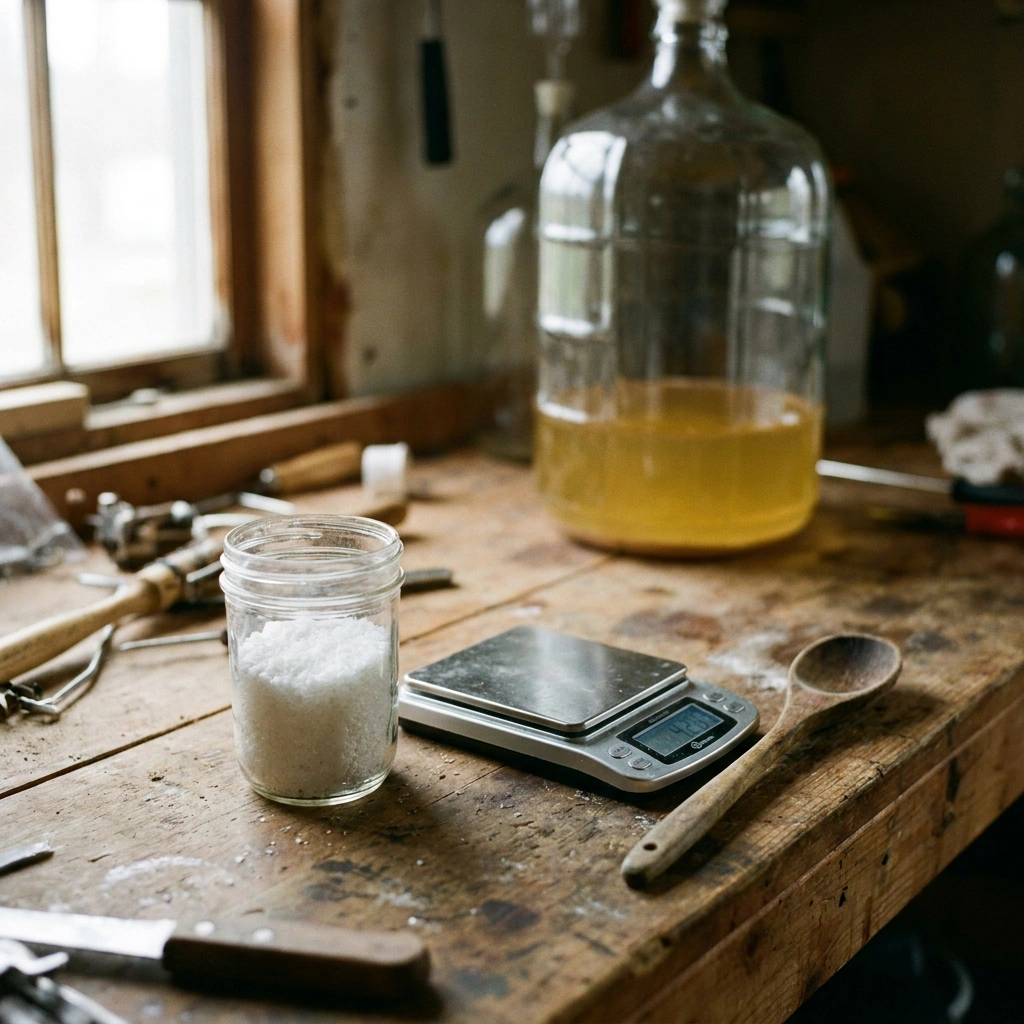
Many guides say “¼ teaspoon per 5-6 gallons ≈ 50 ppm.” That’s a usable ballpark – a level ¼ tsp of KMS weighs roughly 1.4-1.7 g depending on how tightly it’s packed – but we strongly recommend weighing on a gram scale rather than trusting a teaspoon measure. A $15 digital scale is one of the best investments you can make as a home winemaker. Aim for 1.6 g per 19 L (5 US gal) for a ~50 ppm target.
| Batch size | KMS for ~50 ppm SO₂ | Approx. by spoon |
|---|---|---|
| 5 US gal / 19 L | 1.6 g | ~¼ tsp (weigh it) |
| 6 US gal / 23 L | 2.0 g | ~⅓ tsp (weigh it) |
Wait 24 hours after adding KMS before pitching your yeast. The SO₂ needs time to do its job on wild yeast. Add too soon and you’ll slow down even your selected wine yeast.
Free SO₂ Maintenance: The pH Caveat You Can’t Skip
Here’s where a lot of home winemakers go wrong: they dose SO₂ at crush and then forget about it. But SO₂ gets used up – it binds to acetaldehyde, reacts with oxygen, and bleeds off over time. During aging and especially before bottling, you need to top up your free SO₂ to keep wine protected.
The complication: how much free SO₂ you need depends on your wine’s pH. The molecular SO₂ fraction – the active antimicrobial form – shrinks as pH rises. The target is typically 0.8 ppm molecular SO₂ (as recommended by Zoecklein et al. in “Wine Analysis and Production” and echoed in MoreWine’s SO₂ guide). At different pH levels, the free SO₂ you need to hit 0.8 ppm molecular looks very different:
| Wine pH | Free SO₂ needed for 0.8 ppm molecular |
|---|---|
| 3.0 | ~11 ppm |
| 3.3 | ~22 ppm |
| 3.5 | ~34 ppm |
| 3.7 | ~55 ppm |
| 4.0 | ~109 ppm |
Note on pH 4.0+: At pH 4.0 and above, wine is microbiologically at risk and SO₂ alone is not sufficient protection – chasing 109 ppm free SO₂ is impractical and will damage the wine. If your wine is at pH 4.0 or higher, acidify first (add tartaric acid) to bring pH down, ideally below ~3.6, rather than trying to compensate with very high SO₂ additions.
Most cold-climate red hybrids (Marquette, Frontenac, Petite Pearl) run around pH 3.3-3.6. A Frontenac red at pH 3.5 needs roughly 30-35 ppm free SO₂. A Vidal Blanc at pH 3.1-3.2 needs only 12-18 ppm. You can’t just add the same amount every time – test your pH first, then dose accordingly.
For accurate free SO₂ measurement, use a Titrets kit or an aeration-oxidation (AO) setup – the Ripper method or the gas-chromatography equivalent. Guess-by-sniff doesn’t work, and strip tests are unreliable for free SO₂. If you’re serious about making good wine, a Titrets kit is worth every penny.
Our pick: Keep a stock of KMS powder in a dark cupboard and test free SO₂ with Titrets. If you’re starting out, search for potassium metabisulfite for winemaking on Amazon – the 1 lb / 454 g bags from homebrew suppliers will last you several seasons for a 5-6 gallon home setup.
Sanitizing Equipment With KMS Solution
KMS isn’t just for the wine – it’s your go-to equipment sanitizer too. Mix a stronger solution and rinse your carboys, airlocks, bungs, racking canes, and funnels before each use. The SO₂ gas kills residual microbes on contact.
Standard sanitizing rinse: 1-2 tablespoons (15-30 g) of KMS per 1 US gallon (3.8 L) of warm water. Shake it in the carboy, coat all surfaces, and let it drain – no rinse needed if used at this concentration. (Adding a small amount of citric acid, roughly ½ tsp per gallon, lowers the pH of the solution and boosts its antimicrobial effect, a trick common in commercial winery sanitation.)
Don’t use a KMS sanitizing solution as a long-term soak – it’s a quick rinse. And make the solution fresh each use; once mixed, it slowly loses potency as SO₂ escapes.
KMS vs. Campden Tablets vs. Sodium Metabisulfite
You’ll run into three SO₂ sources in homebrew shops:
- Potassium metabisulfite powder (KMS) – what this post is about. Dose by weight for precision. Best for batches over 3 gallons where you want repeatable results.
- Campden tablets – pre-measured KMS compressed into tablets. Standard dosing is 1 tablet per 1 US gallon (3.8 L), which delivers approximately 65 ppm SO₂. (Not 50 ppm – that’s a common mix-up.) Convenient for small batches, but you can’t fine-tune the dose the way you can with powder. We cover these in detail on the Campden tablets page.
- Sodium metabisulfite – works the same way chemically, but adds sodium. Historically used in commercial winemaking but mostly replaced by the potassium form. Most homebrew guides now default to KMS. Avoid sodium metabisulfite unless you specifically need it for a non-winemaking application.
For 5-gallon home batches, we recommend KMS powder weighed on a scale. For single-gallon test batches or quick sanity-checks on a fruit addition, Campden tablets are plenty precise enough.
See also: our full winemaking walkthrough for how KMS fits into the larger process – from crush through aging – and what grape must is and why it matters for the fermentation chemistry background.
Safety and Handling
Sulfites are one of the eight major food allergens recognized in the US. Anyone with a sulfite sensitivity or sulfite-induced asthma should avoid wine made with KMS additions – and as a winemaker, you should be upfront about it when sharing your wine.
For safe handling:
- Work in ventilation. Dissolving KMS – especially in warm or acidic liquid – releases SO₂ gas. A momentary whiff won’t hurt a healthy adult, but repeated exposure in a closed space is worth avoiding. Open a window or work outdoors when mixing.
- Don’t overdose. Too much SO₂ creates sharp, sulfurous off-aromas (struck match, burnt rubber) that are very hard to fix. Stick to measured additions and test free SO₂ before adding more.
- Store dry. KMS absorbs moisture and slowly oxidizes in air. Keep it in a sealed container, in a cool dark spot. A damp bag loses potency faster than you’d expect.
- Label your solution. If you mix a sanitizing solution, label the container. A 2-tablespoon-per-gallon KMS rinse solution looks exactly like water.
Frequently Asked Questions
How much potassium metabisulfite do I add per gallon of wine?
For a 50 ppm SO₂ addition: roughly 1.6 g KMS per 5 US gallons (19 L), or about 0.32 g per 1 US gallon. Weigh it – don’t trust a teaspoon measure. Adjust based on your pH and a free SO₂ test: higher pH wine needs more free SO₂ to stay protected.
Can I substitute Campden tablets for KMS powder?
Yes, for small batches – but the dose is different. One Campden tablet per 1 US gallon delivers approximately 65 ppm SO₂ (not 50 ppm). You can’t split tablets reliably for fractional doses, which is why KMS powder is better for larger or more precise additions.
How long after adding KMS can I pitch yeast?
Wait at least 24 hours. The SO₂ needs time to stun wild yeast and bacteria in the must. Adding your selected wine yeast too soon (within a few hours) can kill or inhibit it along with the wild microbes. Some winemakers wait 48 hours if using a higher dose (75+ ppm) on damaged fruit.
What’s the difference between free SO₂ and total SO₂?
Total SO₂ is everything you’ve added. Free SO₂ is what’s still active and unbound in the wine – it’s the number that actually matters for wine protection. A large fraction of total SO₂ gets “bound” to acetaldehyde, sugars, and other wine compounds and loses its protective effect. Always track free SO₂, especially before aging milestones and bottling.
Does KMS affect the taste of wine?
At correct doses, no – or at least nothing detectable in finished wine. Overdosing creates a sharp struck-match or burnt rubber smell (from excess SO₂ gas). If you catch this, try vigorous aeration to drive off excess SO₂, then test and recheck. Prevention is much easier than the cure: measure by weight, test free SO₂, don’t guess.
🍇 Don’t plant the wrong grape
Vines take years to fruit. Get the free cheat-sheet of varieties that actually survive and ripen in your zone.
By subscribing you agree to our Privacy Policy.