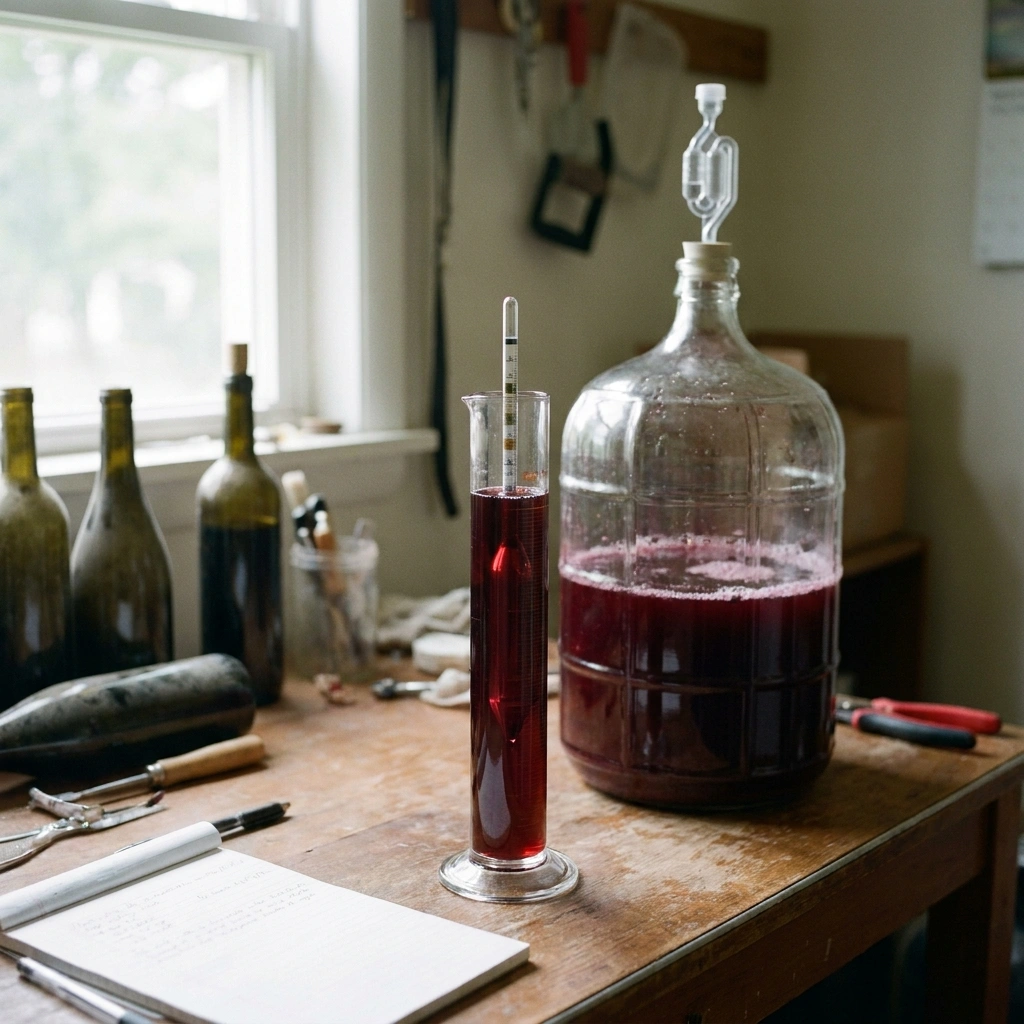
A stuck fermentation means your yeast has stopped working before the wine has gone dry – sugar is still in the wine, your specific gravity (SG) is parked above roughly 1.000-1.005, and your airlock has gone silent. The first move is not to panic and start adding things: grab your hydrometer, take a reading today, and take another one in 48-72 hours. If the SG has not moved at all, you have a stuck ferment. If it has dropped even slightly, fermentation is slow but alive – and slow is a very different problem.
Cold-climate winemakers run into this more than most – heavily chaptalized musts and cold cellars are two of the usual triggers. Working carefully through the steps below usually gets the wine moving again.
- Brix to Alcohol Calculator – convert your must Brix to potential ABV before you ferment
- Grape Variety Finder – find cold-hardy varieties suited to your zone
- Will My Grapes Ripen? – check if your site’s heat units are enough
Is It Really Stuck? Confirm with a Hydrometer
Before you do anything else, confirm the diagnosis. Visual signs – a quiet airlock, no bubbles, a wine that looks still – can all be misleading. CO2 can escape through a leaky bung even when fermentation is very active. The only reliable test is a hydrometer reading over time.
- Day 1: Draw a 100 ml (3.4 fl oz) sample into a test cylinder and take an SG reading. Write it down with the date and time.
- Day 3: Take another reading. A healthy fermentation at room temperature typically drops 0.002-0.006 SG points per day. Any drop at all means yeast is still working.
- Stuck threshold: If SG has not moved in 72 hours and sits at or above 1.005, you have a stuck fermentation. A fully dry wine finishes at 0.990-0.996 for most grape wines.
Keep notes. If you added sulfite (potassium metabisulfite) at crush and your must was cold, those two facts together are your most likely culprit – we will get to that below.
For a full step-by-step on the winemaking process that surrounds fermentation, see our guide on how to make wine from grapes – it covers crush through bottling and puts the fermentation window in context.
Why Fermentation Gets Stuck: Five Common Causes
1. Temperature Out of Range
Yeast has a working temperature range. Most wine yeasts stop working – or dramatically slow – below about 60°F (15°C). Above about 85-90°F (29-32°C), the heat stresses and eventually kills yeast cells. Cold-climate home winemakers are far more likely to run into the cold problem. Your unheated Wisconsin barn in October, a Michigan basement in November, a garage in Minnesota – all of these can drop below the yeast’s minimum.
The ideal fermentation range for most Saccharomyces cerevisiae wine strains is roughly 65-75°F (18-24°C) for reds and 55-65°F (13-18°C) for whites (lower = slower = more aroma retention). Check your must or wine temperature with a simple floating thermometer, not the room temperature – a large carboy can stay cold for hours after the room warms up.
2. High Starting Sugar After Chaptalization
Cold-climate grapes – Marquette, Frontenac, La Crescent, Petite Pearl – often struggle to fully ripen in Zones 3-6. Chaptalization (adding sugar to raise potential alcohol) is common and legal for home winemakers, but it carries risk: if the must is chaptalized to a potential alcohol above roughly 14-15% ABV, you are pushing many standard wine yeasts past their alcohol tolerance threshold. Fermentation starts fine but stalls as the alcohol climbs and the yeast shuts down.
Check the yeast manufacturer’s stated alcohol tolerance before you pitch. EC-1118 (Champagne yeast) tolerates up to 18% ABV. Lalvin 71B, popular for cold-climate aromatic whites, tops out around 14%. If you chaptalized a 24 Brix (roughly 13.8% potential ABV) must up to 28 Brix (roughly 15.5-16%), you will need an alcohol-tolerant strain from the start – not as a rescue after a stuck ferment.
3. Yeast Nutrient Deficiency (Low YAN)
Yeast needs more than sugar to survive: it needs nitrogen and micronutrients. The critical measure is Yeast Assimilable Nitrogen, or YAN. Cold-climate and chaptalized musts are particularly prone to low YAN – the grapes may have been harvested at lower maturity than Mediterranean varieties, and added sugar dilutes whatever nitrogen is present. When yeast runs low on nutrients, it produces hydrogen sulfide (that rotten-egg smell), gets sluggish, and eventually stops altogether.
A simple diammonium phosphate (DAP) addition at the start of fermentation, ideally combined with a complex organic nitrogen source like Fermaid-O or Fermaid-K, is standard practice. Scott Labs and Lallemand both publish YAN target charts by variety and style. For cold-climate musts, a common target is 150-250 mg N/L YAN, with nutrients added in two additions: one at pitching and one at one-third sugar depletion.
4. Excess Sulfur Dioxide (SO2)
Potassium metabisulfite (K-meta) added at crush protects the must from oxidation and wild yeast. But the dose matters. At low pH – which cold-climate grapes often have – a larger fraction of the total SO2 exists in its “free” and “molecular” form, which is the active antimicrobial fraction. If molecular SO2 is too high when you pitch your yeast, it can kill or severely inhibit the starter culture. The target molecular SO2 at pitch is around 0.8 mg/L or less. At pH 3.2 (common for Marquette), even 40 mg/L free SO2 translates to a molecular SO2 higher than that.
Waiting 24-48 hours after a K-meta addition before pitching yeast helps SO2 dissipate. Splashing the must (splash racking) accelerates SO2 loss if you need to ferment quickly.
5. Extreme Low pH
Cold-climate grapes, especially early harvests, can arrive with pH as low as 2.9-3.1 – lower than almost any warm-climate Vitis vinifera. Yeast functions best between pH 3.0 and 4.0, but at the low end, yeast activity is significantly impaired. Acid reduction through malolactic fermentation (for reds) or calcium carbonate addition (targeted for whites) can raise the pH before fermentation if you anticipate problems. Check pH before pitching and adjust if needed.
How to Restart a Stuck Fermentation
Restarting is possible in most cases, but it requires patience and the right sequence. Dumping yeast into a cold, high-alcohol, nutrient-depleted wine almost always fails. Here is the method that works:
Step 1: Fix the Environment First
Bring the stuck wine to 70-75°F (21-24°C) and hold it there. Move the carboy to a warm room, wrap it in an electric blanket, or use an aquarium heater in a water bath. Do not try to restart cold – any new yeast you add will stall again immediately. Give the wine a gentle swirl to release trapped CO2 (degassing) and rouse any yeast that has settled to the bottom.
Step 2: Add Yeast Nutrient and Stir
Once warm, add a combined yeast nutrient and energizer at the rate on the package (often 1 tsp per 5 gallons / 19 L for a restart) and stir vigorously to degas. The difference between a nutrient and an energizer: a nutrient (like DAP) supplies nitrogen. An energizer is a more complete mixture that includes DAP, inactive yeast hulls, vitamins, and minerals. For a restart, use an energizer if you have it – it addresses multiple deficiencies at once.
Step 3: Build a Vigorous Restart Starter
This is the part most home winemakers skip – and why their restart fails. You cannot simply sprinkle dried yeast on a stuck wine. The alcohol and CO2 environment will kill a dry yeast culture before it gets established. Instead, build a starter and acclimate the stuck wine into it gradually.
- Rehydrate a fresh, alcohol-tolerant yeast (EC-1118 is the standard restart choice) according to package directions in 104°F (40°C) water. Let it sit for 15 minutes and cool slightly.
- Make a starter must: mix 1 cup (240 ml) of water with 1/4 cup (50 g) of sugar, a pinch of yeast energizer, and the rehydrated yeast. Let it ferment actively for 1-2 hours at room temperature until you see vigorous bubbling.
- Begin step-feeding the stuck wine into the starter – add 1/4 cup of stuck wine to the starter. Wait 15 minutes. Add another 1/4 cup. Repeat until you have added about 1 cup (240 ml) of stuck wine total. This acclimates the yeast to rising alcohol gradually.
- Add the inoculated starter to the main batch once it is still clearly active (bubbling). Stir gently to distribute. Keep the batch warm.
- Watch the hydrometer over the next 24-48 hours for a resumption of fermentation. A small drop in SG (even 0.002) in 24 hours means success.
This step-wise acclimation method is recommended by both Scott Labs and Lallemand in their restart protocols. Adding the full volume of stuck wine directly to a fresh starter shocks the yeast with an alcohol concentration it is not prepared for – the restart fails.
What If It Still Won’t Restart?
If the fermentation will not restart after two proper attempts, check: Is there residual SO2 from an over-sulfited must? Is the pH below 3.0? Is there a chemical contamination (cleaning agent residue, off-odors)? A pH below 3.0 can be raised with potassium bicarbonate (tartrate precipitation method). An over-sulfited must can be treated with splash racking and waiting. Chemical contamination – unfortunately – often means a lost batch.
Preventing Stuck Fermentation Next Time
- Rehydrate yeast properly in 104°F (40°C) water (or with a rehydration nutrient like GoFerm) – dry-pitched yeast has lower viability and causes more stuck ferments.
- Add yeast nutrient at pitching and at one-third sugar depletion – especially for chaptalized musts and low-Brix cold-climate harvests.
- Control fermentation temperature – keep reds above 65°F (18°C) and whites above 55°F (13°C) until at least half the sugar has fermented.
- Match yeast to potential alcohol – if your must is above 14% potential ABV, choose a yeast rated for 16-18% ABV.
- Wait 24-48 hours after K-meta before pitching – especially if your must is low pH and you used a standard 50 mg/L addition.
- Keep a fermentation log – SG readings every 2-3 days catch a slowdown early, before it becomes a full stuck ferment.
Cold-climate winemaking – with its high-acid, lower-Brix musts that often need chaptalization – is a setup for nutrient deficiencies and temperature problems if you are not watching. The good news: a stuck fermentation handled quickly and correctly almost always recovers.
Frequently Asked Questions
What specific gravity reading means fermentation is stuck?
A stuck fermentation is typically diagnosed when the SG has not dropped at all over 48-72 hours and remains above 1.000-1.005. A fully dry wine finishes at 0.990-0.996. Compare two readings taken several days apart – a single high reading without a comparison point does not confirm the ferment is stuck, only that it has not finished yet.
Can I just add more yeast directly to the stuck wine?
Dry-pitching yeast straight into a stuck wine rarely works. The existing alcohol level – often 10-13% ABV when a ferment stalls – shocks freshly rehydrated or dry yeast before it can establish itself. The correct method is to build an active starter and step-feed the stuck wine into it in small increments, gradually acclimating the yeast to the alcohol level before adding it to the full batch.
What yeast should I use to restart a stuck fermentation?
EC-1118 (Lalvin Champagne yeast) is the standard restart choice because of its very high alcohol tolerance (up to 18% ABV), robust character under stress, and aggressive fermentation style. It is not ideal for aromatic whites where you want to preserve esters, but for restarting a stuck ferment, its fermentation reliability outweighs stylistic considerations.
Why is my cold-climate must more likely to get stuck?
Cold-climate musts (Marquette, Frontenac, La Crescent, and similar hybrid varieties) create multiple stress factors for yeast. They are often harvested at lower maturity = lower natural YAN. If chaptalized, added sugar raises potential alcohol without adding nitrogen. They typically have higher natural acidity and lower pH, which can directly inhibit yeast activity and increase the antimicrobial effect of any sulfite added. Cellar temperatures in cold climates drop faster and lower. All of these factors compound.
How do I know when a slow fermentation has actually stalled?
Track specific gravity readings with dates. A slow but active fermentation will show a small but measurable SG drop over 48-72 hours. If SG does not budge at all over three days (at the proper temperature), and there is no sign of CO2 production (no airlock activity, no fine bubbling when the wine is swirled), the fermentation has stalled. A rotten-egg smell (hydrogen sulfide) alongside a slow ferment is a strong indicator of nutrient stress.
🍇 Don’t plant the wrong grape
Vines take years to fruit. Get the free cheat-sheet of varieties that actually survive and ripen in your zone.
By subscribing you agree to our Privacy Policy.