Primary fermentation is the fast, foam-filled first stage of winemaking – typically lasting 5-7 days – where yeast converts most of the grape sugar into alcohol and CO₂. Secondary fermentation is the slower, quieter finish inside a sealed carboy, where fermentation completes down to a dry wine. The key difference: primary happens in an open vessel with lots of activity; secondary happens under an airlock with minimal oxygen exposure.
If you are wondering why you need two different vessels, it helps to understand what the yeast is actually doing at each stage – then the whole process clicks. Here is how it works, verified against the University of Minnesota Extension and Cornell Enology guidance.
What Is Primary Fermentation?
Primary fermentation is the first and most vigorous stage. You add your yeast to the crushed grapes (or juice), and it gets to work immediately. Within 12-24 hours you will see foam forming on the surface, CO₂ bubbling up, and the must warming slightly from the yeast activity.
This stage typically runs 5-7 days, though cool temperatures can stretch it to 10 days or more. According to the University of Minnesota Extension, wine yeast works best at 65-75°F (18-24°C) during primary fermentation. At temperatures below 60°F (15°C) fermentation can stall; above 80°F (27°C) you risk off-flavors and stressed yeast – though this caution applies mainly to whites and quality-focused fermentations. Reds are often fermented warmer (up to ~85°F / 29°C) to maximize color and tannin extraction from the skins, while whites prefer cooler temperatures (~55-65°F / 13-18°C) to retain aroma.
What the Yeast Is Doing
Yeast (most commonly Saccharomyces cerevisiae) consumes the dissolved sugars in the grape juice and converts them to ethanol and carbon dioxide via anaerobic glycolysis. The CO₂ is what creates all that foam and activity. This is also when most of the alcohol content of your wine is established.
For a typical home wine batch, the starting specific gravity (SG) is around 1.080-1.095, which corresponds roughly to 10-12% potential alcohol. By the end of primary fermentation, the SG drops to approximately 1.010-1.020. You still have some residual sugar at that point – that is why there is a secondary stage.
Primary Fermentation for Red Wines: Skin Contact and Cap Management
If you are making red wine from cold-hardy varieties like Marquette, Frontenac, or Baco Noir, primary fermentation happens on the skins. This is critical – the skins are where the color (anthocyanins) and much of the tannin come from. You cannot skip this step and just use juice if you want a genuine red wine.
The grape skins float to the surface and form a dense layer called the “cap.” You need to push the cap down or pump juice over it 2-3 times daily during primary. This keeps the skins wet, extracts color evenly, and prevents spoilage bacteria from taking hold in the dry cap. Read more about why skins matter in our guide to grape skin compounds.
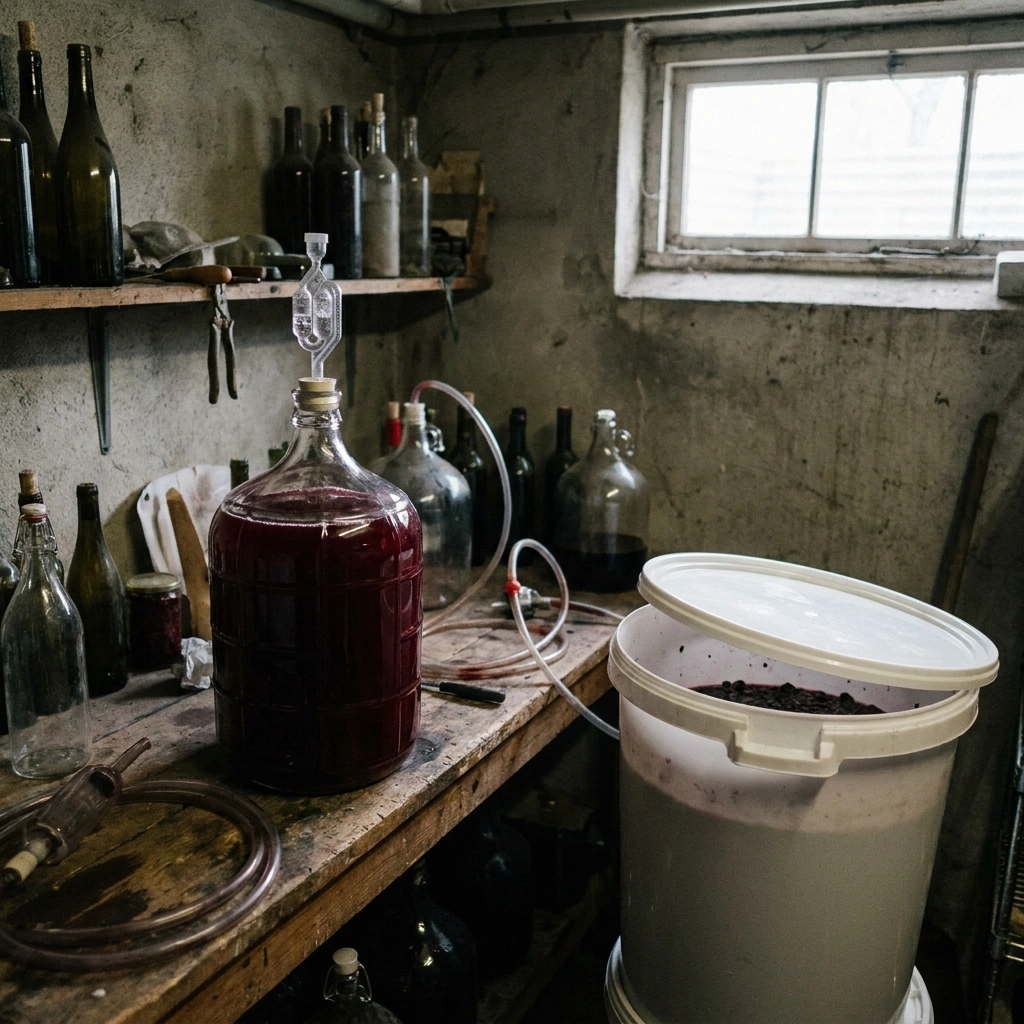
Primary fermentation for reds takes place in an open or loosely covered vessel – a food-grade plastic bucket with a lid just resting on top works fine. You need some airflow because CO₂ needs to escape freely and you are punching down frequently.
White and rosé wines, and fruit wines, typically ferment on juice only (no skin contact), so the open bucket approach still works but cap management is not needed.
When to Move from Primary to Secondary
The transition happens when the vigorous foam subsides and your SG reading hits approximately 1.010-1.020. At this point, the yeast has consumed most of the sugar and the fermentation rate has slowed considerably. For reds, this is also when you press the grape solids off and transfer only the liquid.
Two reliable cues:
- SG reading of 1.010-1.020 – take a hydrometer reading on days 5, 6, and 7. When it is in this range and stable or still dropping slowly, you are ready to rack.
- Foam has mostly subsided – the vigorous bubbling calms to a slow gurgle. The foam cap on reds collapses.
Do not wait until the must is completely dry before transferring. A small amount of remaining fermentation activity in the carboy helps push out oxygen through the airlock as the yeast finishes its work.
The transfer process – called racking – involves siphoning the liquid off the sediment (gross lees) and into a clean carboy. Our full wine-making instructions post covers the racking setup in detail.
What Is Secondary Fermentation?
Secondary fermentation is the slow, quiet completion of alcoholic fermentation inside a sealed carboy fitted with an airlock. The yeast finishes consuming the remaining sugar – typically bringing the SG from ~1.010 down to 0.990-0.996 (fully dry). At the same time, the wine begins to clarify as sediment (fine lees) settles to the bottom.
The key equipment change is the airlock. Where primary fermentation needed oxygen access for cap management and CO₂ escape, secondary fermentation needs near-anaerobic conditions. Oxygen is the enemy at this stage – it can oxidize your wine and invite spoilage. The airlock lets CO₂ out while keeping air from getting in.
Secondary typically lasts 2-4 weeks for most home winemakers, though some winemakers leave wine on the fine lees longer for complexity. Temperature remains important: 65-75°F (18-24°C) is still ideal. Cooler temperatures (down to 55°F / 13°C) are acceptable and can help with clarification, but very cold temperatures may stall fermentation before it reaches dry.
The “Not MLF” Clarification
Here is a point of confusion that trips up a lot of beginners: secondary fermentation is not the same as malolactic fermentation (MLF).
MLF is a separate bacterial process (Oenococcus oeni and related bacteria) that converts sharp malic acid into softer lactic acid. It can happen after or alongside alcoholic fermentation, and it changes the flavor profile – making wine rounder and less sharp. For cold-climate grapes like Marquette, which already tend toward high acidity, MLF is a deliberate winemaking decision, not an automatic step. See our post on managing acidity in cold-climate wines for more on that.
When home winemakers say “secondary fermentation,” they almost always mean the slow alcoholic fermentation stage in the carboy – not MLF. Just know the two are distinct processes, especially if you are following more advanced winemaking guides.
SG Roadmap: From Juice to Dry Wine
Here is a simple specific gravity timeline to track your progress:
| Stage | Specific Gravity (SG) | What’s Happening |
|---|---|---|
| Crushed juice / must | ~1.080 – 1.095 | All the sugar is still there; potential alcohol ~10-12% |
| Primary fermentation active | 1.090 → 1.020 | Vigorous yeast activity; foam, cap, cap punch-downs for reds |
| Transfer to secondary | ~1.010 – 1.020 | Rack off lees (press reds); move to carboy + airlock |
| Secondary fermentation | 1.010 → 0.996 | Slow completion; wine clarifying; minimal CO₂ |
| Dry / finished wine | ~0.990 – 0.996 | Sugar essentially gone; wine ready to age or bottle |
A hydrometer is the only accurate way to track this. Guessing by foam level alone is unreliable – some fermentations are quiet even when very active, especially at cooler temperatures. See our post on how much fruit you need per bottle for more on juice yield and starting sugar calculations.
Keeping It Clean: Sanitation Throughout
Both stages require scrupulous sanitation. Any equipment that touches the wine – buckets, carboys, airlocks, siphon tubing, hydrometers – should be sanitized with a no-rinse sanitizer like Star San before use. At the primary stage, contamination is less catastrophic because the yeast population is large and vigorous; in secondary, where things are calmer, off-bacteria have more room to cause problems.
Our pick: Star San is sold mainly through homebrew supply shops. If you would rather order online, potassium metabisulfite powder mixed into a sanitizing rinse is the traditional alternative – the K-meta guide has the mixing ratio and how to use it safely.
Top up the carboy to minimize headspace in secondary. Oxygen in the empty space above the wine is your main oxidation risk once you are under airlock. If you cannot fill completely, a small blanket of CO₂ from a tank helps, or just work quickly when racking.
What You Need for Both Stages
For primary fermentation you need a food-grade plastic bucket (6-8 gallon / 22-30 L for a 5-gallon / 19 L batch), a lid, and a way to punch down the cap (a long-handled potato masher works).
For secondary you need a glass or food-grade plastic carboy sized to minimize headspace, plus an airlock and stopper. 5-gallon (19 L) glass carboys are a good choice – they are heavy but inert and easy to inspect. A hydrometer is essential for both stages.
Our pick for secondary fermentation:
A good glass carboy with airlock kit is the single most important upgrade from primary. Combined with a hydrometer to track SG, you will never wonder if your wine is done fermenting again.
Frequently Asked Questions
How long does primary fermentation take?
Primary fermentation typically takes 5-7 days at 65-75°F (18-24°C). At cooler temperatures – common in basement or garage wineries, especially in cold climates – it can run 7-10 days. The reliable signal to move on is an SG reading of 1.010-1.020, not a fixed number of days.
What is the ideal temperature for wine fermentation?
Most wine yeast strains work best between 65-75°F (18-24°C). Below 60°F (15°C) fermentation slows significantly and can stall; above 80°F (27°C) you risk stressed yeast and off-flavors – a caution that applies especially to whites and delicate styles. Reds are often fermented warmer (up to ~85°F / 29°C) to extract color and tannin from the skins. Cornell Cooperative Extension recommends keeping temperature as consistent as possible through both primary and secondary stages.
Do I need an airlock during primary fermentation?
No. During primary fermentation, CO₂ is produced so vigorously that it creates a protective blanket over the must, keeping oxygen out. An open or loosely covered bucket works fine – and for red wines it is necessary because you need to punch down the cap. Once you transfer to secondary and the vigorous activity calms, an airlock becomes essential.
What specific gravity signals the end of secondary fermentation?
A fully dry wine reaches SG 0.990-0.996. Take readings 2-3 days apart: if the SG is stable in this range across two consecutive readings, fermentation is complete. Wines bottled above ~1.000 SG risk refermentation in the bottle, which can cause corks to pop or bottles to break.
Is secondary fermentation the same as malolactic fermentation?
No – they are separate processes and the terms should not be used interchangeably. Secondary fermentation refers to the slow alcoholic fermentation stage in the carboy, where yeast finishes converting residual sugar to alcohol. Malolactic fermentation (MLF) is a bacterial process that converts malic acid to lactic acid, softening the wine’s acidity. MLF may or may not happen depending on the winemaker’s choice, the bacteria present, and the wine style.
🍇 Don’t plant the wrong grape
Vines take years to fruit. Get the free cheat-sheet of varieties that actually survive and ripen in your zone.
By subscribing you agree to our Privacy Policy.