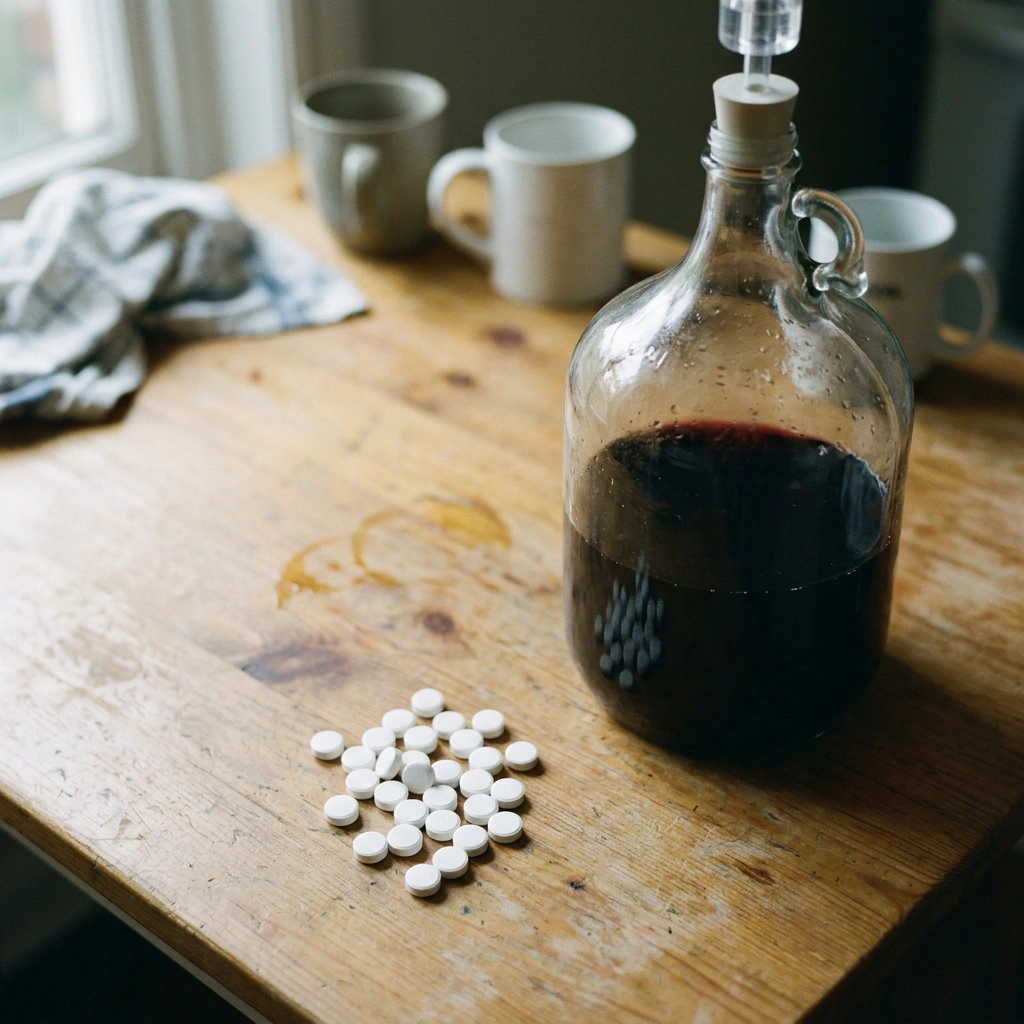
Campden tablets are pre-measured, convenient tablets of potassium or sodium metabisulfite that release sulfur dioxide (SO₂) when they dissolve in must or wine. One standard tablet – weighing about 0.44 g – added to one US gallon (3.8 L) delivers roughly 65 ppm (mg/L) of SO₂. That’s a bit more than most winemakers want at crush; a target of ~50 ppm is more typical, achieved with about ¾ tablet per gallon. After adding Campden at crush, wait at least 24 hours before pitching your cultured yeast – the SO₂ needs time to do its work and partly dissipate, otherwise it can inhibit or kill the yeast you’re counting on.
Campden tablets are cheap, shelf-stable, and foolproof for small batches. Here’s everything you need to know about using them correctly.
What Are Campden Tablets?
Campden tablets are nothing exotic – they’re simply a measured dose of metabisulfite salt pressed into tablet form. You’ll find two versions:
- Potassium metabisulfite (K₂S₂O₅) – the preferred choice for winemaking. Adding potassium doesn’t alter the sodium content of your wine, which matters for people on low-sodium diets and for general taste.
- Sodium metabisulfite (Na₂S₂O₅) – works identically in terms of SO₂ release but adds a small amount of sodium. Fine for equipment sanitizing; less ideal for the wine itself.
Both types release sulfur dioxide (SO₂) when dissolved in liquid. SO₂ is the workhorse of winemaking sanitation: it’s an antioxidant, an antimicrobial agent, and a wild-yeast inhibitor – all in one affordable tablet.
For a full overview of the home winemaking process, see our step-by-step guide – Campden tablets appear at several stages.
Dosing: How Many Campden Tablets Per Gallon?
This is the most common question, and the numbers are well-established by WineMaker Magazine and home-winemaking extension resources:
- 1 standard tablet (0.44 g) per US gallon = approximately 65 ppm SO₂
- Typical crush target: ~50 ppm, which works out to roughly ¾ tablet per gallon
- For a 5-gallon batch: 4 tablets ≈ 52 ppm hits the ~50 ppm crush target on clean fruit; 3 tablets ≈ 40 ppm (only enough for a very clean, healthy must); 5 tablets if grapes show mold or damage
- For a 1-gallon trial batch: ¾ of a tablet is easy enough – just crush and split one
Why not just use 1 tablet per gallon every time? At 65 ppm total SO₂, you’re adding more than you need for a clean, healthy must. Excess SO₂ can slow or even kill your cultured yeast later, and at high levels it produces off-flavors. Target 50 ppm for a fresh, healthy must; bump toward 65-75 ppm only if you’re dealing with moldy or damaged fruit.
The skin contact stage has its own chemistry – see our notes on grape skin contact and maceration for how SO₂ interacts with phenols and color extraction.
At Crush: Stun Wild Yeast, Then Wait 24 Hours
Adding Campden at crush is the most important use. Here’s the standard sequence:
- Crush and destem your grapes into a primary fermentation vessel.
- Crush ¾ tablet per gallon of must and dissolve in a small amount of juice or water, then stir in.
- Wait 24 hours before adding your cultured wine yeast. This gives the SO₂ time to stun wild yeast and bacteria and then partially off-gas. Pitching yeast too early – within an hour or two – risks the SO₂ inhibiting your starter culture.
- After 24 hours, sprinkle your yeast on top or pitch a rehydrated starter.
The 24-hour wait isn’t optional – it’s the step home winemakers most often skip, and skipping it is a common cause of stuck fermentations.
Pre-Bottling: Top Up Free SO₂ to Protect Against Oxidation
Before bottling, you want enough free SO₂ in the wine to protect it from oxidation during aging. A common target is 25-35 ppm free SO₂, though the ideal amount depends on the wine’s pH (more on that below).
For a 5-gallon (19 L) batch approaching bottling:
- Test your current free SO₂ level (a simple SO₂ test kit or titration tells you where you stand).
- Calculate the addition needed – at 1 tablet per gallon = 65 ppm, you can work backwards: to add 25 ppm to 5 gallons, you need roughly 2 tablets.
- Stir gently after adding to distribute; avoid splashing (that’s the opposite of what you’re trying to prevent).
Using Campden Tablets for Equipment Sanitizing
Campden tablets aren’t just for the must – they’re one of the easiest ways to sanitize carboys, airlocks, racking tubes, and siphon hoses. The sanitizing solution is stronger than what you’d add to wine:
- Standard sanitizing solution: 1-2 Campden tablets (or 1 tsp potassium metabisulfite powder) per quart (approx. 1 L) of water, with a small pinch of citric acid to lower pH and boost SO₂ effectiveness.
- Rinse equipment with this solution, let sit for a minute or two, then drain and use – no need to rinse with water afterward (the SO₂ level is not harmful to the wine at these dilution rates once equipment is drained).
- Campden sanitizing solution breaks down relatively quickly (hours), so make it fresh each session.
This is the same equipment hygiene step described in our notes on what grape must is and how to handle it.
Campden Tablets vs. Potassium Metabisulfite Powder
Campden tablets are essentially potassium metabisulfite (K-meta) in pre-dosed form. They’re convenient for small batches where you’re adding one or two tablets – no weighing required. But for larger batches or when you want more precise control, potassium metabisulfite powder lets you weigh exact grams and hit your ppm target more accurately.
For home batches of 1-5 gallons (3.8-19 L), tablets are perfectly adequate. For 10+ gallon batches where splitting tablets gets awkward, switch to powder and a small digital scale.
The pH Caveat: Don’t Dose Blind
Here’s the detail most beginner guides gloss over: how much free SO₂ actually protects your wine depends heavily on its pH.
SO₂ exists in wine in two main forms – molecular SO₂ (the active antimicrobial form) and bound/ionized forms that don’t protect the wine. At lower pH (more acidic wine, say pH 3.0-3.2), a higher proportion of your SO₂ is in the active molecular form, so you need less total SO₂ to get protection. At higher pH (less acidic, say pH 3.6-3.8), you need more free SO₂ to achieve the same molecular SO₂ level.
A rough rule of thumb:
- pH 3.0: about 11 ppm free SO₂; pH 3.3: about 22 ppm
- pH 3.5: about 34 ppm free SO₂; pH 3.7: about 55 ppm
- These targets aim for roughly 0.8 ppm molecular SO₂, the level that actually protects the wine. Above about pH 3.6, winemaking gets harder in general – stability and microbial risk climb. Full pH table in our potassium metabisulfite guide.
The practical takeaway: use an SO₂ test rather than dosing by tablet count alone, especially before bottling. Knowing your wine’s pH helps you hit the right target. This matters especially for cold-climate wines – Marquette, Frontenac, and La Crescent tend to have good acidity (lower pH), which actually works in your favor here. For how sugar content and ripeness affect harvest decisions, see our guide to pounds of grapes per bottle.
Safety: Sulfites and Ventilation
A few practical cautions:
- Sulfite allergen: Some people – particularly those with asthma – are sensitive to sulfites. If you’re making wine for others, disclose that it contains sulfites (required labeling in the US for commercial wines; good practice for home winemaking too).
- Ventilation: When dissolving tablets or mixing metabisulfite powder, work in a ventilated space. The SO₂ gas released can irritate the respiratory tract if you inhale it directly – don’t lean over the must and breathe deeply right after adding Campden.
- Don’t overdose: More Campden is not better. Excess SO₂ inhibits fermentation, produces sulfurous off-flavors, and at very high levels produces hydrogen sulfide (the “rotten egg” smell) during fermentation. Stick to the guidelines.
- Storage: Keep tablets in a sealed container away from moisture. They absorb water from the air and slowly degrade, losing potency over time.
Our Pick
A standard bottle of 100 potassium Campden tablets goes a long way if you make one or two batches a year. They’re inexpensive and widely available.
Browse Campden tablets on Amazon
Related Winemaking Tools
While we’re on the topic of measurements and chemistry, a few of our free calculators might come in handy for your batch planning:
- Brix to Alcohol Calculator – enter your starting Brix and get a projected ABV
- Grape Variety Finder – find hardy cold-climate varieties for your zone
- Will My Grapes Ripen? – check if your variety and location line up for harvest
Frequently Asked Questions
How many Campden tablets per gallon of wine?
One standard Campden tablet (0.44 g) per US gallon delivers approximately 65 ppm SO₂. For a typical crush addition targeting ~50 ppm, use about ¾ tablet per gallon – so for a 5-gallon batch, use 4 tablets (≈ 52 ppm) for the standard crush target on clean fruit, or 3 tablets (≈ 40 ppm) only if your must is very clean and healthy. Step up to 5 tablets if grapes show mold or damage.
How long after adding Campden tablets can I add yeast?
Wait at least 24 hours. The SO₂ needs time to stun wild yeast and bacteria, and then it needs to partially dissipate so it doesn’t inhibit your cultured wine yeast. Pitching yeast within an hour or two of adding Campden is one of the most common causes of stuck fermentations in home winemaking.
Are Campden tablets the same as potassium metabisulfite?
Essentially yes – most Campden tablets are made from potassium metabisulfite (K₂S₂O₅), pressed and pre-dosed at 0.44 g each. Potassium metabisulfite powder is the same chemical; the powder format lets you weigh precise doses by grams, which is useful for larger batches or when you need a specific ppm addition.
Can Campden tablets be used to sanitize equipment?
Yes. Dissolve 1-2 tablets per quart (approx. 1 L) of water – optionally add a pinch of citric acid to lower the pH and boost SO₂ effectiveness. Rinse equipment with this solution, let sit for a minute, then drain and use. No rinse with plain water is needed; the residual SO₂ at that dilution won’t harm your wine.
Do high-pH wines need more Campden tablets?
Yes. At higher pH (less acidic wine), a smaller fraction of your SO₂ is in the active molecular form that actually inhibits microbial activity. You’ll need more free SO₂ – and thus more Campden tablets or metabisulfite additions – to achieve the same protective effect. Always test pH alongside free SO₂ when preparing wine for bottling.
🍇 Don’t plant the wrong grape
Vines take years to fruit. Get the free cheat-sheet of varieties that actually survive and ripen in your zone.
By subscribing you agree to our Privacy Policy.